

A distinctive voice and an intimate ensemble
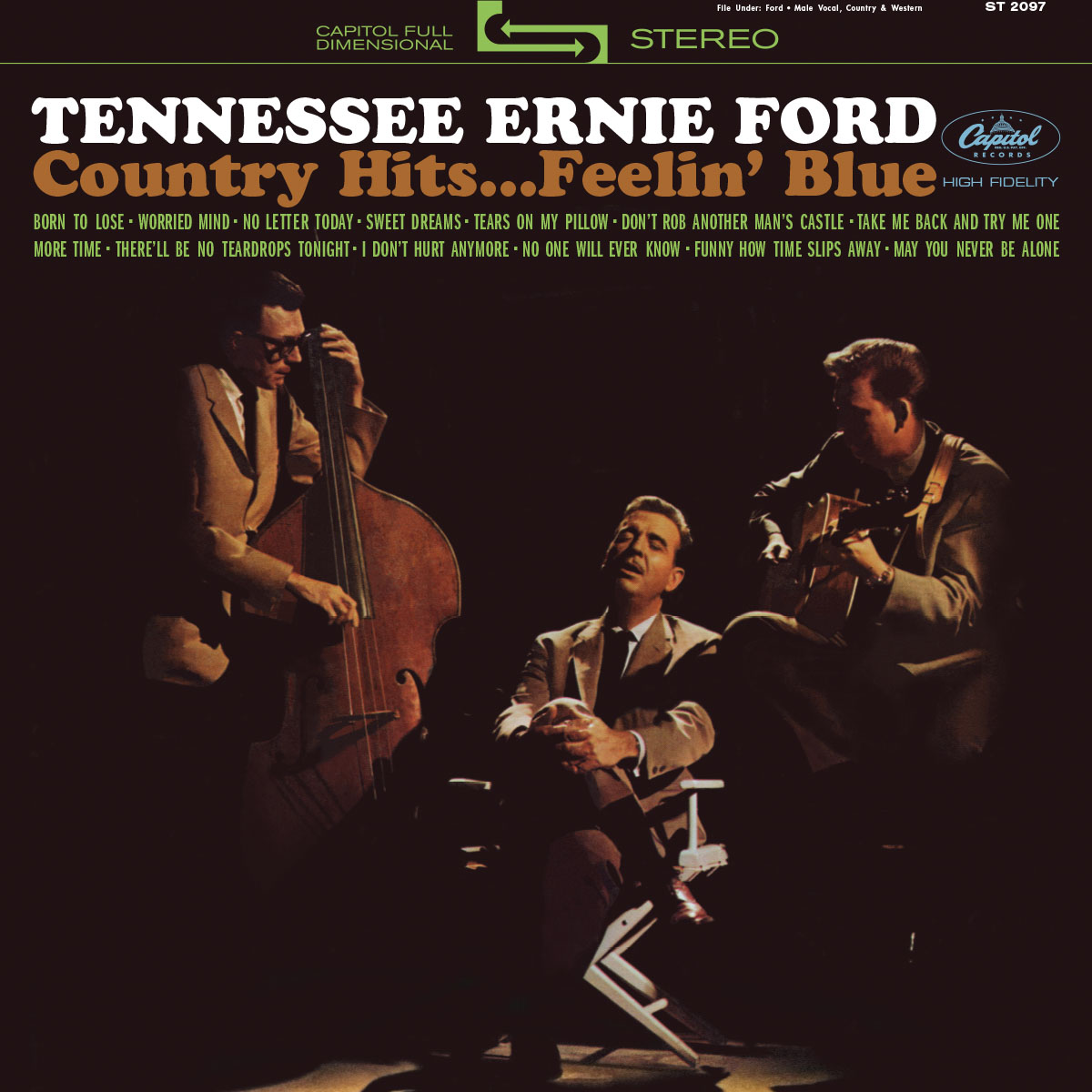
Country Hits… Feelin’ Blue places Tennessee Ernie Ford in a particularly concentrated musical setting. Twelve country songs, an unmistakable voice and two accompanists form the programme of this Capitol album. The official album chronology dates the recordings to 1963 and the release to June 1964. At its centre is the meeting of Ford’s singing with Billy Strange’s guitar and John Mosher’s double bass. That choice gives each participant a clearly identifiable role and makes the record a distinctive discovery within a collection of American vocal music.
The title brings together two complementary ideas: familiar country repertoire and an emotional world touched by the blues. “Blue” describes a mood and an approach to the songs; it does not mean that every composition follows the same blues structure. The selection instead connects different writers and different ways of expressing loss, memory, wounded pride or a last remaining hope. Ford approaches these stories with a deep voice that carries an identity of its own. The small ensemble leaves room to follow the language, the shape of a phrase and the movement of a melody.
Listeners who primarily associate Ford with “Sixteen Tons” will encounter another aspect of his repertoire here. That famous song is not included. The album’s continuity comes instead from twelve chosen pieces that share concerns without becoming interchangeable. It amounts to more than an anthology of familiar tunes. In its own way, the record asks what a singer can do with well-known words when the accompaniment is restricted to a few deliberately selected musical voices.

Billy Strange and John Mosher as musical partners
Billy Strange plays guitar and John Mosher double bass. Ford’s official chronology specifically identifies these two musicians as the album’s accompanists. There is no reason to assume an additional drummer, steel guitarist or string section merely because those sounds might be associated with country recordings. The actual personnel are an essential part of the story. A country album cannot be explained solely by instruments considered typical of the genre; it results from the people involved and the decisions they make for particular songs.
Within a trio of this kind, the roles can overlap closely. Guitar can provide harmony, rhythm and brief melodic connections, while the bass supports the progression with a line of its own. Above them, the singer does more than deliver a tune: words acquire emphasis, and the story finds its shape. A useful listening question is how these tasks are shared. When does the accompaniment follow a vocal thought, when does it prepare one, and how much expression can reside in the space between phrases? Such questions provide a concrete approach to interpretation without pretending to report a private listening session.
Lee Gillette is credited as producer. The original context is therefore a Capitol production of the early 1960s, even though this particular reissue arrived much later. Recording, original release and modern mastering are separate stages in the same history. Distinguishing them is helpful when an album exists in several formats and pressings. The new illustration shows Ford at a microphone, using a securely identified 1958 image as its facial reference. A second illustration focuses on guitar and double bass, with plausible relative dimensions, to reflect the modest scale of the ensemble.
All three musicians deserve attention. A small accompaniment is not necessarily an easy assignment. There are fewer opportunities to cover an awkward transition by adding another instrumental layer, and the balance between movement and restraint becomes particularly consequential. For lovers of vocal records, that creates an appealing possibility: follow the singer first, then return to the same selection with attention directed towards his two partners. Their names consequently remain visible in the musician section rather than disappearing behind a general description of accompaniment.

Twelve ways of addressing loss and memory
The first side opens with Ernest Tubb’s “Try Me One More Time.” “No Letter Today,” “Born to Lose” and “Don’t Rob Another Man’s Castle” follow. Their titles already suggest different situations: a request for another chance, a message that never arrives, a defeat that seems inevitable, and a warning against intruding into someone else’s life. Those perspectives give the programme internal variety. This is not one sorrow repeated twelve times, but a series of different ways to give emotional experience words and musical form.
Hank Williams’s “There’ll Be No Teardrops Tonight” and “I Don’t Hurt Anymore,” by Don Robertson and Jack Rollins, complete side one. Both titles invite attention to the relationship between a declaration and the feeling beneath it. A song may assert strength while leaving open how secure that strength really is. Such tensions are part of the richness of country songwriting. They do not have to be resolved by an external explanation: an interpretation can work with them and leave the listener room to decide how to understand the speaker.
The second side begins with “Worried Mind” and “No One Will Ever Know.” Next comes Willie Nelson’s “Funny How Time Slips Away,” directing attention towards memory and elapsed time. Don Gibson’s “Sweet Dreams” moves into another emotional situation. These writers are more than names on a credit list. They represent different approaches to combining economical everyday language with a durable melody. Ford brings their work together through an interpretation-led album rather than through a single songwriter’s perspective.
“Tears on My Pillow,” by Fred Rose and Gene Autry, and Hank Williams’s “May You Never Walk Alone” close the programme. With “Tears on My Pillow,” the writing credit is particularly useful because familiar titles can refer to different compositions. The track list here follows this specific Capitol LP, with six selections on each side. Together, the twelve songs accommodate lament, self-assertion and a wish for someone else’s well-being. Listeners who care about lyrics as much as voices and instruments will find many possible points of return.
Analogue Productions and Kevin Gray’s mastering
This reissue carries catalogue number AAPP 126 and presents the album as a stereo LP at 33⅓ RPM. Kevin Gray at Cohearent Audio mastered it from the original tape, with pressing by Quality Record Pressings. The presentation includes a traditional Stoughton tip-on jacket. Current publisher information specifies 180 grams, while an older documented pressing is listed at 200 grams. That difference is retained rather than converted into an unsupported promise concerning the weight of every individual copy.
The single-LP format preserves the two carefully assembled six-song sides. It is a coherent presentation for this repertoire: the selections can work as a sequence without requiring another side change after only a few minutes. The edition’s appeal rests on its documented mastering and clearly identified provenance, rather than on a blanket ranking of rotational speeds. Even with such a small ensemble, the original performance remains the starting point. A new mastering does not replace the artists or the decisions that shaped their collaboration.
Country Hits… Feelin’ Blue draws attention to the relationship between a voice, a song and two thoughtfully chosen accompanists. You order from Michael 45 in Germany. We handle the US import and ship from Hilden. For collectors, the edition adds an intimately scored Capitol album to the larger picture of Tennessee Ernie Ford. For music lovers, it opens twelve concise narrative spaces in which familiar country songs find continuity through a singer with an unmistakable personality.
Customer question: Buying Analogue Productions records in Europe
Musicians
Participants and documented credit status. Track references correspond to the tracklist.
- Tennessee Ernie Fordportrait reference 1958vocalsParticipation: Album personnel
- Billy StrangeguitarParticipation: Album personnel
- John Mosherdouble bassParticipation: Album personnel

Voice, guitar and double bass: the official Ford album chronology confirms Billy Strange and John Mosher as the two accompanists. Recorded in 1963, released June 1964. Produced by Lee Gillette. No invented drum or orchestra credit.

Reviews
There are no reviews yet.