

Familiar melodies in a different instrumental setting
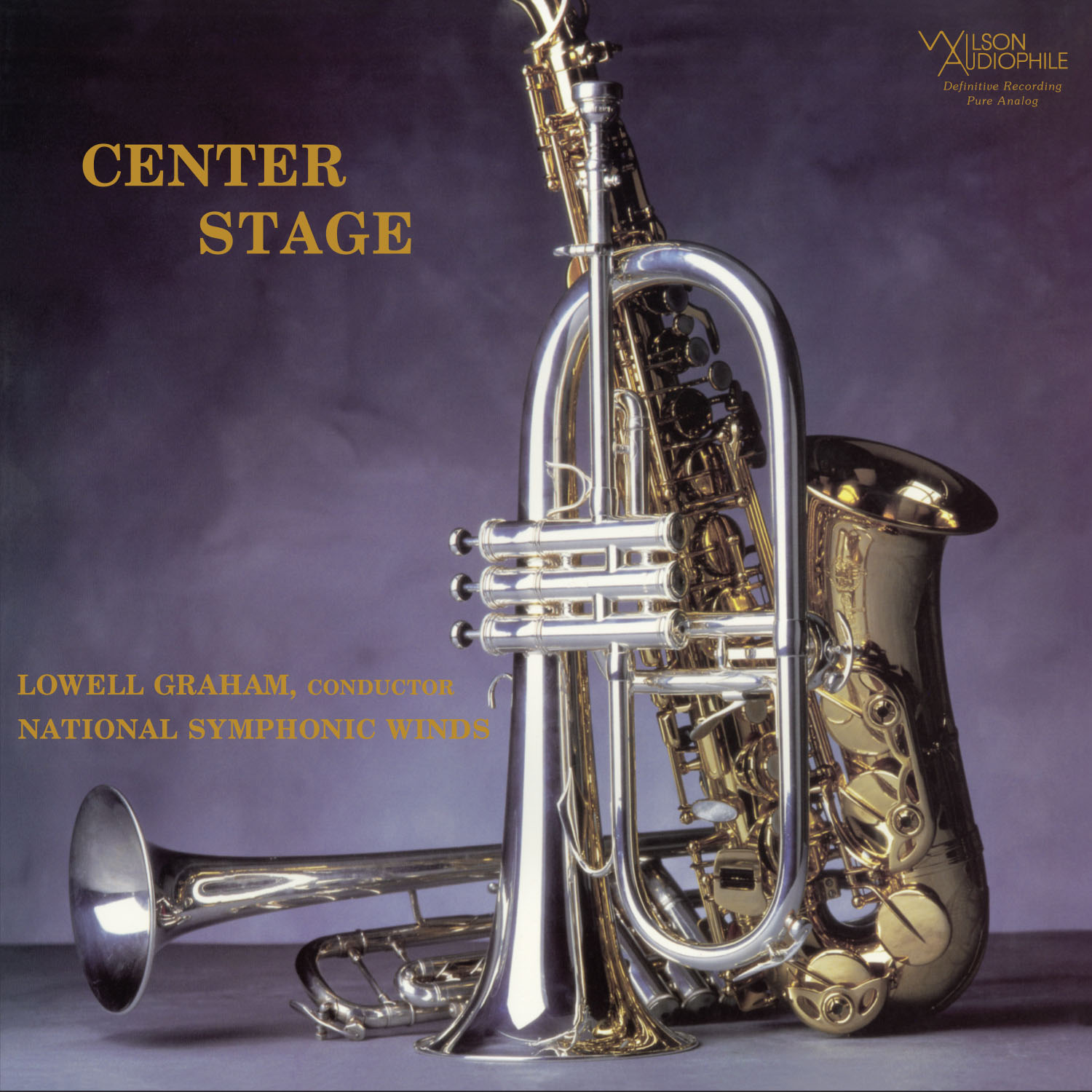
A fanfare creates a different expectation from a quiet solo opening. It calls for space, clear entrances and an ensemble capable of organising its strength collectively. Center Stage places that ability at the centre of its programme. Lowell Graham conducts the National Symphonic Winds in music connecting Olympic ceremony, cinema and the musical stage. Familiar material appears in the setting of a symphonic wind ensemble, changing which instruments carry a melody, where colours blend and how a large musical climax takes shape. The instrumentation is an essential part of the album’s interest.
The programme contains six selections or groups of selections. “Olympic Fanfare” is followed by The Cowboys and music from Oklahoma!; side B brings together Barnum, Mary Poppins and West Side Story. All have connections with public occasion, screen or stage, but they are not designed to produce the same effect. Representative gestures sit beside narrative transitions, singing themes and rhythmically active passages. A wind ensemble can be forceful and immediate, yet it also needs to work through smaller gradations. The programme gives those contrasting requirements a shared framework.
The recording was made for Wilson Audiophile, a catalogue in which the documentation of ensemble sound and performing space has a particular place. This Analogue Productions reissue returns to that recording. Its history is therefore interesting both musically and in terms of recording practice. The two can be considered together without reducing the programme to a demonstration of a playback system’s capabilities. Recognisable tunes offer reference points, while their different instrumental surroundings encourage the listener to attend to the way they have been shaped and connected.
For anyone who associates symphonic weight primarily with a large string section, this offers another route. Woodwinds, brass and percussion must create transitions, balance and transparency through their own resources. That requires careful relationships between instrumental groups whose attack and tonal character differ considerably. The music consequently invites attention to the approach to a large accent, not merely to the accent itself. The quieter preparations and changes of colour are part of the same musical argument as the most immediately impressive passages.

Lowell Graham and the National Symphonic Winds
Lowell Graham conducts an ensemble assembled, according to the label, from leading American military bands and the Virginia Symphony Orchestra. National Symphonic Winds is the name of the performing group here. The consulted sources do not provide a complete list of individual instrumentalists. The personnel section therefore identifies Graham and the ensemble without inventing named trumpet, clarinet or percussion players, or attributing the entire group to one of the institutions from which its members came. The documented collective identity is retained as such.
The conductor’s work has a close relationship with the musical outcome in a project of this kind. A simultaneous entrance is only a beginning. The relative strength of a brass figure against a woodwind line, the duration of a final chord and the transition from a forceful section to a quieter melody all need to agree. With well-known stage and film themes, the continuity of the musical story also matters after the instrumentation has changed. These arrangements depend on more than adding together recognisable tunes; their sequence and internal proportions give the programme its shape.
The documented arrangers demonstrate that each group of selections brings a particular translation into this instrumental setting. James Curnow is named for The Cowboys and Warren Barker for Oklahoma!; Barnum is associated with Bob Lowden, Mary Poppins with Irwin Kostal and Alfred Reed, and West Side Story with William J. Duthoit. Those names describe the musical versions, not a set of additional performing members of the ensemble. Even where a title is immediately familiar, an arrangement determines which voice comes forward and how that voice relates to everything around it.
The recording took place in the concert hall at Hampton University, in the Hampton Roads area of Virginia. The label describes a single five-hour session. The available evidence does not securely establish the precise recording year, so no year is supplied here. Bruce Leek is identified as the responsible recording engineer. Place, working framework and central participants are therefore documented without deriving a supposedly exact session date from the general history of the Wilson catalogue. The distinction keeps the account specific to this recording rather than to the label more broadly.

Ceremony, storytelling and the musical stage
“Olympic Fanfare” establishes the ceremonial aspect at the outset. Music of this kind makes clear how strongly an effect can depend on shared breath, precise entrances and the relationship between call and response. The label’s documented listing also refers to “Bugler’s Dream.” As a listening approach, the immediate point is the way the fanfare directs attention towards a collective gesture. It opens the programme before the following selections allow more space for changing scenes and extended development, giving the record an unmistakable sense of arrival.
The Cowboys introduces the narrative manner of film music. In a concert suite, motifs must establish connections without the images that originally accompanied them. The listener can follow the transfer of material between instrumental groups and the way a rhythmic impulse changes character when it acquires a different colour. The selections from Oklahoma! place different demands on the ensemble. Melodies originally connected to voices and dramatic situations must now assert their outlines instrumentally. Recognising a tune is the starting point; shaping the path into and out of it is the group’s continuing task.
On side B, Barnum extends the theatrical perspective before Mary Poppins introduces another familiar musical world. Selections from musicals depend on placing individual themes in a sequence that becomes more than a collection of short quotations. Changes of pace, weight and instrumental colour carry that connection. In wind arrangements, the quieter transitions are particularly useful places to listen closely. They reveal how a new melody is prepared and how the ensemble maintains a common line between the more expansive gestures, allowing contrast without sacrificing continuity.
West Side Story concludes the programme. Here, attention can turn especially towards rhythmic relationships: sharply placed accents, impulses of movement and the alternation between ensemble blocks and individual lines coming forward. One listening route is to follow the familiar themes first, then return to their distribution among the instruments. Center Stage becomes accessible both as a varied concert programme and as an exploration of a symphonic wind ensemble’s resources. The large gestures acquire meaning through the smaller choices from which they have been assembled.
Recorded directly to two-track tape, later remastered
The recording method is described in unusual detail. According to the label, a limited number of Sennheiser microphones fed a half-inch two-track tape recording running at 30 inches per second. The Wilson Ultramaster recorder was based on a modified Studer with electronics by John Curl. The recording description states that the room sound was captured without subsequently added reverberation. These details concern the original session and its approach, rather than measurements newly made on the particular record copy available for purchase.
“Directly to two-track tape” must be distinguished from direct-to-disc recording. This is a tape recording serving as the source for a later vinyl release. Likewise, the reissue’s remastering should not be described as a documented new mix of the original session. Kevin Gray worked on the material at Cohearent Audio for this Analogue Productions edition. Its catalogue number is AAPC 8824, and its format is one 200-gram stereo LP playing at 33⅓ RPM. Those specifications identify the release without requiring assumptions about undocumented stages of its production.
For understanding the edition, such concrete information is more useful than broad promises of maximum dynamics or guaranteed natural reproduction on every system. A minimalist recording chain describes a method of working. The result in a listener’s room also depends on equipment, placement and playback level. Documented production details and suggestions for following the music are consequently kept separate from a personal listening test. Record weight alone likewise does not establish a particular sonic result, however useful it may be as an identifying specification.
Center Stage offers a clearly defined combination of concert programme and documented recording approach. It provides large, often familiar melodies alongside the opportunity to follow their realisation by a distinctive ensemble. Giving attention to transitions, quieter voices and shared articulation, as well as to the fanfares, reveals more than a series of impressive climaxes. The different musical worlds come together through the work of the same players, and that collective shaping remains the programme’s central subject.
You order from Michael 45 in Germany. We arrange the US import and dispatch from Hilden.
Customer question: Buying Analogue Productions records in Europe
Musicians
Participants and documented credit status. Track references correspond to the tracklist.
- Lowell E. GrahamconductorParticipation: All six groups of works
- National Symphonic Windssymphonic wind ensembleParticipation: Individual instrumentalists not named in the sources

Lowell E. Graham: conductor; National Symphonic Winds: ensemble drawn from US military bands and the Virginia Symphony Orchestra; individual musicians not named in the sources. Bruce Leek: recording engineer, not a performing musician credit. Hampton University concert hall, Virginia; recording year unconfirmed; five-hour session according to the label. Arrangements: The Cowboys – J. Curnow; Oklahoma! – W. Barker; Barnum – B. Lowden; Mary Poppins – I. Kostal/A. Reed; West Side Story – W. J. Duthoit. Direct two-track tape recording, not direct-to-disc. Kevin Gray: remastering, no documented remix.

Reviews
There are no reviews yet.