
Eleven tracks introducing a new guitar language in 1967
Are You Experienced is a debut on which very different possibilities already coexist: a concise song, an open-ended sound experiment, a connection to the blues and an unmistakable guitar attack. The Jimi Hendrix Experience brought those possibilities together with a line-up that looks economical on paper. Jimi Hendrix sang and played guitar, Noel Redding supplied bass, and Mitch Mitchell played drums. The resulting music is difficult to describe as the simple addition of three instruments. The players made space for one another while using the studio to extend that space beyond the immediate sound of a trio performance.
This UHQR presents the eleven-track American stereo version. With this album, that distinction matters. The British edition appeared on 12 May 1967 and the American release on 23 August. For the US programme, “Red House”, “Remember” and “Can You See Me” were replaced by “Purple Haze”, “Hey Joe” and “The Wind Cries Mary”. Listeners familiar with another edition may therefore encounter a different dramatic sequence. Here “Purple Haze” opens the record, while the title track closes its second side.
The route to the album led through London. Chas Chandler, previously the Animals’ bassist, became Hendrix’s producer and a central figure in the formation of the Experience. Redding originally came as a guitarist and found his position in the new group on bass. Mitchell brought a flexible drumming vocabulary that responded actively to the other players. Recording extended from October 1966 to April 1967. This was not one miraculous week in a studio, but a succession of sessions during which the songs, the band and the available technical possibilities continued to develop.
That history makes the debut especially rewarding to revisit. Every listen need not revolve around locating its most celebrated guitar sound. It is just as interesting to follow the way a song changes when the drums become busier, the bass sustains a figure or Hendrix opens a little space between his vocal and instrumental phrases. The record offers concise, immediately accessible songs alongside passages that invite patience and curiosity. Both are part of the Experience from the beginning.

Three musicians and several London studios
The sessions took place at De Lane Lea, CBS and Olympic. Several engineers consequently belong in the account: Dave Siddle, Mike Ross and Eddie Kramer worked on different recordings. Kramer is rightly closely associated with Hendrix, but the entire creation of this debut cannot be credited to him alone. Chandler guided the project as producer. Recognising these different contributions is useful because the album grew through successive stages of work, rather than one unchanging recording situation with a single technical team.
Hendrix’s guitar functions as accompaniment, answering voice and principal attraction. In “The Wind Cries Mary”, listen for the small responses between sung lines. “Purple Haze” brings another expressive world forward. Roger Mayer’s Octavia effect belongs to the technical story of its solo: the added octave colour formed part of an exploration of sounds extending beyond the unamplified vibration of a string. Such devices were musical decisions. They made particular expressions possible, rather than merely advertising the presence of a new piece of equipment.
Redding and Mitchell are indispensable to that freedom. A bass can provide orientation when the guitar moves away from a familiar outline. Drums can support the outline or set it in motion through independent accents. Mitchell’s playing invites attention to transitions and responses, rather than just a steadily counted beat. Redding’s contribution should not disappear behind the more spectacular foreground voice. The Experience draws some of its mobility from bass and drums taking different responsibilities instead of continuously doubling the same emphases.
“Hey Joe” adds backing vocals by The Breakaways, so the basic trio does not represent the complete personnel on every track. Authorship requires care as well: “Hey Joe” is credited here to Billy Roberts, rather than loosely described as traditional. The name attached to a famous interpretation and the name of its songwriter are different kinds of information. The musician and track sections below retain these distinctions without inventing individual vocal-group credits where the participating members have not been securely established.

Songwriting, rhythm and the exploration of sound
Side one travels from “Purple Haze” through “Manic Depression” and “Hey Joe” to “Love Or Confusion”, “May This Be Love” and “I Don’t Live Today”. Those six tracks alone prevent the album from being reduced to one degree of volume or energy. The triple-time motion of “Manic Depression” offers a different rhythmic point of departure from a straight-ahead rock song. “May This Be Love” directs attention towards another kind of atmosphere and guitar accompaniment. Part of the pleasure is hearing these contrasts belong so naturally to the same group.
Side two begins with “The Wind Cries Mary” and continues through “Fire”, “Third Stone From The Sun”, “Foxey Lady” and “Are You Experienced?”. “Fire” is particularly rewarding when followed as an interaction between three musicians: where does the guitar enter, what does the bass hold together, and how do the drums respond? “Third Stone From The Sun” opens a different sense of scale. The path between verse and chorus is no longer the only thing that matters; the development of a world of sound becomes part of the musical argument. The closing title track extends that perspective again.
The recording’s fascination therefore need not depend on ranking guitar techniques. It can be heard as a collection of sharply defined songs, then revisited with attention directed towards the studio construction. Voice, instrument and effect do not always occupy neatly separated positions. Their transitions are part of the expression. Hendrix’s singing remains important within that relationship. The placement of a vocal line helps determine when the guitar can answer and when an instrumental passage can turn the music in another direction.
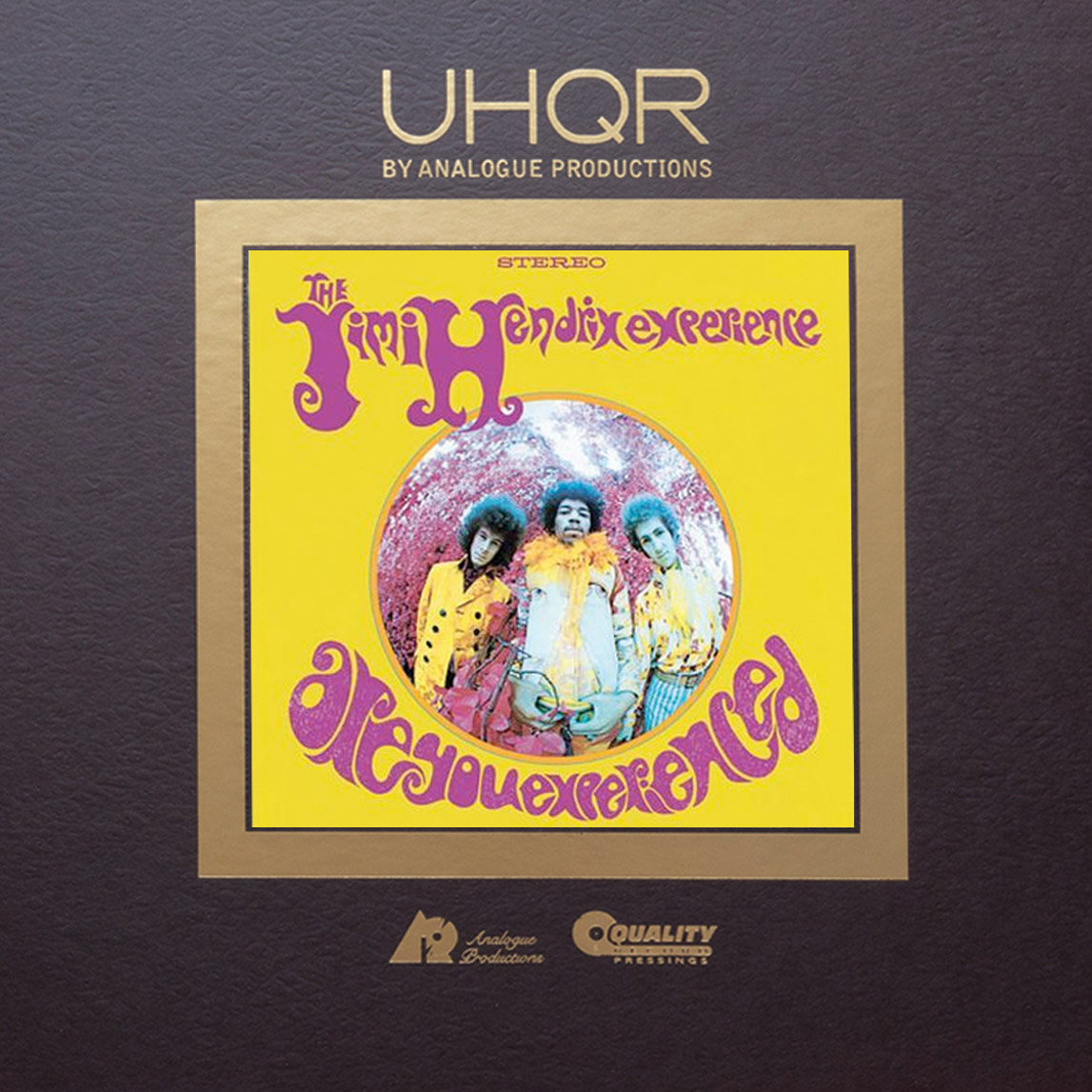
The American presentation is part of the history too. Karl Ferris’s familiar US cover photograph differs from the original British sleeve and shapes many listeners’ visual memory of the record. A collector’s edition consequently brings together two historical layers: recordings made in London and the particular American album assembled from them. This UHQR follows that eleven-track sequence. It does not combine every song from the original national editions and later bonus programmes into a single supposedly definitive running order. Knowing which album configuration is on the record is part of understanding the release.
A UHQR preserving the shape of a single LP
The edition offered here is Analogue Productions UHQR AUHQR 0005, a stereo LP at 33⅓ RPM, manufactured on 200-gram Clarity Vinyl at Quality Record Pressings. Bernie Grundman handled mastering, using the original analogue tapes according to the publisher. The announced edition was limited to 20,000 copies. These specifications identify the 2022 UHQR release; they should not be transferred to other Hendrix reissues or confused with a mono edition of the album.
The choice of 33⅓ RPM preserves a familiar two-side listening pattern. For an album containing such varied stages, that has an understandable attraction. The six tracks on the first side retain their continuous sequence, as do the five on the second. A single side change separates the two larger arcs. A 33⅓ RPM edition is therefore more than a smaller alternative to an album spread across four sides. It offers a particular, often convenient way of experiencing the programme as a connected whole. Actual reproduction still depends on the specific mastering, pressing and playback system.
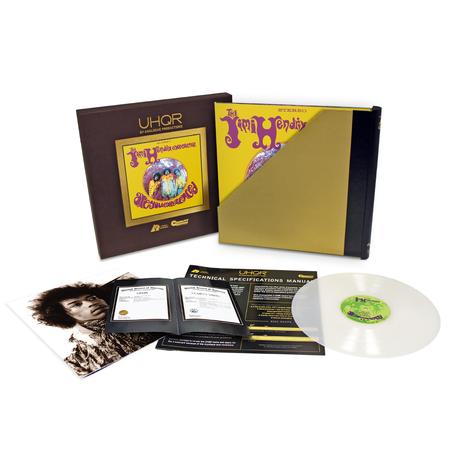
The UHQR presentation includes an elaborate box and accompanying material with writing by Dave Marsh, Brad Tolinski and John McDermott. Its collector appeal extends beyond the weight of the vinyl to the clearly identified US stereo programme, the mastering work and the relationship between music and documentation. Playback uses a conventional stereo turntable with a correctly adjusted cartridge; UHQR describes this edition rather than an additional playback format. The eleven songs remain the centre of a release designed to give them sustained attention, from the opening guitar statement to the change of perspective at the end of side two.
You order from Michael 45 in Germany. We arrange the US import and dispatch from Hilden.
Also on SACD: Are You Experienced?
More by The Jimi Hendrix Experience: Axis: Bold As Love
Artist page: All titles by Jimi Hendrix
Customer question: Collecting UHQR records: limited editions of great albums
Series: UHQR – all 31 editions with pressing run and mastering
Musicians
Participants and documented credit status. Track references correspond to the tracklist.
- Jimi Hendrixelectric guitar, vocalsParticipation: album personnel
- Noel Reddingelectric bass, backing vocalsParticipation: album personnel
- Mitch MitchelldrumsParticipation: album personnel
- The Breakawaysbacking vocalsParticipation: A3


Recorded October 1966–April 1967 at De Lane Lea, CBS and Olympic, London. Producer: Chas Chandler. Engineers: Dave Siddle, Mike Ross and Eddie Kramer at different sessions. Hey Joe written by Billy Roberts. Eleven-track US stereo album. UHQR mastering: Bernie Grundman; pressed at Quality Record Pressings.
How Michael hears this edition
Listening impression · paraphrased from the video
Compared with the regular George Marino edition, Michael hears more clarity, separation and soundstage depth on the Bernie Grundman UHQR. He stresses that both sound very good: he places them roughly at nine versus ten, rather than treating one as poor and the other as good.
🎧 Review video: The 10 Best Audiophile Reissues Of 2022!
This video is hosted by YouTube (Google). It only loads once you switch on “Functional” in the cookie settings.

Reviews
There are no reviews yet.