The studio joins the band
Only a few months separated the Doors’ debut and Strange Days in 1967. Yet the second album changes the view of the group. The songs retain clear outlines while unfamiliar sounds and unexpected transitions appear around them. Jim Morrison’s voice, Ray Manzarek’s keyboards, Robby Krieger’s guitar and John Densmore’s drums remain the core. The studio supplies additional ways to alter that familiar combination, directing attention toward details that can give an otherwise recognizable arrangement an unsettled character.
At Sunset Sound in Hollywood, the Doors again worked with producer Paul A. Rothchild and engineer Bruce Botnick. An eight-track machine replaced the four-track setup used for the debut, providing more room to record ideas separately and bring them together. Doug Lubahn supplemented the group as studio bassist on most of the songs. The resulting record retains the band’s performance background while exploring possibilities that would only acquire their final shape inside the recording room rather than onstage.

Concise songs with an oblique perspective
“People Are Strange” compresses its unease into a brief, memorable form. “Love Me Two Times” places a mobile guitar figure and a different rhythmic emphasis beside it. Both became singles without representing the album’s full range. “You’re Lost Little Girl” leads into a more restrained setting, while “Moonlight Drive” draws attention to the connection between Morrison’s singing and Krieger’s guitar colors. The pieces are concise enough for a single arrangement decision to make a substantial difference to their character.
The title track is among the early rock recordings to feature a Moog synthesizer, with Paul Beaver helping the band work with the new instrument. Its significance here lies less in displaying technology than in making a voice or a texture seem unfamiliar. The short “Horse Latitudes” interrupts the sequence with spoken words and sound effects. These interventions appear among songs with melodies strong enough to stand without elaborate production. The alternation keeps recognizable forms slightly off balance rather than replacing them altogether.

Eleven minutes change the scale
At the end, “When the Music’s Over” receives a very different amount of space. The roughly eleven-minute performance develops tension through recurrence, interruption and exchanges between the band and Morrison’s voice. Densmore’s entrances and Manzarek’s recurring figures are useful points to follow. They preserve orientation as the music changes state. The finale feels expansive partly because most of the preceding tracks are short. Its position in the sequence helps determine its effect as much as its duration does.
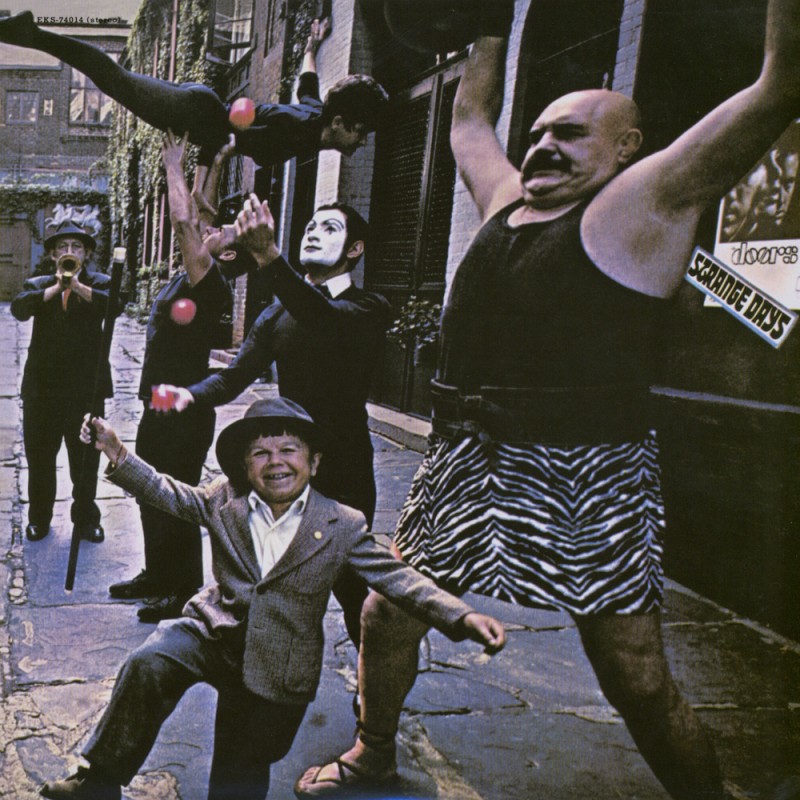
Botnick later explained that the doubled guitar solo acquired its distorted character by feeding one microphone preamplifier into another. Such choices reveal the practical craft behind the apparently unreal atmosphere. The cover also avoids the conventional band portrait: Joel Brodsky photographed street performers in New York’s Sniffen Court. Image and music do not tell an identical story, but both suggest a familiar world becoming unexpectedly strange. On the record, that impression emerges from specific decisions about playing, arrangement and the treatment of sound.
This edition
Analogue Productions’ AAPP 74014-45 contains two 180-gram LPs at 45 RPM, pressed at Quality Record Pressings. Doug Sax mastered the release using an all-tube system, with Bruce Botnick overseeing the reissue. The publisher identifies the original analog master tapes as the source for Strange Days. All ten album tracks are included. This edition belongs to the Doors series mastered by Sax and should be distinguished from the separate SACD and mono releases.
Also on SACD: Strange Days
More by The Doors: Waiting For The Sun · L.A. Woman
Artist page: All titles by The Doors
Customer question: Buying Analogue Productions records in Europe
Musicians
Documented selection of participating musicians. Personnel may vary by track; this list does not claim to be complete.
| Name | Instrument / role |
|---|---|
| Jim Morrison | Synthesizer, Vocals |
| Ray Manzarek | Keyboards, Marimba |
| Robby Krieger | Guitar |
| John Densmore | Drums |
| Doug Lubahn | Electric bass |

Reviews
There are no reviews yet.