

A new label, five starting points
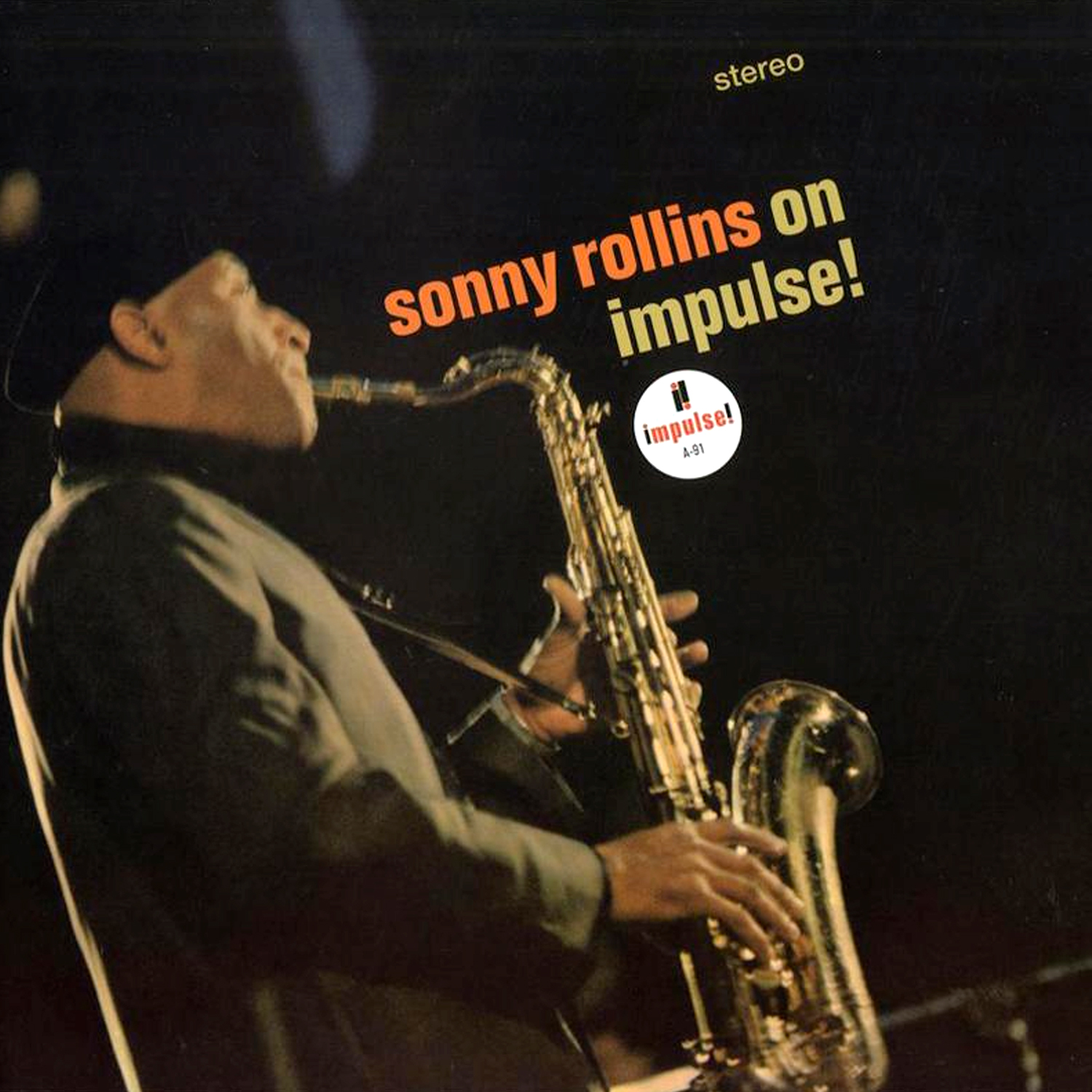
Sonny Rollins on Impulse! makes the change of label part of its title. Recorded on July 8, 1965, at Rudy Van Gelder’s studio in Englewood Cliffs, the album appeared that August. It begins a brief, distinctive sequence of Rollins releases for Impulse!. That does not mean the whole period should be treated as one uniform musical project. This first record has a specific character: five compositions by other writers, performed by an acoustic quartet with a clearly identified piano, bass and drums partnership.
Rollins is joined by Ray Bryant on piano, Walter Booker on double bass and Mickey Roker on drums. Their names deserve as much attention as the prominent pairing of artist and label. They determine the particular musical company the tenor saxophonist keeps during this session. Bryant supplies an individual piano voice, with Booker and Roker forming the rhythm section. This is neither a pianoless trio nor a large studio ensemble, but four named musicians participating throughout the five selections.
Bob Thiele produced the date and Rudy Van Gelder engineered it. Nat Hentoff wrote the liner notes, while Chuck Stewart supplied the photographs. The original stereo edition carries the catalogue number AS-91. Such details locate the album within its period, but the musical invitation remains direct: Rollins takes familiar songs and a calypso as material for his work with melody, form and improvised development. No composition of his own is required for the result to retain a distinctive Rollins identity.
For a collection, that is part of the record’s value. Knowing a melody can make a soloist’s decisions easier to follow than they might be with entirely unfamiliar material. It provides orientation while revealing how far an interpretation can travel beyond a straightforward statement of the theme. These five pieces are therefore not a neutral backdrop for saxophone technique. Each poses a different set of possibilities and a different way of sustaining a musical narrative over the course of a complete performance.

Four personalities at Englewood Cliffs
Ray Bryant is not simply an interchangeable supplier of chords. A piano can provide harmonic support, introduce rhythmic accents or offer an independent melodic answer. Which of these possibilities moves to the foreground is one of the pleasures of attentive listening. Beside a soloist as prominent as Rollins, it is especially worthwhile to direct the ear towards the pianist from time to time. The same passage then changes perspective: a tenor line becomes an exchange between two identifiable voices.
Walter Booker plays double bass throughout the album, rather than appearing on only one selection. Within the quartet, the bass connects harmonic orientation with continuing movement. It is useful to hear more than the low notes as a general foundation, following the direction of a line and its relationship to the drums. The larger musical argument is being shaped in places where a first hearing may naturally concentrate almost entirely on the saxophone. Returning with the bass in mind can uncover another route through familiar material.
Mickey Roker is the drummer on all five recordings. Together with Booker, he provides the rhythmic foundation that gives the different song forms a shared setting. Transitions offer a helpful listening focus: how is a new phrase taken up, where does an accent meet a line, and how does the pulse remain present through a longer span of development? These questions do not require a prescribed answer. They draw attention to the amount of interaction taking place beyond the statement of the main melody.
One ensemble and one recording date give the album a clearly defined identity. There is no need to import guest appearances or personnel from another Impulse! release into these credits. Earlier and later Rollins groups can make useful points of comparison, but they do not replace the particular combination of Bryant, Booker and Roker. With a large and stylistically mobile discography, that precision is valuable. The record offers an encounter with a specific group at a specific moment rather than an illustration of a general idea about the artist’s entire career.

Standards, a calypso and room to develop
“On Green Dolphin Street” opens the album. The composition by Bronisław Kaper, with lyrics by Ned Washington, belongs to the group of songs that developed an independent life within jazz. Here it supplies the quartet’s first point of departure. Listen to the relationship between the outline of the theme and the path taken by the improvisation. A melody can provide a firm point of reference without dictating every turn that follows during the performance.
Matt Dennis and Tom Adair’s “Everything Happens to Me” comes next. At a little over eleven minutes, it is the longest selection and occupies a substantial part of side A. That span changes the task: a song must be developed as well as introduced. For close listening, consider the relationship between recurrence and variation. Which small figures remain in the memory, and how does another setting alter their effect? The interest lies in the unfolding of ideas rather than simply in the duration of the performance.
Side B begins with “Hold ’Em Joe,” the calypso credited to Harry Thomas. It brings a different reference point into a programme otherwise built around American standards. Caribbean song is part of Rollins’ musical world, and here it appears through a specific composition. The selection should neither be treated as an incidental interlude nor confused with another, more famous Rollins calypso. Its individual identity and its place at the beginning of the second side are part of this album’s construction.
Richard Rodgers and Lorenz Hart’s “Blue Room,” followed by Harry Ruby and Bert Kalmar’s “Three Little Words,” completes the record. Both return to songs with a verbal history and roots in popular entertainment. The absence of a singer does not erase that background. One can follow the melodic shape as though an imagined voice were forming a line, then notice how the saxophone carries it forward instrumentally. The relationship to song remains available while the quartet develops possibilities that belong to its own performance.
An Impulse! programme on one LP
This edition is AIMP 42701 in the Verve/UMe Acoustic Sounds Series. It presents the stereo album on one 180-gram LP running at 33⅓ RPM. Ryan K. Smith at Sterling Sound handled the mastering from analogue tapes. The record is manufactured at Quality Record Pressings, with a Stoughton gatefold jacket and a lined inner sleeve of the type commonly described as a rice-paper sleeve. These specifications identify this reissue rather than every earlier release of the same recording.
A single 33⅓ RPM LP has a clear practical purpose for this programme. The first side belongs to the two more extended interpretations of “On Green Dolphin Street” and “Everything Happens to Me.” The second moves from calypso to “Blue Room” and “Three Little Words.” One side change retains that division and allows the longer performances their full space without further interruption. The format supports the original album sequence: an extended opening pair, followed by three shorter selections with different identities. This division also allows the two sides to register as distinct sections within the programme.
For collectors, a clear place within Rollins’ Impulse! period matters alongside the production specifications. This record documents the quartet of July 1965. Its details should not be mixed with the differently staffed recordings of East Broadway Run Down or other releases from the same label relationship. Those differences are part of what makes a collection rewarding: an artist can explore several ensemble forms and repertoires within a short period, without one record having to represent all the others.
Five compositions and four musicians provide a varied album-length programme. The extended Dennis–Adair ballad, the calypso and the two closing standards each give Rollins different opportunities to examine a melody and carry it onwards. Bryant, Booker and Roker hold those encounters together within the same quartet. That relationship gives this first Impulse! appearance a distinct place in his recorded work. You order from Michael 45 in Germany. We arrange the US import and dispatch from Hilden.
More by Sonny Rollins: Way Out West · Alfie
Artist page: All titles by Sonny Rollins
Series: Impulse! – all 19 records: the house that Trane built
Musicians
Participants and documented credit status. Track references correspond to the tracklist.
- Sonny RollinsPortrait: existing verified portraittenor saxophoneParticipation: All tracks
- Ray BryantPortrait: later portrait versionpianoParticipation: All tracks
- Walter BookerPortrait: 1993 · later portrait referencedouble bassParticipation: All tracks
- Mickey RokerPortrait: 1976 · later portrait referencedrumsParticipation: All tracks
- Bob ThieleproductionParticipation: Recording production
- Rudy Van Gelderrecording engineerParticipation: Recording production


All five tracks: Sonny Rollins, Ray Bryant, Walter Booker and Mickey Roker. July 8, 1965, Englewood Cliffs.
How Michael hears this edition
Listening impression · paraphrased from the video
Michael hears pleasing separation, soundstage and dynamics. Compared with the older AP 45, Sonny Rollins' saxophone sits further back in the room on the new Acoustic Sounds edition. He personally prefers the older 45's more immediate presentation, while also praising the new 33⅓ edition.
🎧 Review video: Shootout: Acoustic Sound: Sonny Rollins: On Impulse, Oliver Nelson: The Blues and The Abstract Truth
This video is hosted by YouTube (Google). It only loads once you switch on “Functional” in the cookie settings.

Reviews
There are no reviews yet.