
Flute, alto saxophone and two basses
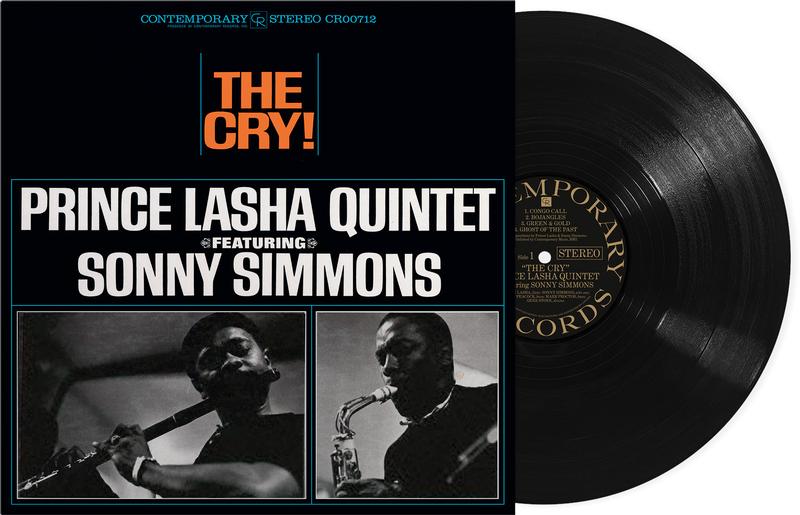
The Cry! was recorded at Contemporary in Los Angeles on November 21, 1962. Prince Lasha plays flute, Sonny Simmons alto saxophone, Gary Peacock and Mark Proctor double bass, and Gene Stone drums. The instrumentation immediately distinguishes the album from many small-group jazz recordings: there is no piano, two basses share the lower register on several pieces, and the front line pairs two markedly different wind instruments. Released in 1963, the Contemporary debut consists entirely of compositions by Lasha and Simmons, with eight selections presenting their shared musical conception.
Lester Koenig produced the session, and Howard Holzer handled the recording. The sleeve photographs were taken during the date, giving the album a direct visual connection to that particular studio day. Lasha and Simmons had already known and worked with one another for some time. This was therefore not simply a first meeting assembled for a record. It brought an established partnership into a recording environment that could accommodate both the unusual instrumentation and a complete programme of the musicians’ own material.

The paths leading to the partnership
Lasha grew up in Fort Worth and knew Ornette Coleman from his youth. They learned music and played together over a period of years. That association is important to his development, but it does not by itself explain the music Lasha and Simmons made on The Cry!. Simmons moved to Oakland as a child and developed his own musical path there. Their partnership drew on personal experiences and sustained instrumental work, with an interest in allowing melody and collective expression to help determine the direction of a piece.
Without a piano, the relationships between individual lines become especially relevant. Lasha is credited here on flute and Simmons on alto saxophone. Peacock plays bass throughout the eight selections; Proctor joins him on five. “Bojangles”, “Lost Generation” and “A.Y.” feature Peacock as the only bassist. The original notes place Peacock in the left channel and Proctor in the right. That information turns a general description of “two basses” into a specific feature that can be followed across the programme and its different instrumental combinations.

Images and dedications in the titles
“Bojangles” refers to dancer Bill Robinson. Simmons explained that he had imagined Robinson dancing. “Juanita” is dedicated to Lasha’s mother, while “Ghost Of The Past” remembers departed musicians including Charlie Parker, Chu Berry and Clifford Brown. These connections give the compositions individual identities. The titles provide clues to memories and images associated with the music, offering points of entry even for listeners encountering the group’s language for the first time. They also connect the album’s original repertoire with a wider history of performers and personal relationships.
“Congo Call” begins the sequence, with “Green And Gold” and “Red’s Mood” among its further destinations. “A.Y.”, meaning “Affectionately Yours”, closes side B. In his liner notes, Koenig placed the idea of the “cry” within a broader discussion of human expression, from voices to instruments. The eight jointly written pieces remain the album’s practical expression of that idea. Their dedications, images and changing bass personnel provide different perspectives, while the continuing partnership between Lasha and Simmons holds the programme together.
The Contemporary Acoustic Sounds reissue
Craft Recordings presents this edition in the Contemporary Records Acoustic Sounds Series as CR00712, distributed under ACONC 712. It is a single 180-gram stereo LP at 33⅓ RPM, with mastering and lacquer cutting by Bernie Grundman. Craft specifies all-analogue mastering from the original master tapes; that is the publisher’s account of the production process. Quality Record Pressings manufactures the record. The complete album is retained, with four selections on each side and no supplementary material.
Released in 2024, the reissue comes in a tip-on jacket, with Stoughton Printing identified as the printer. Its value as a document remains closely connected to the particular credits: Holzer at the recording desk, Lasha on flute, Simmons on alto saxophone and Proctor participating on only part of the programme. The edition presents the eight original compositions in their established order. It returns listeners to a specific meeting of an unusual instrumental group and a developed musical partnership, captured during one November day in Los Angeles in 1962.
You order from Michael 45 in Germany. We arrange the US import and dispatch from Hilden.
More from the series: Verve (Acoustic Sounds Series)
Series: Contemporary – all 24 records: sunny jazz from Los Angeles
Musicians
Participants and documented credit status. Track references correspond to the tracklist.
| Name | Instrument / role | Participation |
|---|---|---|
| Prince Lasha | flute, bandleader | Album personnel |
| Sonny Simmons | alto saxophone | Album personnel |
| Gary Peacock | double bass (left channel) | Album personnel |
| Mark Proctor | double bass (right channel) | A1, A3, A4, B1, B2 |
| Gene Stone | drums | Album personnel |
Proctor is absent from A2, B3 and B4, with Peacock the sole bassist. Lasha has a documented flute credit on this album.
🎧 Review video: 12 Amazing New Reissues!
This video is hosted by YouTube (Google). It only loads once you switch on “Functional” in the cookie settings.

Reviews
There are no reviews yet.