
Armstrong looks back to his mentor
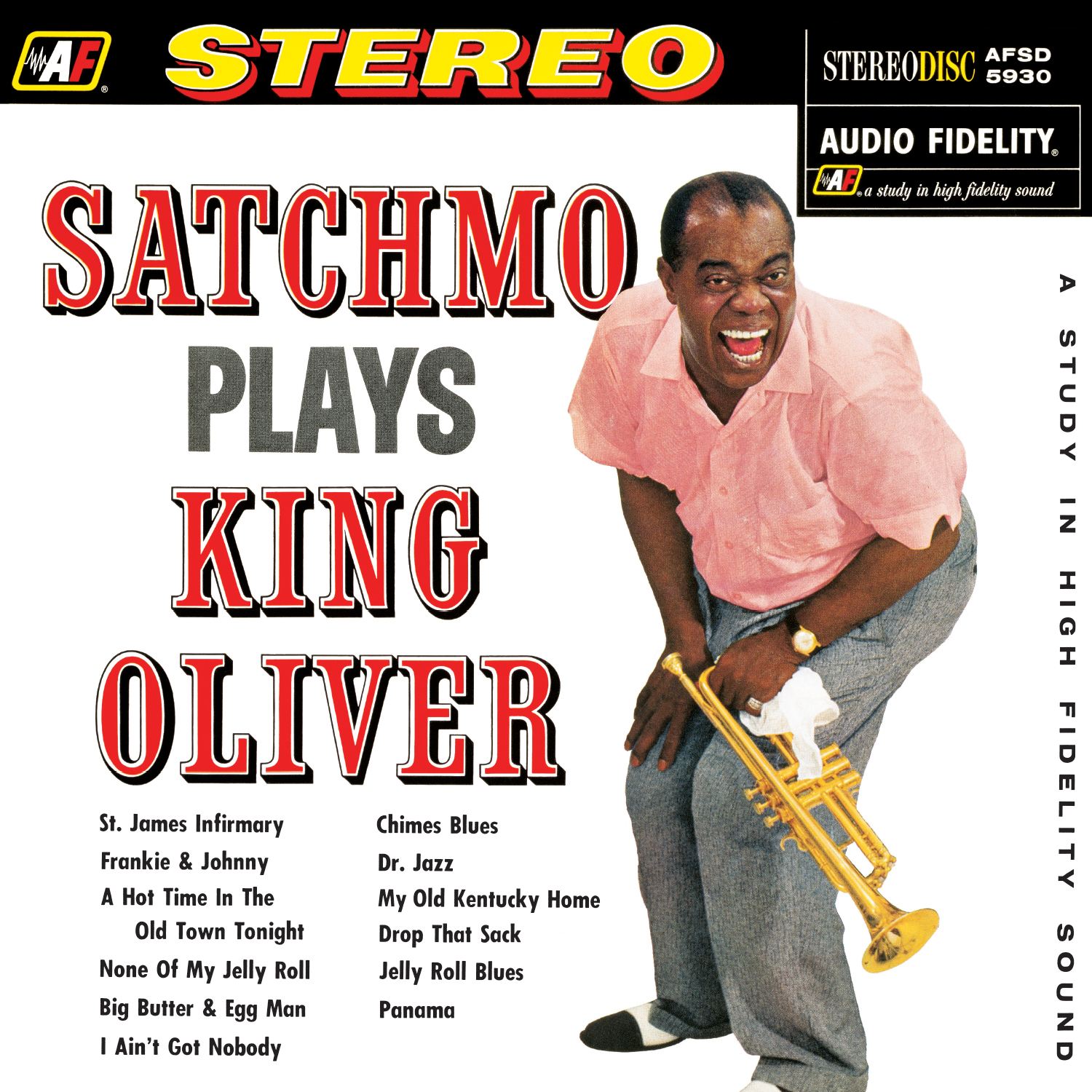
With Satchmo Plays King Oliver, Louis Armstrong returned to the musical world of a figure who had helped shape his career. Joe “King” Oliver was his mentor in New Orleans and brought him to Chicago in 1922 to join the Creole Jazz Band. Armstrong played second cornet before establishing his own extraordinary place in jazz. Recorded in 1959, this album is a later tribute to that relationship. He approaches the older repertoire with his contemporary All Stars and with several decades of experience between him and those formative years.
The sessions took place at Radio Recorders in Hollywood in late September and early October 1959, with Audio Fidelity issuing the album in 1960. Armstrong sings and plays trumpet alongside Trummy Young on trombone, Peanuts Hucko on clarinet, Billy Kyle on piano, Mort Herbert on double bass and Danny Barcelona on drums. Sidney Frey produced the twelve-track programme. These are recordings by the band of 1959, rather than a compilation of the early records made with Oliver. The distance between those periods is part of the tribute’s meaning.

A particular All Stars line-up
The musicians represent a specific phase of the All Stars. Young’s trombone and Hucko’s clarinet provide additional horn voices around Armstrong, while Kyle, Herbert and Barcelona complete the instrumental setting. The group’s membership changed over the years, so identifying the players is more useful than treating the All Stars name as a fixed personnel list. This album preserves one particular combination. Listeners familiar with recordings from other periods can follow the return of older material within the working relationships of this later band.
“Frankie And Johnny” is a documented exception to the larger line-up: the session credits identify Armstrong and Billy Kyle, with the other musicians absent. That smaller setting creates a specific change within the programme. It also illustrates why general album credits should not automatically be applied to every track. Armstrong’s singing and trumpet playing offer different routes into the songs, and each piece carries a history of its own. The personnel information makes the participation clearer while retaining the distinction between the album’s overall group and an individual performance.

A connection to the earliest recordings
The closing “Chimes Blues” reaches back to King Oliver’s April 1923 recordings with the young Armstrong. Revisiting that material more than three decades later gives the dedication a tangible point of reference. Other selections include “Dr. Jazz”, “Panama”, “Jelly Roll Blues” and “Drop That Sack”. Together they evoke a musical world that Armstrong had helped create, not merely encountered through historical records. His relationship to the repertoire is therefore both personal and professional, shaped by the early associations to which the album’s title refers.
“St. James Infirmary” opens side A, with “I Ain’t Got Nobody” appearing third. Those two performances were subsequently paired on a separate 45-RPM release. On this LP they remain part of the complete twelve-track sequence, which continues through to “Chimes Blues”. The full programme allows the tribute to take shape across both sides. The title expresses Armstrong’s dedication to Oliver; it should not be taken to mean that every selection is an Oliver composition. The repertoire draws on a wider shared tradition within which their relationship developed.
The complete 33⅓-RPM album
AAPJ 5930 is the single 33⅓-RPM LP from Analogue Productions, containing all twelve selections in stereo. Bernie Grundman is responsible for the mastering, with the publisher specifying original analogue tapes as the source. Quality Record Pressings is named for plating and pressing. This edition is distinct from the release carrying the “-45” suffix, which contains only two tracks. The complete album sequence belongs to this 33⅓-RPM version, arranged across its two sides.
The record comes in a Stoughton Printing tip-on jacket. An earlier 200-gram pressing and a later 180-gram version are documented under the same catalogue number, so that number alone does not establish the weight of a particular copy. The musical programme remains the same. Satchmo Plays King Oliver connects Armstrong’s memory of his mentor with the working present of his 1959 All Stars: a studio album whose twelve songs place an earlier chapter of jazz history within the experience of musicians returning to it decades later.
You order from Michael 45 in Germany. We arrange the US import and dispatch from Hilden. Editions not currently in stock are dispatched after the goods arrive.
Customer question: Buying Analogue Productions records in Europe
Musicians
Participants and documented credit status. Track references correspond to the tracklist.
| Name | Instrument / role | Participation |
|---|---|---|
| Louis Armstrong | trumpet, vocals | Album personnel |
| Trummy Young | trombone | A1, A2, A3, A4, A5, A6, B2, B3, B4, B5, B6 |
| Peanuts Hucko | clarinet | A1, A2, A3, A4, A5, A6, B2, B3, B4, B5, B6 |
| Billy Kyle | piano | Album personnel |
| Mort Herbert | double bass | A1, A2, A3, A4, A5, A6, B2, B3, B4, B5, B6 |
| Danny Barcelona | drums | A1, A2, A3, A4, A5, A6, B2, B3, B4, B5, B6 |
B1 Frankie And Johnny: Armstrong and Billy Kyle. The other tracks feature the listed All Stars.


Reviews
There are no reviews yet.