

An alto saxophone among familiar orchestral voices
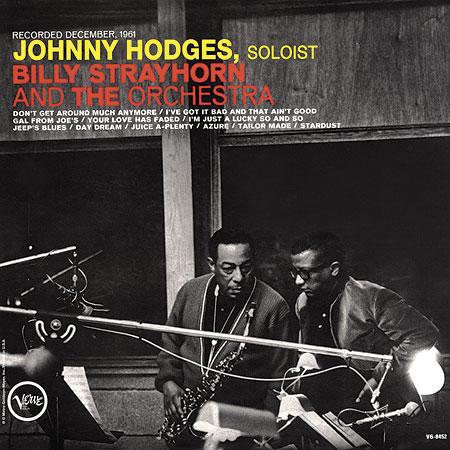
Johnny Hodges With Billy Strayhorn And The Orchestra places a musical relationship at its centre that cannot be reduced to the word accompaniment. Hodges stands with his alto saxophone before an orchestra whose members largely come from Duke Ellington’s circle. Billy Strayhorn provides the arrangements and conducts. He is not the pianist on this recording: that role belongs to Jimmy Jones. If you want to buy this Johnny Hodges album on vinyl, the Analogue Productions double LP at 45 RPM offers a meeting between a soloist, an arranger and a distinctive collection of orchestral voices.
The sessions took place on December 11 and 12, 1961, with the album appearing on Verve in 1962. Creed Taylor produced and Rudy Van Gelder handled the recording. Those names form part of its history, but the musical centre is the relationship between Hodges and Strayhorn. One leads the listener through the programme with an individual instrumental voice; the other determines how the ensemble gathers around it. This division of responsibility can reveal as much about a soloist as a smaller group in which every contribution stands immediately exposed.
The eleven pieces frequently draw on the repertoire associated with Ellington’s circle. Don’t Get Around Much Any More, I’ve Got It Bad And That Ain’t Good, Jeep’s Blues and Day Dream already evoke a familiar musical world through their titles. Alongside them are numbers that may be less immediately prominent in a listener’s memory, including Your Love Has Faded, Juice-A-Plenty and Tailor Made. Recognition and discovery therefore belong together. A familiar melody can provide the starting point from which to explore another piece rather than the reason to overlook it.
Hodges remains the point of reference throughout that exploration. An orchestral album does not have to make its case through sheer weight. A characteristic alto saxophone can demonstrate how much a single line can achieve in relation to a larger body of sound. The listener gains two perspectives: following the melody while also attending to the space and context created by the arrangement. That makes the record a worthwhile destination for collectors who have mainly encountered Hodges in smaller settings.

Strayhorn’s work and the orchestra’s individual voices
The personnel is substantial and specifically documented. Among the reed players, Hodges is joined by Russell Procope, Jimmy Hamilton, Paul Gonsalves and Harry Carney. The credits list alto saxophone and clarinet for Procope, baritone saxophone and bass clarinet for Carney. Such differences of register give an arranger several ways to frame a melody. Every passage does not need the same colour, and every voice does not need the same responsibility. The instrumental list consequently offers more than supplementary information: it helps explain the possibilities available within the ensemble.
Cat Anderson, Harold Baker, Bill Berry and Ed Mullens are credited on trumpet. Howard McGhee appears on three specifically identified pieces: I’m Just A Lucky So And So, Azure and Tailor Made. This qualification matters. A long list of names can otherwise suggest that every player contributes equally to every selection. McGhee’s participation can be narrowed down precisely here. The other entries follow the album credits; they have not been expanded into invented track assignments or assumptions about which instrument must be heard at every moment.
Lawrence Brown, Quentin Jackson and Chuck Connors make up the trombone group. Jimmy Jones on piano, Aaron Bell on double bass and Sam Woodyard on drums form the rhythm section. As arranger and conductor, Strayhorn shapes the music through a different kind of contribution. He organises voices, transitions and emphasis, and establishes possibilities that the score places before the players. This is a different activity from taking a piano solo, but it is no less central to the identity of the record. His name in the title has a specific musical meaning.
The familiarity among many of the participants is part of the attraction. The Ellington connection resides not only in well-known compositions, but also in individual approaches to sound and in musical relationships developed over time. Yet this remains a Hodges album under Strayhorn’s direction, rather than an interchangeable orchestral setting with a guest soloist attached. Comparing the personnel with the programme reveals a particular gathering of familiar names for a distinct purpose. The album deserves to be heard on those terms, as its own occasion.

Eleven pieces shaped by song, blues and orchestral colour
The first side brings together Don’t Get Around Much Any More, I’ve Got It Bad And That Ain’t Good and Gal From Joe’s. They offer three melodic starting points for the same central voice. On an initial listen, it can be rewarding to follow the length and direction of a phrase before concentrating on the surrounding arrangement. Familiar songs make that approach accessible: the melody supplies orientation, while the soloist decides how closely or indirectly to follow it. The orchestra can become a counterpart, a background or a link between gestures.
Your Love Has Faded and I’m Just A Lucky So And So occupy the second side. The latter is one of the three selections with Howard McGhee. Knowing this need not turn listening into a test of identification; it simply supplies another point of reference for later visits. The album can first be experienced as a sequence of moods and then explored more closely through its personnel and arrangements. These approaches complement one another. A record drawing on familiar repertoire can continue to generate fresh questions precisely because the songs provide a secure starting point.
Jeep’s Blues, Day Dream and Juice-A-Plenty share the third side. Their juxtaposition directs attention towards the range between a blues reference and a more lyrical invitation. It remains useful to treat each piece as an individual composition, rather than placing the entire programme beneath one descriptive adjective. Hodges’ alto connects the selection, but each melody offers a different task. For listeners building a collection around a particular musician, the record supplies several perspectives on the same soloist without requiring a move between unrelated albums or recording periods.
Azure, Tailor Made and Stardust complete the fourth side. McGhee is specifically credited on the first two, while the widely familiar melody of Stardust closes the programme. The running order maintains the central idea of gathering songs and orchestral colours around an individual musical personality. It does not need a dramatic conceptual break to hold together. You can follow the eleven pieces as a complete album, or choose a single side as a smaller programme. The double LP supplies clearly defined sections for either approach.
The Verve reissue across two 45 RPM records
The offered Analogue Productions edition carries shop catalogue number AVRJ 8452-45. It places the eleven selections on two LPs playing at 45 revolutions per minute. George Marino at Sterling Sound is credited with the mastering, and Quality Record Pressings with manufacturing the records. These details establish the identity of this particular edition. Historical pressing documentation sometimes specifies 200 grams, while the publisher also gives a 180-gram specification. The description therefore avoids promising an unchecked current pressing weight and concentrates on the edition that can be identified reliably.
The four sides contain three, two, three and three pieces respectively. This turns the album into manageable listening sections and requires more side changes than a single LP. That is a practical feature of the edition, not merely a number printed on the label. Anyone seeking the longest possible uninterrupted sequence should bear it in mind; listeners who enjoy selecting a side deliberately may appreciate the concise programmes. The format alone does not establish automatic sonic superiority over every other pressing, and no such blanket comparison is needed to explain its appeal.
Within a collection that includes Ellington, Hodges or Strayhorn, the album has a particularly clear place. Hodges leads, Strayhorn arranges and conducts, and the documented orchestra gives the project its individual makeup. The complete tracklist and personnel section below help establish exactly what is included before purchase. Above all, this is a programme of eleven pieces intended for listening, rather than simply a catalogue of notable names. The relationships between those names become meaningful when the record starts to play.
You order from Michael 45 in Germany. We arrange the US import and dispatch from Hilden.
Musicians
Participants and documented credit status. Track references correspond to the tracklist.
- Johnny HodgesExisting portrait; not a session depictionalto saxophoneParticipation: Album personnel
- Russell ProcopePortrait reference: 1946alto saxophone, clarinetParticipation: Album personnel
- Jimmy Hamiltontenor saxophoneParticipation: Album personnel
- Paul GonsalvesPortrait reference: 1963tenor saxophoneParticipation: Album personnel
- Harry CarneyExisting portrait; not a session depictionbaritone saxophone, bass clarinetParticipation: Album personnel
- Cat AndersonExisting portrait; not a session depictiontrumpetParticipation: Album personnel
- Harold BakertrumpetParticipation: Album personnel
- Bill BerrytrumpetParticipation: Album personnel
- Ed MullenstrumpetParticipation: Album personnel
- Howard McGheetrumpetParticipation: B2, D1, D2
- Lawrence BrownExisting portrait; not a session depictiontromboneParticipation: Album personnel
- Quentin JacksontromboneParticipation: Album personnel
- Chuck ConnorstromboneParticipation: Album personnel
- Jimmy JonesExisting portrait; not a session depictionpianoParticipation: Album personnel
- Aaron Belldouble bassParticipation: Album personnel
- Sam WoodyardExisting portrait; not a session depictiondrumsParticipation: Album personnel
- Billy StrayhornExisting portrait; not a session depictionarrangements, conductingParticipation: Album personnel


Billy Strayhorn: arrangements and conducting, not piano. Howard McGhee only B2, D1, D2. Other roles follow album credits, without independently established individual track assignments. Recorded December 11–12, 1961; Creed Taylor: producer; Rudy Van Gelder: engineer; George Marino / Sterling Sound: edition mastering; QRP: pressing. Sources differ on 180/200 g weight.

4dd –
It’s amazing.