

Three sessions on the way to an individual voice
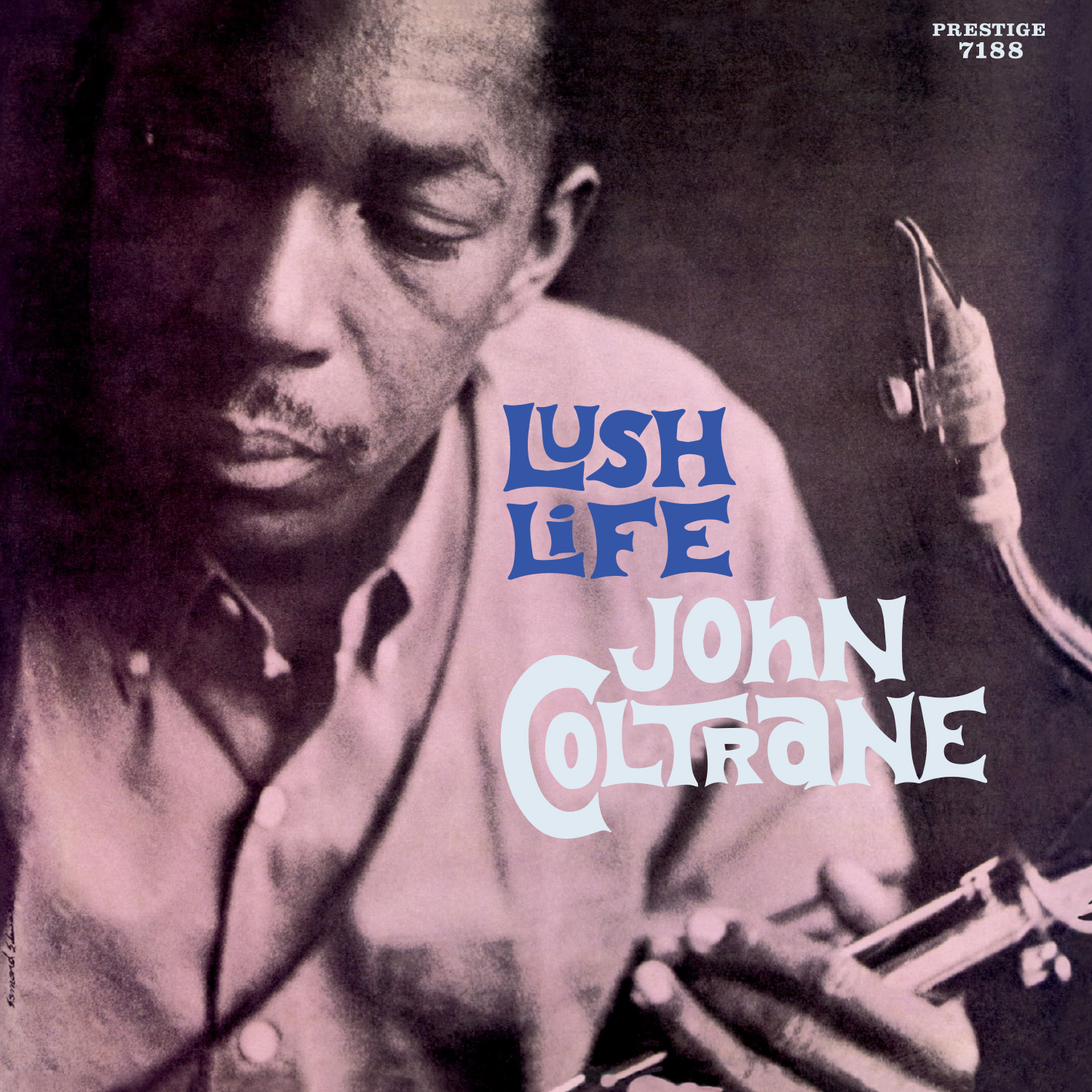
Lush Life takes its name from a great ballad, but its story extends beyond a single performance. Prestige released the album in 1961 using material from three sessions held in 1957 and 1958, after John Coltrane’s work for the label had ended. The programme consequently moves through different groups and musical situations rather than documenting one continuous day in the studio. That is part of its appeal. The same tenor saxophonist appears in the open setting of a trio, in a piano quartet and finally in a quintet addressing the demanding title composition.
The earliest date is 31 May 1957. It supplies I Hear A Rhapsody, with Red Garland on piano, Paul Chambers on double bass and Albert “Tootie” Heath on drums. On 16 August that year, Coltrane records three pieces with Earl May and Arthur Taylor, forming a trio without piano. The third date, 10 January 1958, brings Donald Byrd, Garland, Chambers and Louis Hayes together with the saxophonist. All three sessions take place at Rudy Van Gelder’s Hackensack studio. These changing names are not a minor footnote: they explain the album’s construction and the resources available to Coltrane in each performance.
The released sequence is not chronological. We encounter the trio first, then the quintet of the title piece, and finally the earlier quartet recording. The album can therefore be heard as a succession of different spaces for a single musical voice. In one setting the saxophone must make more of the harmonic movement apparent itself; in another it can refer to Garland’s chords, while Byrd’s trumpet adds a second horn perspective. For collectors, that history matters as much as the celebrated title. Lush Life preserves several distinct working situations rather than a unity invented retrospectively for the sleeve.

Space between saxophone, bass and drums
Like Someone In Love, I Love You and Trane’s Slow Blues form a coherent opening group. Coltrane, Earl May and Arthur Taylor are the entire personnel on those first three tracks. There is no pianist accidentally missing from the credits: the absence of piano is fundamental to the setting. More harmonic space remains between tenor and bass. The saxophone can suggest and explore the chord movement while May helps carry its direction. Taylor’s drums bind the activity together without introducing another sustained layer of harmony.
The two opening standards provide recognisable points of departure. Keep the melody in mind and follow the moments when Coltrane moves away from it, then notice where its outline becomes apparent again. Knowing the personnel changes the listening experience. An event that might sound like a response to a piano chord in a quartet has to emerge here from the relationship between only three voices. It is worth attending not simply to the density of the tenor lines, but to the bass replies and the subtle shifts of emphasis in the drumming.
Trane’s Slow Blues then offers a different framework. The blues form supplies orientation, while the slower movement allows individual gestures to carry greater weight. Together, these three pieces constitute a substantial identity within the album. Earl May should not disappear behind the more famous names associated with the other dates: he is the bassist throughout this opening block, not Paul Chambers. Arthur Taylor belongs specifically to these performances as well. Accurate credits do more than satisfy a collector’s wish for detail; they help explain how strongly Coltrane’s musical surroundings shape his possibilities.

Billy Strayhorn, Donald Byrd and the return of the piano
The perspective changes considerably with Lush Life. Billy Strayhorn’s composition calls for attention to an extended melodic and harmonic design that cannot be reduced to a quickly repeated theme. The performance lasts almost fourteen minutes. Donald Byrd joins on trumpet, Red Garland takes the piano chair, Paul Chambers plays bass and Louis Hayes plays drums. The trio has become a quintet, giving Coltrane additional voices against which to set his lines. This is more than a simple increase in headcount: it creates another relationship between the leading parts and their accompaniment.
Garland and Chambers also connect this session with many important Prestige recordings of the period. Byrd, meanwhile, supplies a particular colour within this album: his trumpet is credited only on the title piece. Hayes likewise appears on this selection alone. Treating the record as a continuous quintet album would therefore put several musicians in the wrong places. The precise line-up explains the change and allows the extended title performance to emerge as a centre of gravity without reducing the preceding trio pieces to mere preliminaries. Each setting has something separate to contribute.
The closing I Hear A Rhapsody is the earliest performance in the sequence. Coltrane plays in a quartet with Garland, Chambers and Albert Heath, returning to a group without trumpet after the expansive title track. Taylor, Hayes and Heath thus belong to three clearly differentiated situations. That gives Lush Life a particular place in a collection. Alongside Coltrane albums conceived as more unified projects, it offers a view of working relationships and transitions. Its variety becomes more rewarding when the compilation is understood on its own terms and each recording date retains its individual character.
The mono LP: trio on side A, new voices on side B
The edition offered here, Analogue Productions APRJ 7188, presents Lush Life on a single mono LP running at 33⅓ RPM. Kevin Gray handled the mastering and lacquer cutting at Cohearent Audio, with the label identifying the analogue masters as the source. Manufacture is by Quality Record Pressings. The current edition is listed at 180 grams and comes in a Stoughton tip-on jacket. These details describe the vinyl release; the separately available hybrid SACD is a different physical format with its own catalogue number.
For this album in particular, the side division explains part of the musical history. Side A belongs entirely to the pianoless trio with Earl May and Art Taylor. After the record is turned, Byrd, Garland, Chambers and Hayes join Coltrane for the title piece, followed by the earlier quartet performance with Albert Heath. Moving from side A to side B therefore also means entering a distinctly different instrumental setting. The 33⅓ RPM LP keeps that relationship in two coherent halves while allowing the nearly fourteen-minute title performance to retain its uninterrupted span.
The current pressing is offered as a 180-gram edition, although individual weight variations have been documented. This does not amount to a general promise of an earlier 200-gram pressing or a numbered copy. The relevant characteristics for collectors are the specified mono programme, Gray’s mastering and the preserved album sequence. In this form, Lush Life can take its place in a collection both as a familiar Coltrane title and as a revealing encounter with several of his early recording groups. You order from Michael 45 in Germany. We arrange the US import and dispatch from Hilden.
Also on SACD: Lush Life
More by John Coltrane: With The Red Garland Trio · Soultrane
Artist page: All titles by John Coltrane
Customer question: Buying Analogue Productions records in Europe
Series: Analogue Productions Prestige – all 50 records, musicians and session paths
Musicians
Participants and documented credit status. Track references correspond to the tracklist.
- Earl Maydouble bassParticipation: A1, A2, A3
- Paul Chambersdouble bassParticipation: B1, B2
- Albert HeathdrumsParticipation: B2
- Art TaylordrumsParticipation: A1, A2, A3
- Louis HayesdrumsParticipation: B1
- Red GarlandpianoParticipation: B1, B2
- John Coltranetenor saxophoneParticipation: A1, A2, A3, B1, B2
- Donald ByrdtrumpetParticipation: B1


A1–A3: trio with Earl May and Art Taylor, August 16, 1957. B1: quintet with Byrd, Garland, Chambers, Hayes, January 10, 1958. B2: quartet with Garland, Chambers, Albert Heath, May 31, 1957. All sessions: Hackensack.
How Michael hears this edition
Listening impression · paraphrased from the video
In a direct comparison with Craft Small Batch, Michael hears a warmer, less analytical presentation from the Analogue Productions 33⅓ RPM edition. He finds the differences small. He would probably choose the AP himself, but also attributes this to his listening habits and explicitly declares no clear winner. He did not compare the earlier AP 45 RPM edition here.
🎧 Review video: John Coltrane Lush Life: Craft vs. Analogue Production
This video is hosted by YouTube (Google). It only loads once you switch on “Functional” in the cookie settings.

Carlos Julian –
There is something beautiful about Lush Life, don’t ask me to explain it, It’s not Blue Train, it’s not Giant Steps, it’s a different Coltrane. He creates a distinct and interesting listen and mood composed strictly of romantic lyricism. He is able to harness immense energy to create music of breathtaking beauty.
The standout track for me here is the nearly 14-minute long “Lush Life,” featuring one of my favorite trumpeters Donald Byrd, rightfully considered one of Coltrane’s unrated masterpieces.
Carlos J. Martin, Spain
Carlos J. Martin –
There is something beautiful about Lush Life, don’t ask me to explain it, It’s not Blue Train, it’s not Giant Steps, it’s a different Coltrane. He creates a distinct and interesting listen and mood composed strictly of romantic lyricism. He is able to harness immense energy to create music of breathtaking beauty.
The standout track for me here is the nearly 14-minute long “Lush Life,” featuring one of my favorite trumpeters Donald Byrd, rightfully considered one of Coltrane’s unrated masterpieces.