

Two voices leaving room for one another
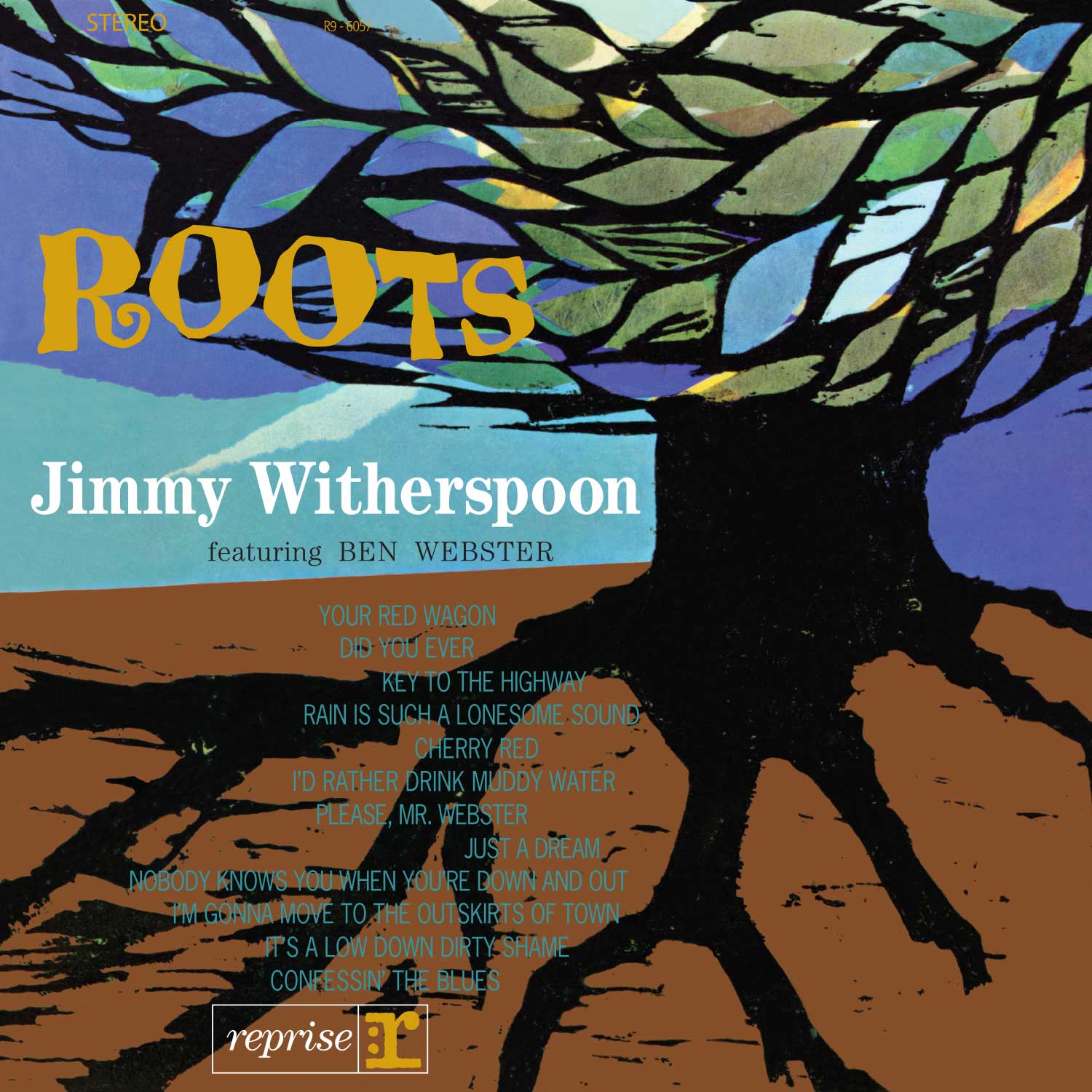
Roots brings together two personalities whose musical tools are different but whose language is closely related. Jimmy Witherspoon sings; Ben Webster plays tenor saxophone. Both can give a phrase substance without filling every available space with notes. Originally released by Reprise in 1961, the album places those central voices in a small ensemble. Its title points towards shared ground: blues as a song tradition, a way of telling a story and a framework for musicians working together. Within that common language there is room for different temperaments, for an emphatic statement as well as a quietly considered reply.
The recordings were made at Radio Recorders in Hollywood. Witherspoon and Webster are joined by Gerald Wilson on trumpet, Ernie Freeman on piano, Ralph Hamilton on double bass and Jimmy Miller on drums. That sextet tells us something important about the record’s proportions. Two wind instruments can offer contrasting voices, while piano, bass and drums support the movement of the songs and give the singer a dependable setting. There is no large orchestra surrounding the vocal; instead, a compact group of identifiable musicians supplies the accompaniment. The relationships between those six players are part of the album’s particular identity.
For listeners who first encountered Witherspoon through blues records and Webster through jazz, the meeting has an obvious appeal. Those categories provide useful points of entry without accounting for everything that happens here. A sung blues can open a space for an instrumental response, and a saxophone phrase can extend the implication of a lyric without repeating its words. Roots can therefore be approached as a conversation whose participants do not have to surrender their individual characters. Its interest for a collection lies in that specific encounter, with this repertoire and these musicians, rather than in a general claim about where one style ends and another begins.

Twelve songs drawing on a shared memory
The first side moves from I’d Rather Drink Muddy Water through I’m Gonna Move to the Outskirts of Town to Key to the Highway. Even the titles suggest different states of mind: resolve, withdrawal and departure. These songs have histories extending beyond a single performance, but here they acquire a particular shape through the people playing them. Familiar material rewards attention to more than the melody. The length of a line, the placement of an answer and the delivery of a phrase can all change its character. Recognition can become the beginning of closer listening rather than the point at which curiosity stops.
Did You Ever, Confessin’ the Blues and Nobody Knows You When You’re Down and Out complete the first half. Their writing credits connect the programme with Jimmy Rushing, Jay McShann and Walter Brown, and Jimmy Cox, among others. Those are connections in the history of the songs; they do not make the writers participants in this Hollywood session. That distinction matters for a record built on established repertoire. Roots depends both on inherited material and on its present performance. A listener who knows another version can consider what Witherspoon chooses to bring forward: a narrative, a particular turn of language or the space separating two lines.
The second side contains Your Red Wagon, Rain Is Such a Lonesome Sound, Cherry Red, It’s a Low Down Dirty Shame and Just a Dream, before ending with Please, Mr. Webster. That final title directs attention towards the tenor player before a note has sounded. The twelve selections offer different views of a common musical world rather than twelve repetitions of the same statement. Six songs on each side provide a clear structure. Each remains a manageable individual encounter, while the sequence gradually creates something broader: a record of language, musical memory and the many ways a blues song can be made to speak.

The musicians behind the two leading names
Gerald Wilson’s trumpet supplies a second instrumental wind voice alongside Webster’s tenor saxophone. Keeping those instruments distinct is more useful than describing an undifferentiated horn section. Trumpet and tenor offer different ways to begin a line, sustain it or place it against another part. Wilson is documented as a performer on the album; that credit is not expanded into a claim that he arranged every selection. A musician’s wider reputation as a composer or bandleader cannot replace an album-specific credit. Here his place in the personnel section reflects the instrument assigned to him in the documentation for this recording.
Ernie Freeman, Ralph Hamilton and Jimmy Miller provide the harmonic and rhythmic framework through piano, double bass and drums. One rewarding listening approach is to follow their work even when the voice or saxophone takes the foreground. How is a new section prepared? Does the accompaniment remain steady, or does a small adjustment give the next phrase another emphasis? Such questions treat the rhythm section as part of the storytelling rather than as anonymous support. The checked credits establish the album personnel but do not document every individual entrance or solo. A complete-looking allocation of players to each song would therefore imply more knowledge than the sources provide.
The drummer appears as Jimmy Miller, shortened to Jim Miller in the publisher’s prose. He should not be confused with the same-named producer later associated with major rock recordings. That care also applies to the illustrations. A matching name is not enough to establish the identity of a face. Witherspoon and Webster receive individual illustrations within the main description, and verified existing portraits accompany the personnel list. Where an unambiguous visual reference has not been established, the musician’s name and contribution remain visible without a substituted face. The complete musical credit matters more than making every row look artificially identical.
The album in this Analogue Productions edition
The edition offered here is AAPP 6057, a stereo LP running at 33⅓ RPM. Kevin Gray cut the record at Cohearent Audio from the original analogue master tape, with Quality Record Pressings credited by the publisher for plating and pressing. The original Reprise issue is documented as R9-6057. Nat Hentoff supplied its liner notes, Mary Ella Warren the cover image and Merle Shore the art direction. Those historical sleeve credits belong to the original presentation. They are kept separate from the newly created illustrations accompanying this product story, which are not reproductions of the album cover.
The current publisher listing specifies 180-gram vinyl, while an earlier documented Analogue Productions pressing is listed at 200 grams. The two entries are not combined into a single unsupported promise about every stock copy. Musically, the more important distinction is straightforward: the complete twelve-song programme occupies one record, with six selections per side. The 33⅓ format suits an album whose effect develops through the succession of compact, self-contained performances. Only one side change interrupts the journey from the opening song to the closing address to Webster, preserving the scale of the original programme as a natural part of the listening experience.
Roots has a clear place in a collection where blues and jazz are allowed to meet. It offers a real musical gathering rather than an abstract history of styles: Witherspoon’s voice, Webster’s tenor, Wilson’s trumpet and a three-piece rhythm section recorded in Hollywood. Established songs become material for a shared present without losing their earlier associations. Listeners who already value Webster as a soloist encounter a distinctive setting for him here; those following Witherspoon find a group surrounding his stories with recognisable voices of its own. You order from Michael 45 in Germany. We arrange the US import and dispatch from Hilden.
Customer question: Buying Analogue Productions records in Europe
Musicians
Participants and documented credit status. Track references correspond to the tracklist.
- Jimmy WitherspoonPortrait circa 1963; facial reference circa 1960vocalsParticipation: Album personnel; no track-by-track allocation documented
- Ben WebsterEarly-1960s portraittenor saxophoneParticipation: Album personnel; no track-by-track allocation documented
- Gerald WilsontrumpetParticipation: Album personnel; no track-by-track allocation documented
- Ernie FreemanpianoParticipation: Album personnel; no track-by-track allocation documented
- Ralph Hamiltondouble bassParticipation: Album personnel; no track-by-track allocation documented
- Jimmy MillerdrumsParticipation: Album credit; not the same-named rock producer


Radio Recorders, Hollywood, 1961. Documented sextet; no track-specific entrances confirmed. Drummer Jimmy/Jim Miller is not the same-named rock producer. Nat Hentoff: liner notes; Mary Ella Warren: cover image; Merle Shore: art direction.

Reviews
There are no reviews yet.