

A tenor player with more than one famous tune
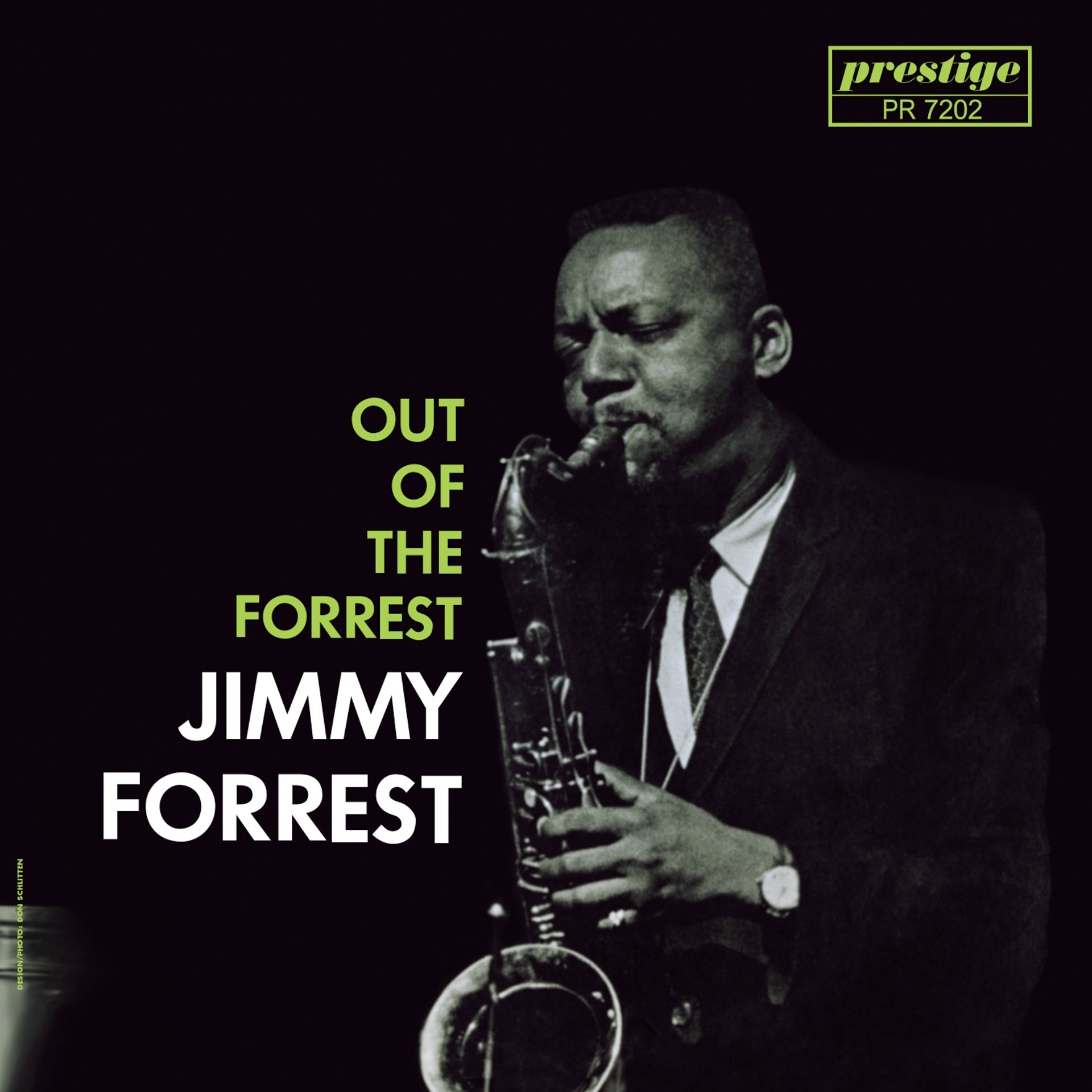
Jimmy Forrest is often introduced through “Night Train”. His recording became a number-one hit on the American R&B chart in 1952 and held the top position for seven weeks. A success of that scale can keep a name familiar for decades while also obscuring other aspects of a musician’s work. Out of the Forrest offers a chance to widen the view. Recorded for Prestige on 18 April 1961, it presents Forrest leading a quartet through original pieces and songs from several traditions. “Night Train” is not on this record. The album has a repertoire of its own and deserves attention beyond the memory of the famous hit.
Born in St. Louis in 1920, Forrest already had a substantial working history behind him. His earlier associations included Fate Marable and Jay McShann, followed by Andy Kirk and Duke Ellington. Those names represent different orchestral environments in which a tenor saxophone had to function both as an individual voice and as part of something larger. On Out of the Forrest it is the only horn. The move to a small ensemble is therefore more than a change in headcount. It also changes how directly a melody, rhythmic accent or pause relates to the three accompanying musicians.
The recording took place at Rudy Van Gelder’s studio in Englewood Cliffs. Esmond Edwards supervised the production; Joe Goldberg supplied the liner notes, and Don Schlitten handled design and photography. Prestige issued the album in 1961 as PRLP 7202. All eight tracks belong to a single session with the same personnel. This is not a later compilation intended to survey Forrest’s career. Its attraction lies in a particular meeting on a spring day, with a pianist from Austria and a rhythm section whose names deserve careful attention.

Zawinul, Potter and Johnston
Joe Zawinul plays acoustic piano here. Listeners who primarily associate him with later electric sound worlds encounter an earlier chapter of his work on this album. The label introduces him as a young Austrian pianist and describes the line-up as having come from Harry “Sweets” Edison’s combo. That provides useful context: musicians arriving at a recording session are not necessarily strangers assembled for the occasion. It should not, however, become an invented account of exactly what happened during the day. The personnel and instruments are documented; the nature of their musical relationship is something to explore through the record itself.
Tommy Potter on double bass and Clarence Johnston on drums complete the quartet. Potter also belongs to the history of Charlie Parker’s quintet in the 1940s. On this date, though, he is Forrest’s bassist rather than a representative of an earlier band. Johnston contributes to the repertoire as well: “Crash Program” is credited jointly to him and Forrest. His surname is Johnston; the shortened “Johnson” found in some listings should not obscure the identity of the musician involved. Even a small detail in a composer credit can change the way an accompanying player is perceived.
A useful listening question follows naturally from the instrumentation. How does Forrest carry a familiar tune, and how does Zawinul answer when the tenor leaves space? How do Potter and Johnston sustain movement without simply duplicating the melodic line? There is no need to invent supposedly heard moments to make those questions worthwhile. The quartet’s basic arrangement already offers plenty of starting points for attentive listening. In describing Forrest, the label makes occasional comparisons with Ben Webster. That is a comparison rather than an equation: Forrest’s biography and the selections on this record remain his own.

From “Bolo Blues” to “That’s All”
“Bolo Blues” opens the first side. Forrest had recorded the piece earlier; here it appears in the quartet performance made in 1961. “I Cried for You”, “I’ve Got a Right to Cry” and “This Can’t Be Love” follow. The selection thus moves between an original blues, older popular song, Joe Liggins’ R&B repertoire and Rodgers and Hart. Such neighbours tell us something about the permeability of this musical world. A jazz album does not have to make every source of its material identical in order to create a coherent programme from it.
The second side begins with “By the River Sainte Marie” and continues through Jerome Kern and Otto Harbach’s “Yesterdays” to “Crash Program”. Alan Brandt and Bob Haymes’ “That’s All” closes the record. Eight tracks, one group and two sides give the album a clear structure. The alternation between familiar song and original writing is easy to keep in view. The standards bring different histories from Forrest’s own compositions, but all encounter the same tenor voice and the same three partners. That continuity turns a list of recognised titles into an album by a particular leader.
With “Crash Program”, the shared composer credit is worth remembering. Johnston is more than a name at the end of the personnel list. This does not mean that, without further documentation, we can assign particular passages to one writer or the other. The established joint authorship is already enough to loosen the usual division between “leader” and “accompaniment”. In a similar way, Zawinul’s early acoustic-piano work offers a less familiar perspective on a well-known artist. Discoveries of this kind make the album especially appealing within an established jazz collection.
Forrest’s major hit remains a useful biographical starting point, but it is not the only standard by which his work should be measured. Approaching Out of the Forrest solely in search of another version of “Night Train” would miss the independence of this programme. The record provides another route into a musician whose career crossed big bands, R&B and the jazz quartet. Collectors have a double point of interest: a clearly documented Prestige album by the leader, and an early chapter in Zawinul’s career. Both stories meet in the same eight performances, without one needing to displace the other.
Analogue Productions, Prestige Stereo and this edition
The edition offered here is APRJ 7202, part of the Analogue Productions Prestige Stereo series. It presents the album on one stereo LP at 33⅓ rpm. Kevin Gray is credited with cutting, Quality Record Pressings with manufacture and Gary Salstrom with plating. The label describes the series as mastered from the analogue master tapes, with a tip-on jacket. The original eight-track sequence remains the reference point for this reissue. The recording session, subsequent mastering work and physical manufacture are distinct stages in the edition’s history.
The current label specification is 180 grams. An earlier numbered AP issue from 2016 is documented at 200 grams, while a later 2023 issue is listed at 180 grams. Without inspecting the individual stock copy, that history cannot establish its batch or promise a number on its jacket. A careful comparison should therefore consider the catalogue number and particular pressing, rather than transfer every feature of an older edition to the whole series. None of these manufacturing distinctions alters the original session information: 18 April 1961, Englewood Cliffs, with Forrest, Zawinul, Potter and Johnston.
Two continuous sides are well suited to an album whose interest comes from changing repertoire within a stable ensemble. A first listen can follow Forrest’s path through the songs; another can concentrate on the piano or rhythm section. The record needs no invented legend to earn attention. It offers a significant tenor player away from his best-known tune, a young Zawinul and two colleagues with their own part in the musical proceedings. That specific combination makes Out of the Forrest a rewarding addition to a Prestige collection and gives the album an identity beyond the stories usually told about its participants. You order from Michael 45 in Germany. We arrange the US import and dispatch from Hilden.
Customer question: Buying Analogue Productions records in Europe
Series: Analogue Productions Prestige – all 50 records, musicians and session paths
Musicians
Participants and documented credit status. Track references correspond to the tracklist.
- Jimmy Forresttenor saxophoneParticipation: Album personnel
- Joe ZawinulPortrait 2006pianoParticipation: Album personnel
- Tommy PotterPortrait 1947double bassParticipation: Album personnel
- Clarence JohnstondrumsParticipation: Album personnel


Recorded 18 April 1961, Englewood Cliffs. Rudy Van Gelder, engineer. Analogue Productions: Kevin Gray, cutting; QRP, pressing. Personnel on all tracks.

Reviews
There are no reviews yet.