
A recital as a musical calling card
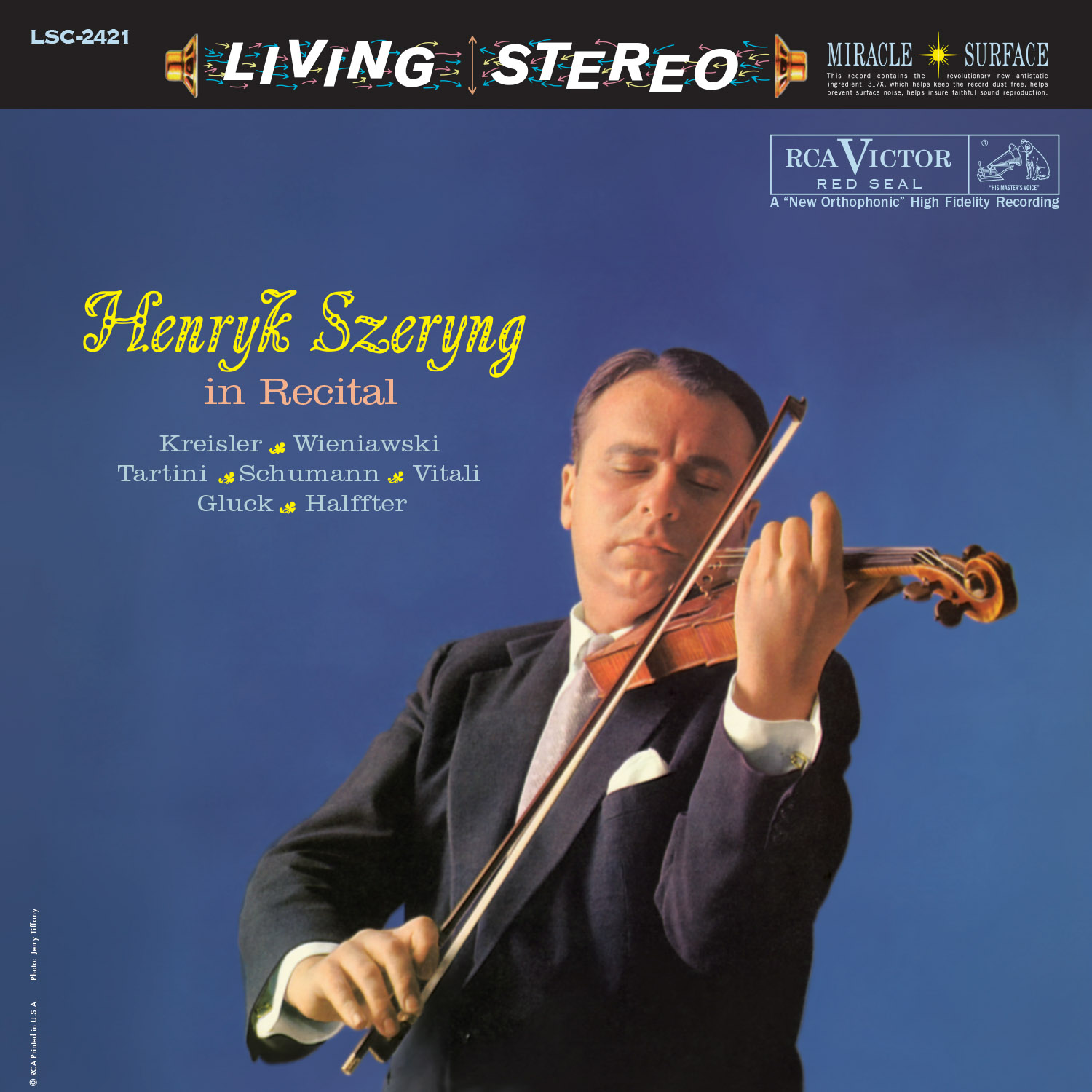
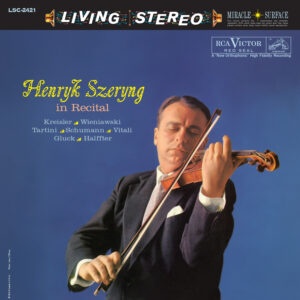
A great violinist cannot be understood through the major concertos alone. Sometimes eight pieces for violin and piano reveal just as much about a musician’s priorities: how a line unfolds, how a dance acquires momentum, or how a virtuoso gesture becomes part of a coherent argument. Henryk Szeryng in Recital, released by RCA Victor Red Seal in 1960 as LSC-2421, offers precisely that kind of encounter. Its programme moves from the Chaconne attributed to Vitali through Tartini and Gluck to Schumann, Halffter and Wieniawski. Charles Reiner is the pianist. Two musicians carry a remarkably varied programme without an orchestra around them.
Szeryng brought several traditions to this repertoire. His studies with Carl Flesch in Berlin and Jacques Thibaud in Paris belong to a biography that crosses national schools. Born in Poland, he subsequently made Mexico a second home. For this record, however, a catalogue of biographical milestones matters less than the relationship between discipline and expression demanded by the music. A sustained phrase needs the same sense of purpose as a rapid change of figuration. A short character piece must hold its own rather than serve merely as a breathing space between more obviously demanding works.
The selection also represents a particular understanding of the classical recital. Earlier compositions and later arrangements stand alongside one another without erasing their different histories. Kreisler, Francescatti and Heifetz appear as arrangers. Their names evoke a violin culture that continually brought existing music into a new instrumental setting. To approach this programme as a collection of unaltered Baroque originals would miss an essential part of its character. It also concerns the ways successive generations of violinists passed musical ideas onwards, reshaped their outlines and contributed their own understanding of sound and gesture.
The original RCA release is dated 1960. An exact recording date and a securely established venue are not available in the documentation for this edition. That does not prevent a meaningful discussion of the music: the players, programme and release are documented. It does prevent turning a familiar Living Stereo presentation into an invented account of a particular day in a particular studio.

Charles Reiner and the art of breathing together
The pianist is Charles Reiner, not conductor Fritz Reiner, whose name appears on many other RCA Living Stereo recordings. In a recital, this distinction is more than a footnote. The piano establishes harmonic space, gives direction to transitions and helps determine how freely the violin can unfold a melody. Szeryng is not playing in front of a neutral background. The musical proportions emerge between two people whose parts continually affect one another.
The first side contains two extended works: the Chaconne in G minor and Tartini’s Devil’s Trill Sonata in Fritz Kreisler’s arrangement. Rather than opening with a sequence of brief encores, the record allows room for sustained development. In a chaconne, the relationship between recurrence and change offers a rewarding listening thread. Harmonic continuity provides orientation while the violin transforms its contribution. Tension depends on more than mounting technical difficulty; each new turn gains meaning from its relationship to what has already been established.
Tartini’s sonata introduces a different narrative scale. Its familiar nickname naturally draws attention to virtuosity. Yet trills, runs and double stopping become expressive only when they belong to an intelligible line. One useful approach is therefore to follow a phrase beyond its conspicuous technical features. Where does Reiner’s piano prepare an entrance? How does the weight of a cadence change? How does a melody remain legible as the violin writing becomes more active? These questions connect instrumental accomplishment with the shape of the piece rather than treating the two as separate attractions.
Both longer works occupy a continuous first side on this 33⅓ RPM LP. That arrangement suits the programme: a larger musical span can develop before turning the record introduces a different scale of listening. The speed itself is not a blanket verdict on sound quality. Here it has a specific practical advantage, preserving the original two-sided architecture and allowing each part of the recital to establish its own identity.

Six miniatures with a character of their own
The second side changes the time scale. Tartini’s Variations on a Theme by Corelli, in Zino Francescatti’s arrangement, begin a sequence of shorter works. A variation can establish a fresh perspective through a small alteration of articulation or direction. Listening for relationships between sections can therefore be more revealing than treating the music as a succession of new tricks. This compactness calls for a different form of concentration from the broad spans on the opening side.
Gluck’s Mélodie from Orfeo, arranged by Kreisler, places the violin’s capacity to sing at the centre. Kreisler’s own Allegretto in the Style of Boccherini follows. Its title explicitly describes a stylistic evocation; it does not make the piece a composition by Boccherini. Such distinctions are part of the pleasure of a thoughtfully assembled recital. They show how recollection of an earlier musical language can coexist with personal invention. The programme tells a history of music through the practical activities of playing, adapting and responding.
Schumann’s The Prophetic Bird appears in an arrangement by Jascha Heifetz. Halffter’s Danza de la gitana also carries Heifetz’s name as arranger. Together they suggest how differently the violin can define character: through questioning lines and brief gestures as well as through dance movement. There is no need to attach an invented story to either piece. The relationships between melody, accent and the piano’s responses already provide ample material for attention. Wieniawski’s Scherzo-Tarantelle, Op. 16 closes the programme, bringing virtuosity explicitly back into the foreground.
For a record collection, this combination has a particular appeal. It complements a violinist’s major concerto recordings with a more personal view of repertoire, while reminding us that a short piece deserves shaping as careful as that of an extended movement. The second side is consequently no appendix. It contributes to the album’s central proposition: different scales of form demand the same care for musical continuity. The sequence also rewards listening from beginning to end, because a miniature’s effect changes according to the character that precedes it.
The Analogue Productions edition
This edition carries catalogue number AAPC 2421 and belongs to the second Analogue Productions RCA Living Stereo reissue series. It comprises one stereo LP playing at 33⅓ RPM. Ryan K. Smith at Sterling Sound remastered it from the original three-track master tapes. Quality Record Pressings is the stated pressing plant, with Gary Salstrom credited for plating. John Pfeiffer and John Crawford are documented respectively as producer and recording engineer for the original recording. Those contributions belong to different stages of the recording and reissue history and should not be confused.
The current manufacturer specification lists 180-gram vinyl, whereas the documented early AP edition from 2018 was listed at 200 grams. This is a distinction between editions, not a reason to promise the weight of an uninspected copy. The presentation includes a carefully made tip-on jacket in the classic RCA tradition. The reference to three-track tapes identifies the remastering source; the record offered here is stereo, not a three-channel playback format.
For Living Stereo collectors, the album offers a different perspective from the large orchestral productions. Two instruments bring individual notes, transitions and coordinated entries into focus. The interesting question concerns not simply the impressive reproduction of a violin, but how clearly the musical relationship between violin and piano can be followed. This record invites attention to Szeryng’s choice and organisation of repertoire as well as to the distinguished name on its cover.
You order from Michael 45 in Germany. We arrange the US import and dispatch from Hilden.
Customer question: Buying Analogue Productions records in Europe
Musicians
Participants and documented credit status. Track references correspond to the tracklist.
- Henryk SzeryngPortrait: portrait reference 1964violinParticipation: All tracks
- Charles ReinerpianoParticipation: All tracks
- John PfeifferproductionParticipation: All tracks
- John Crawfordrecording engineerParticipation: All tracks

Charles Reiner is the pianist, not conductor Fritz Reiner. Recording date and venue are unconfirmed. John Pfeiffer and John Crawford are production credits.

Reviews
There are no reviews yet.