



A new voice in New York, 1954

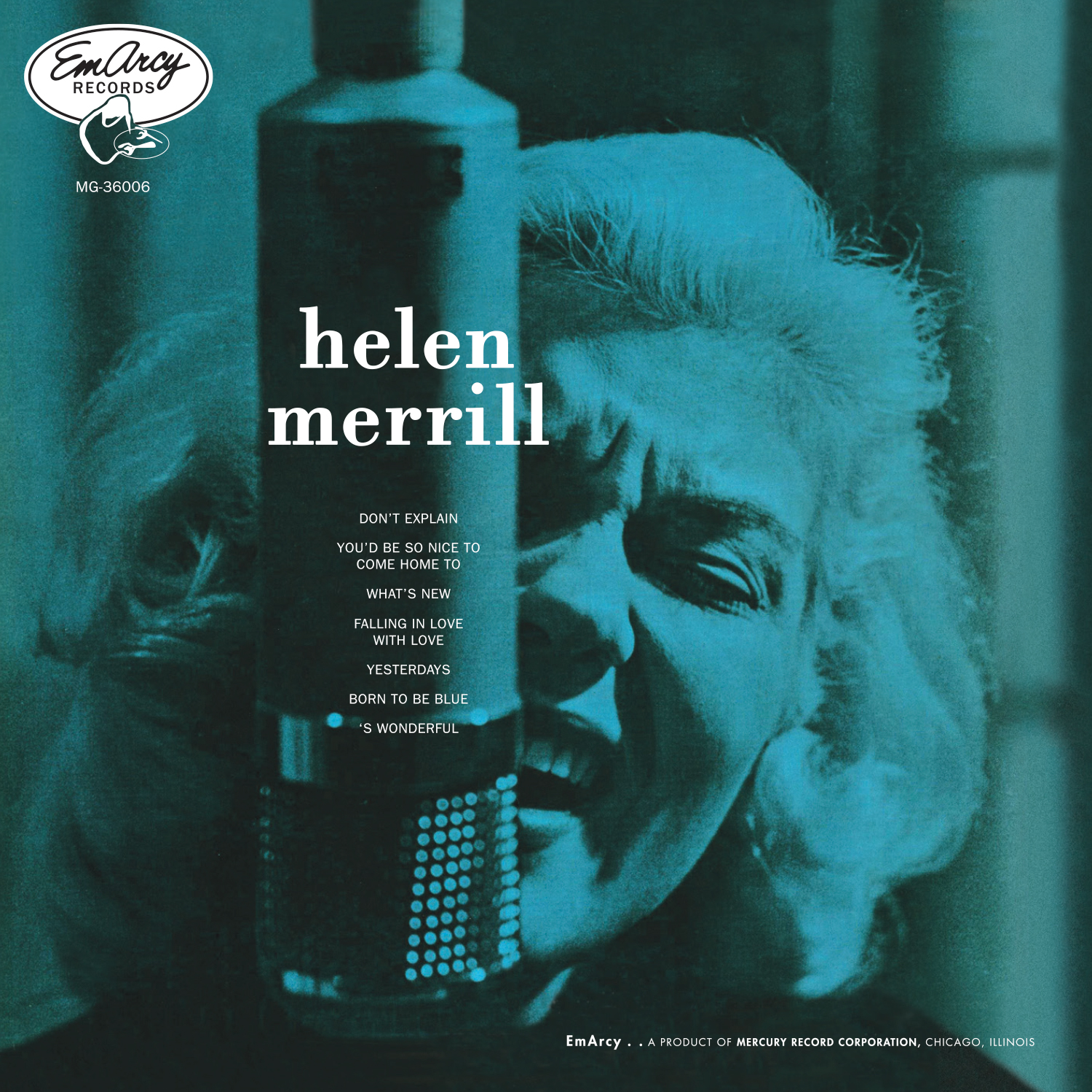
Helen Merrill’s first album bears only her name. That simplicity suits a recording whose attraction grows from a particular meeting: Merrill singing, Clifford Brown playing trumpet and the young Quincy Jones arranging and directing. On 22 and 24 December 1954, they assembled with a small studio group at Fine Sound in New York. EmArcy released the seven performances in 1955 as MG-36006. For Merrill it was her debut LP under her own name; for collectors today it also marks an important intersection of several careers.
Merrill was born Jelena Ana Milčetić in New York to Croatian parents. Her musical history began well before the EmArcy sessions. She was singing in Bronx clubs during the 1940s, and in 1952 recorded “A Cigarette for Company” with Earl Hines. The debut therefore did not arrive without a background. It gathered the experience of a singer who had already found her way through New York’s musical life into a clearly defined album. Seven songs provided the framework in which that identity could emerge.
The connection with Brown is especially valuable. He died in 1956, and these early encounters belong to a compact, remarkably concentrated body of work. Knowledge of his short life need not turn the record solely into a retrospective memorial, however. In December 1954, these musicians were making a new album. The present tense of that encounter matters: a singer with her own expression, a young trumpeter and arrangements that bring them together inside an ensemble. Merrill returned to Brown’s memory decades later with Brownie: Homage to Clifford Brown.

Quincy Jones and two rhythm sections
Quincy Jones was 21 when these sessions took place. His responsibilities were arrangement and musical direction. The shared core of the ensemble includes Merrill and Brown, Danny Bank on flute and baritone saxophone, Jimmy Jones on piano and Barry Galbraith on guitar. This instrumentation offers several ways of framing a vocal line: woodwind colours, piano chords, guitar texture and the trumpet’s independent voice. Pianist Jimmy Jones and arranger Quincy Jones are, of course, different musicians, each with his own role in the record.
Bass and drums change between the two dates. On 22 December, Milt Hinton and Osie Johnson played on “Don’t Explain”, “You’d Be So Nice to Come Home To”, “(I Was) Born to Be Blue” and “’S Wonderful”. On 24 December, Oscar Pettiford and Bobby Donaldson took over for “What’s New?”, “Falling in Love with Love” and “Yesterdays”. This allocation is more than a discographical footnote. It shows that the finished album is a constructed sequence drawn from two sessions, rather than the uninterrupted order of a single day in the studio.
Listeners interested in the accompanists can therefore also approach the songs through these two groups. How do bass and drums support the movement of a song? How does the guitar relate to the piano, and how does attention return to Merrill? Such questions give the names a purpose beyond their familiarity. An album featuring Clifford Brown is also an album shaped by Galbraith, Bank, Jimmy Jones and two specifically identified rhythm sections. Their contributions belong to its character as surely as those of the featured voices.
The engineer was Bob Fine, working at Fine Sound, 711 Fifth Avenue. The record thus belongs to a different studio history from the many Prestige and Blue Note sessions associated with Rudy Van Gelder. Brown had participated in Sarah Vaughan’s EmArcy recording at the same studio a few days earlier. Proximity in time and place connects these albums without making them a single session. They can complement one another in a collection precisely because each singer creates a separate centre of attention.

Seven songs, several points of view
“Don’t Explain”, written by Billie Holiday and Arthur Herzog Jr., opens the programme. Beginning with a song strongly associated with another singer introduces an engaging tension: the material already carries a history, and Merrill brings her own performance to it. Cole Porter’s “You’d Be So Nice to Come Home To” follows. Side one continues with Bob Haggart and Johnny Burke’s “What’s New?” and Richard Rodgers and Lorenz Hart’s “Falling in Love with Love”. Four songs supply four distinct melodic and lyrical starting points.
Side two begins with Jerome Kern and Otto Harbach’s “Yesterdays”. “(I Was) Born to Be Blue”, written by Mel Tormé and Bob Wells, leads to George and Ira Gershwin’s “’S Wonderful”. The closer is the final step in a seven-song programme, rather than an appended bonus. With familiar standards, sequence can be particularly meaningful: memories, moods and melodic shapes meet in an order different from the one a miscellaneous compilation might provide. Following that order is one way of encountering the album on its own terms.
Merrill’s voice and Brown’s trumpet invite consideration of the relationship between singing and wind instruments. Both organise a line through breath; both can give a brief phrase significance. Yet they communicate differently. The singer has words, while the trumpeter shapes an instrumental statement. Listening to the relationship between those forms of expression can offer more than approaching the record solely as a gathering of celebrated names. Jones’ arrangements establish the setting in which those voices meet and remain part of an ensemble.
The debut also provides a useful starting point for Merrill’s later work. Dream of You, made with Gil Evans, followed in 1956. Moving between such albums allows a listener to consider how a singer finds her place in different arranged environments. The first record need not be declared an unsurpassable endpoint to matter. Its importance already lies in the specificity of this encounter: New York in December 1954, seven songs, and a group of musicians whose individual contributions deserve attention.
The Analogue Productions mono edition
AAPJ 127 presents the album on one 180-gram LP at 33⅓ RPM in mono. Kevin Gray cut it at Cohearent Audio from the original master, with pressing by Quality Record Pressings and plating credited to Gary Salstrom. The edition comes in a Stoughton tip-on gatefold containing session photographs, with an accompanying contribution by Robert Fine, the original engineer’s son. This material offers a wider view of the recording’s creation while leaving the original performances themselves intact.
Mono is the channel format of the product offered here. It directs attention to the balance between voice and ensemble within a single sound image. The point is to preserve the documented form of the recording rather than retrospectively ascribe a wider stage to it. The seven tracks also remain in their album sequence. Two LP sides provide a manageable musical arc, suitable both for a first introduction and for returning to details that become more apparent with familiarity.
For a vocal-jazz collection, the record brings together three attractive perspectives: Merrill’s debut, Brown’s work with a singer and Quincy Jones’ early arranging. None needs to displace the others. Their combination creates the character of this particular album, while the carefully identified accompanying musicians complete the picture. You order from Michael 45 in Germany. We arrange the US import and dispatch from Hilden.
Customer question: Buying Analogue Productions records in Europe
Musicians
Participants and documented credit status. Track references correspond to the tracklist.
- Helen MerrillPortrait 1956vocalsParticipation: All tracks
- Clifford BrowntrumpetParticipation: All tracks
- Quincy JonesPortrait 1959arrangements, conductingParticipation: All tracks
- Danny Bankflute, baritone saxophoneParticipation: All tracks
- Jimmy JonespianoParticipation: All tracks
- Barry GalbraithPortrait 1947guitarParticipation: All tracks
- Milt HintonPortrait 1965double bassParticipation: A1, A2, B2, B3
- Osie JohnsondrumsParticipation: A1, A2, B2, B3
- Oscar PettifordPortrait 1946double bassParticipation: A3, A4, B1
- Bobby DonaldsondrumsParticipation: A3, A4, B1


22 December 1954: A1, A2, B2, B3 (Hinton/Johnson). 24 December: A3, A4, B1 (Pettiford/Donaldson). Fine Sound, New York; Bob Fine, engineer. Quincy Jones: arrangements and conducting. Danny Bank’s instrument changes are not established track by track.

Reviews
There are no reviews yet.