
Before The Fox became a Contemporary record
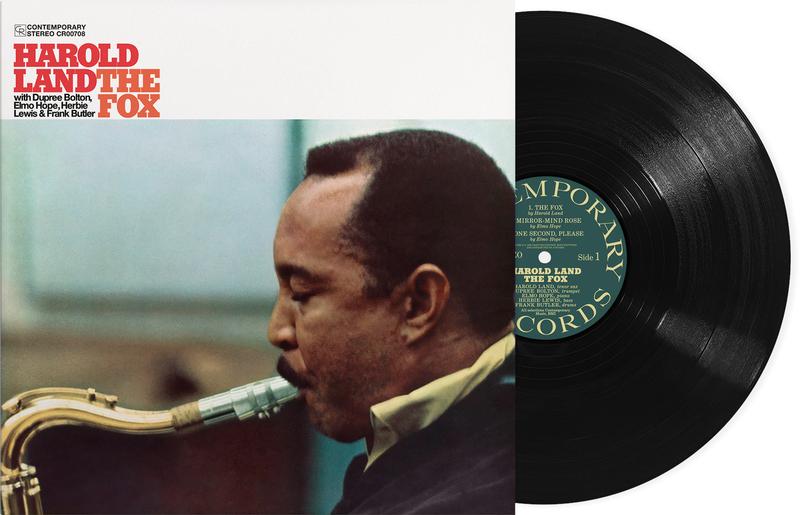
The Fox now seems firmly established within Harold Land's Contemporary discography. Its beginnings, however, lie with HiFi Jazz, another Los Angeles label. The quintet recorded in August 1959 at Radio Recorders' Studio B, and HiFi first released the album in 1960. Contemporary did not bring it into its catalogue until 1969. Behind the familiar later sleeve lies a production that began outside Lester Koenig's own recording operation. Those two stages are essential to understanding the edition's history.
David Axelrod produced the session, which is identified as his first album project. Land played tenor saxophone, Dupree Bolton trumpet, Elmo Hope piano, Herbie Lewis bass and Frank Butler drums. Lewis was only eighteen, the youngest member of the group. Land, Hope and Butler already had connections through earlier work, while Bolton was still little known. The ensemble therefore combined established musical relationships with a trumpeter whose background was largely obscure to the people writing about him at the time.

Elmo Hope supplies four of the six compositions
Hope had moved from New York to Los Angeles in 1957. A childhood friend of Bud Powell and an associate of Thelonious Monk, he worked on the West Coast with musicians including Land and Curtis Counce. His importance to The Fox is immediately apparent from the writing credits. “Mirror-Mind Rose”, “One Second, Please”, “Sims A-Plenty” and “One Down” are his compositions. Land added the title track and “Little Chris”. There are no standards anywhere in the six-piece programme.
Hope is consequently both pianist and the principal supplier of the material. His accompaniment can be followed as the work of a musician who designed much of the music's underlying architecture himself. Land's title piece opens the record and Hope's “One Down” closes it. Their compositions are distributed across the sides rather than separated into individual showcases. The sequence gives both writers a presence within a sustained quintet encounter, with each tune asking the same five musicians to negotiate a different set of ideas.

Looking beyond the mystery of Dupree Bolton
Bolton attracted attention soon after the session, yet contemporary accounts knew remarkably little about where he had come from. His reputation as a mysterious trumpeter lasted for years. Much later, jazz historian Ted Gioia met and interviewed him, allowing a more concrete life story to emerge. It included early musical work, addiction and long periods in prison. The gaps in earlier reporting were consequences of difficult circumstances, rather than an inexplicable quality belonging to the music itself.
On the album, Bolton's immediate role is clear: he stands beside Land in the front line and plays Hope's demanding material. Butler connects the group with further recordings around Curtis Counce, while Hope also recorded a trio album for HiFi during the same year. Listen to the exchanges between the two horns and the piano. That approach keeps the quintet's shared work in view, instead of reducing the entire record to the extraordinary and often incompletely told biography of a single participant.
A reissue with two historical stages
ACONC 708 is a single 180-gram LP in Craft's Contemporary Records Acoustic Sounds Series. Bernie Grundman cut the lacquers and Quality Record Pressings manufactured the vinyl. Craft describes an AAA cut from the original analogue tapes, with the edition housed in a tip-on jacket. All six album tracks are present. “One Down” is the closing selection, following “Little Chris”, a useful distinction when comparing incomplete or inaccurate older tracklists with the actual programme.
There is a specific limit to the source information. The sleeve refers to remastering at Contemporary in 1969, but the historical tape used for Grundman's present cut is not identified beyond the manufacturer's general wording. It cannot securely be assigned to one of those two stages. The original session also belongs to Radio Recorders, so a routine Contemporary recording credit for Roy DuNann would be inappropriate here. The album has its own studio history, and that history helps explain its distinctive place within the current series.
You order from Michael 45 in Germany. We arrange the US import and dispatch from Hilden.
Series: Contemporary – all 24 records: sunny jazz from Los Angeles
Musicians
Personnel for this album version are documented. Track-specific participation is shown in the final column.
| Name | Instrument / role | Participation |
|---|---|---|
| Harold Land | tenor saxophone, bandleader | Album personnel |
| Dupree Bolton | trumpet | Album personnel |
| Elmo Hope | piano | Album personnel |
| Herbie Lewis | bass | Album personnel |
| Frank Butler | drums | Album personnel |



Reviews
There are no reviews yet.