An England made from voices, images and music
A solitary voice opens Selling England by the Pound before the music of Dancing with the Moonlit Knight gradually unfolds. The entrance leads into an album connecting large structures with small observations. In 1973, Genesis imagined an England suspended between inherited images and the modern world of commerce. The music does not provide one continuous backdrop for that idea. Voice, piano, flute, guitars and changing keyboard colours each open another perspective. Its underlying coherence becomes apparent through that variety.
Peter Gabriel, Tony Banks, Steve Hackett, Mike Rutherford and Phil Collins formed the line-up. Following the Foxtrot tour, the band developed new songs and entered Island Studios in London in August 1973. John Burns produced with Genesis, assisted by Rhett Davies. Their fifth studio album appeared in October. It reached number three in Britain, while I Know What I Like (In Your Wardrobe) brought a shorter song from this expansive programme to a wider audience.
One of the record’s strengths is its connection between different scales. More Fool Me needs a voice and acoustic accompaniment; The Battle of Epping Forest unfolds a densely populated narrative. After the Ordeal dispenses with singing, while Gabriel’s characters and verbal images determine the course elsewhere. A first encounter need not depend on deciphering every reference. The individual instrumental voices and the changes between concentrated songs and longer developments provide plenty of orientation in themselves.

Five personalities and changing roles
The instrumental responsibilities extend well beyond fixed job descriptions. Gabriel is credited with vocals, flute, oboe and percussion. Banks plays keyboards and twelve-string guitar, Hackett electric and nylon-string guitars. Rutherford contributes bass, twelve-string and electric sitar, while Collins supplies drums, percussion and vocals. The sleeve thus describes a group whose members can change responsibilities when a piece calls for another colour. Those album credits do not imply that every instrument appears on every track.
More Fool Me offers a particularly clear example. Collins sings, accompanied by Rutherford’s twelve-string guitar. Its smaller scale creates a different intimacy from the densely worked ensemble pieces. In the longer compositions, the instrumentation expands the range considerably: Hammond organ, Mellotron, Pianet, piano and ARP Pro Soloist belong to Banks’ keyboard palette during this period. Their effect depends on more than a recognisable sound. Moving a theme between instruments can alter its character and change the listener’s relationship to it.
Hackett’s contributions also deserve attention beyond the celebrated solo. Nylon-string guitar gives After the Ordeal its particular surface, while electric guitar shapes an extended melodic line in Firth of Fifth. Flute is another voice within that piece’s development. Attentive listening can follow a musical idea through different instrumental identities. The instruments do more than support the singing: they carry parts of the narrative themselves and help shape the passages between sections.

From the piano introduction to the return of the opening
Firth of Fifth starts with Banks at the piano before opening into one of the album’s major musical arcs. The band’s arrival can be heard as a change of perspective on the material as well as an increase in volume. The later guitar solo works within that development, rather than as an isolated display. The Cinema Show likewise gains much from its extended preparation. The acoustic character of its first part leads towards an active instrumental section, with Banks’ ARP Pro Soloist emerging over Rutherford and Collins. The 7/8 pulse carries the music forward without reducing it to an exercise in counting.
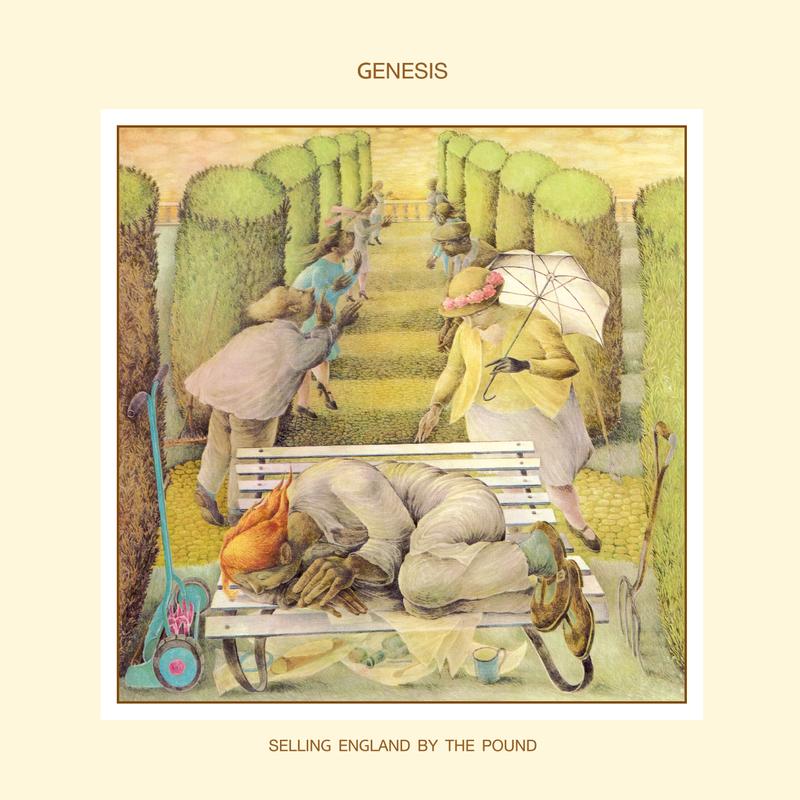
I Know What I Like has a different and immediately recognisable form. Gabriel’s talking drum is one of its documented instrumental colours. The image of an everyday, idiosyncratic character connects with the cover: a lawnmower was added to Betty Swanwick’s painting The Dream for the sleeve. The visual design and songs touch one another without turning the whole album into a simple musical explanation of a single picture.
Aisle of Plenty returns to material from the opening at the end. Everyday commerce enters a language that has also drawn on historical and fantastic imagery. That return gives the long sequence a frame. For collectors and music lovers, the overall shape therefore remains significant alongside the famous individual pieces. Smaller songs, instrumental transitions and extended developments give one another meaning. Each return can bring another connection into focus while the music retains its narrative appeal.
The Hybrid Stereo SACD: Chris Bellman at Bernie Grundman Mastering
The edition offered here is Analogue Productions CAPA 002 SA, part of the Atlantic 75 Series. It contains the eight original tracks on a Hybrid Stereo SACD. The CD layer can be played on conventional CD equipment, while SACD-compatible players access the DSD layer. The Cinema Show and Aisle of Plenty have separate track markers. No bonus material is included. This release should be distinguished from the earlier Virgin SACDs associated with stereo and multichannel remixes.
The back cover identifies Chris Bellman at Bernie Grundman Mastering as the mastering engineer. Its printed source statement describes a direct transfer from the original analogue tape to DSD. That credit identifies the responsible engineer more precisely than the differing short statement on the publisher’s website. The studio’s name is therefore kept distinct from the name of the person doing the mastering. No particular DSD rate or converter is specified.
The disc is supplied in a Super Jewel Box. Questions about reused Classic Records lacquers, four 45 RPM sides or an LP pressing plant belong to the separate vinyl release. This SACD has its own digital transfer path and allows the lengthy album sequence to unfold without side changes. It provides a clearly identified way to experience Genesis’ interplay of song, instrumental music and storytelling as a whole. You order from Michael 45 in Germany. We arrange the US import and dispatch from Hilden.
Also in another edition: Selling England By The Pound
More by Genesis: Wind & Wuthering · A Trick Of The Tail
Artist page: All titles by Genesis and Phil Collins
Customer question: Buying Analogue Productions records in Europe
Musicians
Participants and documented credit status. Track references correspond to the tracklist.
- Peter Gabrielvocals (1, 2, 3, 5, 7, 8); flute; oboe (7); percussion; talking drum (2)Participation: Album personnel; no vocals on tracks 4 and 6
- Tony Bankskeyboards (Hammond, Mellotron, Hohner Pianet, ARP Pro Soloist, piano); twelve-string guitar (7); ARP Pro Soloist (solo) (7)Participation: All except track 4
- Steve Hackettelectric guitar; nylon-string guitar (6)Participation: All except track 4
- Mike Rutherfordtwelve-string guitar (4, 7); bass; electric sitarParticipation: Album personnel
- Phil Collinsdrums, percussion; vocals; lead vocals (4)Participation: Album personnel


Album credits do not mean that every instrument appears on every track. Documented track assignments are given beside the relevant roles; further assignments remain unconfirmed.

Roy Brezinski –
This one sounds wonderful. I own a few original pressings and the Classic Records reissue. The Classic Records was the best sounding one, but the Analogue Productions version is even better. Wonderful imaging. It sounds extremely clear, it’s like the band is playing the songs in my listening room.
Equipment:
Transrotor Fat Bob + JR/SME 3500 tonearm + Audio Technica OC9XML
Thorens TD147 + Linn Basik LVX tonearm + Audio Technica OC9XML
Ayre P5XE phono preamps
Ayre K3x preamp
SPL Active Crossover
2x Aragon 4004 power amps
Magnepan Tympani IV bass panels + modified Magnepan MG12 as hi/mid panels.