
A tenor that needs no second horn
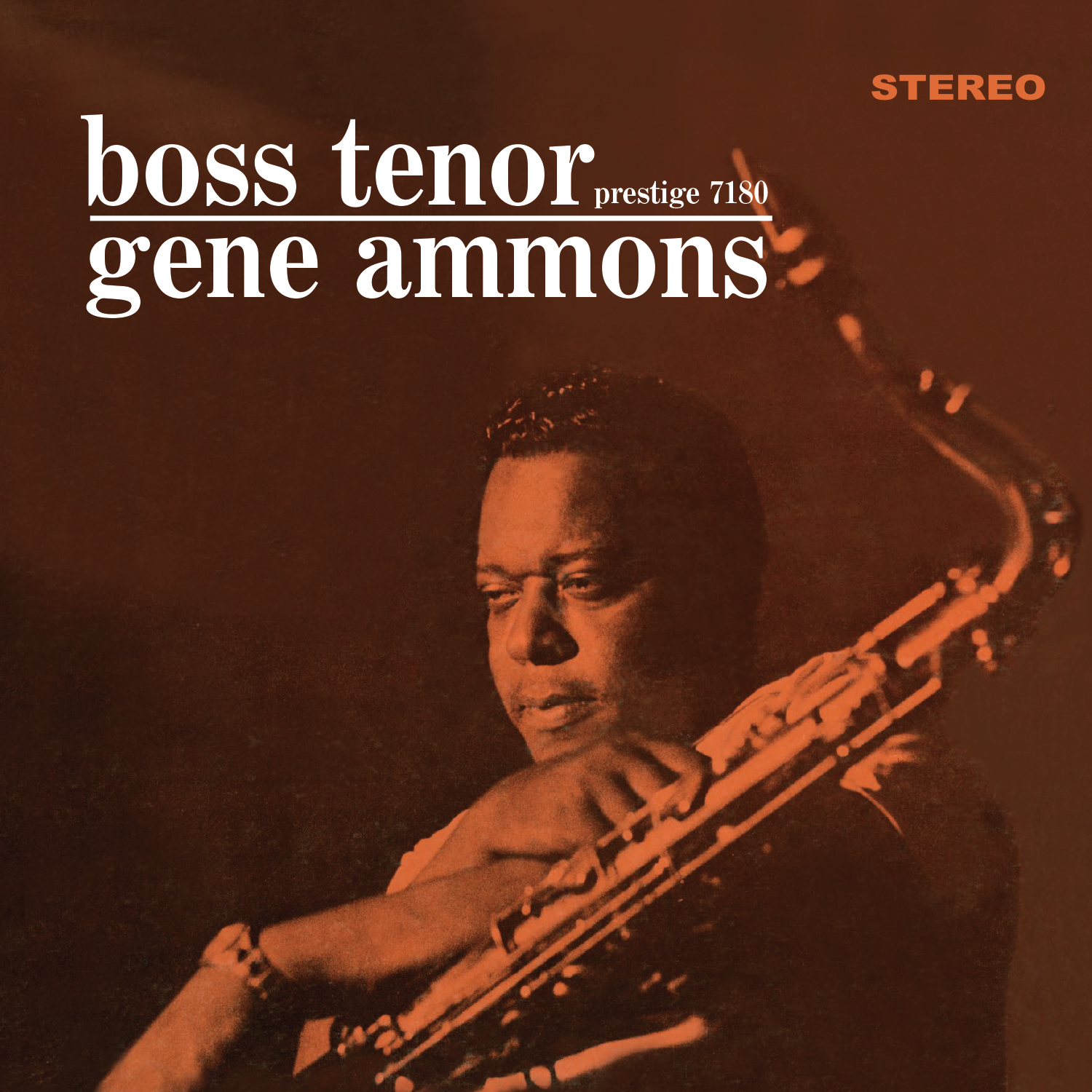
The title Boss Tenor is confident, but it also identifies something very specific: Gene Ammons is the only horn player on this record. Around his tenor saxophone are Tommy Flanagan’s piano, Doug Watkins’ double bass, Art Taylor’s drums and Ray Barretto’s congas. That line-up establishes the album’s setting. It needs neither a second saxophone as a sparring partner nor a larger horn section to sustain a varied programme. Ammons can move between blues, ballad, swing standard and bebop while his four companions offer different ways of supporting and answering his melodic voice. The musical possibilities begin with those relationships.
The five musicians recorded the album on 16 June 1960 at Rudy Van Gelder’s studio in Englewood Cliffs. Prestige released it as PRLP 7180. It belongs to the period in which Ammons resumed work after his first imprisonment, although that does not justify calling it his very first session following release. The established context is sufficient: a new chapter in 1960, involving a musician already closely associated with Prestige. His relationship with the label had begun in 1950 and would accompany a large part of his career. This record occupies a specific place within that longer connection.
The original notes were written by LeRoi Jones, later known as Amiri Baraka. That detail alone suggests that Boss Tenor need not be approached simply as a collection of agreeable tunes. It belongs to a jazz history in which musical identity, expression and social perception were closely connected. At the same time, the record does not demand theoretical preparation from its listener. Familiar melodies and recognisable forms provide an accessible way in, while the varied origins of the repertoire leave plenty of connections to discover through repeated attention. The programme can be welcoming without being narrow.

Four partners with distinct responsibilities
Tommy Flanagan brings a piano voice with both harmonic and melodic importance to this ensemble. Beside a single horn, it can accompany a statement, create a contrast or take the foreground itself. Doug Watkins and Art Taylor establish the bass-and-drums relationship, with Ray Barretto adding congas. All five musicians are credited across all seven tracks. This provides a clear starting point: unlike an album assembled from several sessions, it does not require the listener to distinguish changing line-ups. The variety is generated within a constant ensemble, whose members can be followed from one piece to the next.
Barretto makes the configuration especially noteworthy. Congas are not simply another version of a drum kit; they are a separate instrument played in a different way. Alongside Taylor’s set, they create the possibility of distributing rhythmic responsibilities rather than merely doubling them. Following those two layers separately, then considering them again as a shared texture, can be a rewarding listening approach. Where does the sense of direction come from the kit, where from the hand drums, and where from the bass? Such questions focus attention on a rhythm section as an interaction. Barretto’s contribution therefore deserves a visible place beside the others.
The absence of another horn also changes the perspective. Ammons’ tenor is not part of a continuously harmonised frontline. It can represent a melody on its own while piano and rhythm section shape the surrounding space. That does not predetermine every musical event, but it offers a useful way into the album. Listeners familiar with Ammons’ encounters with other tenor saxophonists will find a different setting here. The attraction is less a comparison between two horn personalities than the relationship of a single voice with four partners able to give it flexibility, definition and a range of musical surroundings.

From personal blues to Parker and the Savoy
Hittin’ the Jug opens the first side with a performance lasting more than eight minutes. Its title refers to Ammons’ nickname, “Jug”, and the piece is one of his own compositions. Bernice Petkere’s Close Your Eyes and Richard Rodgers and Lorenz Hart’s My Romance follow. The first side therefore already moves between a personal blues identity and the American song repertoire. The distinction is more than a matter of songwriting credits. Different kinds of melody and form offer a tenor saxophonist different starting points without requiring a change of personnel. The ensemble remains the common reference throughout.
Side B begins with Eddie Heywood and Norman Gimbel’s Canadian Sunset. Ammons’ Blue Ammons, Charlie Parker’s Confirmation and the piece listed as Savoy, or Stompin’ at the Savoy, complete the programme. The latter connects the record to swing, with Benny Goodman, Edgar Sampson, Chick Webb and Andy Razaf among its writers. Confirmation, by contrast, brings Parker’s bebop repertoire into view. Their proximity is an essential part of the album. Ammons does not have to choose between blues, popular song and a demanding jazz standard. He brings them into one programme, held together by a consistent instrumental personality.
These seven pieces consequently represent more than a single stylistic colour. Filing the record exclusively as “soul jazz” or as a “ballad album” would overlook part of its content. It is more useful to consider the selection as a spectrum: original compositions, songs, a bebop classic and a swing standard, connected by the same tenor player and the same companions. Canadian Sunset and Hittin’ the Jug were also paired on singles, and individual performances later entered compilations. The original LP preserves their relationships within this seven-part sequence. That gives collectors a reason to value it as an album, rather than only as a source of familiar tracks.
The Prestige Stereo edition at 33⅓ RPM
Analogue Productions lists the reissue as APRJ 7180 in its Prestige Stereo series. The album remains together on one LP playing at 33⅓ RPM, with three pieces on the first side and four on the second. This compact form supports the movement between areas of repertoire without subdividing the experience across additional records. Because the personnel remains constant, the group’s identity can be followed through several pieces in succession. The side change before Canadian Sunset provides a natural break; the subsequent sequence leads through Ammons and Parker to the closing swing standard. The format preserves that clear and satisfying organisation.
Kevin Gray mastered the edition at Cohearent Audio from the analogue masters, and Quality Record Pressings manufactures the LP. Gary Salstrom is credited for plating. The presentation includes a traditional tip-on jacket. The current manufacturer description specifies 180-gram vinyl. Earlier 200-gram versions and numbered copies from the original subscriber edition are documented, but are not promised indiscriminately for a current stock copy. The catalogue number, stereo presentation and single-LP configuration identify the edition described here. Historical variations remain part of its publishing history rather than an automatic assurance about the particular copy a customer will receive.
Boss Tenor is especially appealing to listeners seeking Ammons’ musical personality in a clearly defined yet versatile setting. The sole horn player occupies the centre, but the quality of the configuration also lies in Flanagan, Watkins, Taylor and Barretto. Their names belong to the story of every piece. The record brings several jazz traditions together while retaining the identity of its ensemble. For a considered collection, that combination of repertoire breadth and continuity of personnel offers an enduring reason to return to it. You order from Michael 45 in Germany. We arrange the US import and dispatch from Hilden.
More by Gene Ammons: Nice An’ Cool · The Soulful Moods Of Gene Ammons
Customer question: Buying Analogue Productions records in Europe
Series: Analogue Productions Prestige – all 50 records, musicians and session paths
Musicians
Participants and documented credit status. Track references correspond to the tracklist.
- Gene AmmonsPortrait 1971tenor saxophoneParticipation: All tracks
- Tommy FlanaganPortrait 1957pianoParticipation: All tracks
- Doug Watkinsdouble bassParticipation: All tracks
- Art TaylorPortrait 1957drumsParticipation: All tracks
- Ray BarrettoPortrait later referencecongaParticipation: All tracks


16 June 1960, Van Gelder Studio, Englewood Cliffs. Rudy Van Gelder: engineer; LeRoi Jones (later Amiri Baraka): liner notes. All five musicians on all seven tracks; Ammons is the only horn player.

Reviews
There are no reviews yet.