



Rome as a changing orchestral image
Ottorino Respighi's Pines of Rome and Fountains of Rome approach the same city from different perspectives. The pines stand above children's games, catacombs, a nocturnal landscape and an ancient road; the fountains are associated with particular times of day. These are not musical guidebooks. Respighi uses places as starting points for movement, memory and light. A group of trees or a fountain becomes a musical situation whose scale can change, from a single call through a suspended texture to the resources of a large orchestra.
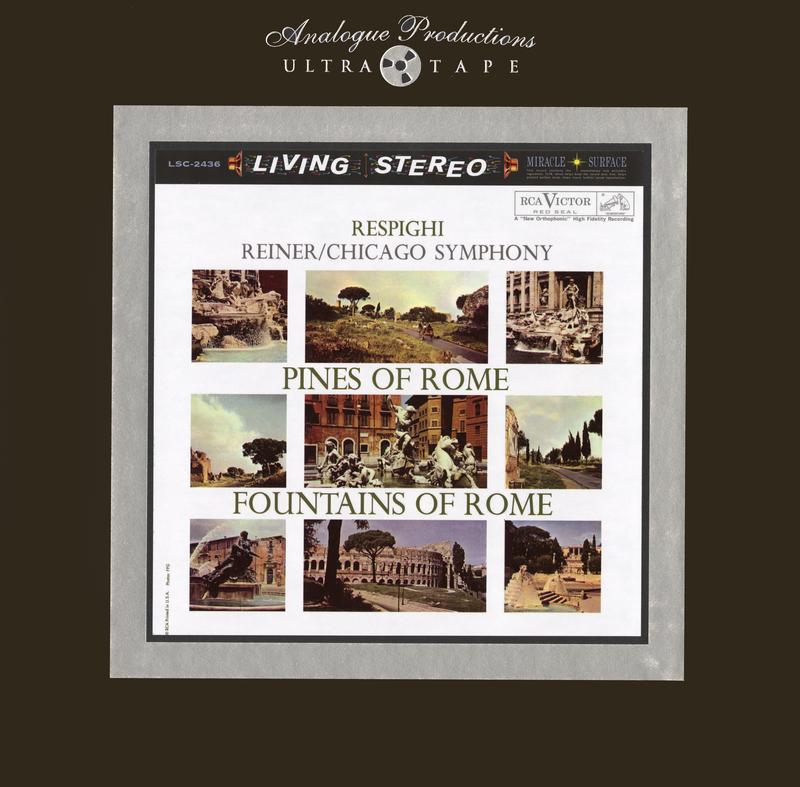
Fritz Reiner and the Chicago Symphony Orchestra recorded both works on October 24, 1959, at Orchestra Hall in Chicago. RCA released the coupling in 1960, with Richard Mohr credited as producer and Lewis Layton as recording engineer. The eight movements thus come from a single recording day, although the compositions are separated by several years: Fountains of Rome dates from 1916 and Pines of Rome from 1924. On the album, the later pines precede the earlier fountains. The sequence follows the programme's musical design rather than the composer's chronology.

Four places beneath the pines
The Villa Borghese opens Pines of Rome in a world quite different from the catacomb that follows. Respighi then moves to the Janiculum before concluding on the Appian Way. Volume and tempo are not the only things that change between these places. The impression of distance also shifts. What seems close, and what appears to come from another space? Which voice moves forward, and which remains within a larger texture? These questions offer a way into the four movements even without personal familiarity with their Roman locations.
An especially unusual detail is written into the score itself: in the Janiculum movement, Respighi requires recorded nightingale song to be played from a gramophone record. A recording medium therefore becomes part of the orchestral composition. The specific bird recording used at Reiner's session is not securely identified, and should be distinguished from the composer's documented instruction. This meeting of an actual sound document and a composed environment is revealing. Respighi's city is not created solely through instrumental imitation; at this point, it also incorporates a previously recorded voice from nature.

The fountains and the passing day
Fountains of Rome connects Valle Giulia with dawn, the Triton Fountain with morning, Trevi with midday and the Villa Medici with sunset. Its four movements turn places and times of day into a progression of their own. You can approach the music through changing light without treating that association as a fixed set of sonic rules. What matters is Respighi's ability to reorganise similar orchestral resources. Water does not suggest the same movement everywhere, and a large fountain does not require the full ensemble at every instant of its musical depiction.
Reiner and the orchestra must connect those details with the direction of the complete work. An individual wind line may define a passage, but its effect also depends on what surrounds it. The orchestra's archive names Adolph Herseth as principal trumpet for Pines of Rome; that documented information should not automatically be extended to all eight movements. Other individual personnel are not comprehensively established. What is certain is the participation of Reiner's Chicago ensemble in two works that repeatedly move between a recognisable image and a much larger symphonic form.
The two tone poems on Ultra Tape
This Analogue Productions edition carries catalogue number RRAP 0008. It comprises two reels of quarter-inch tape at 15 ips, in two-track stereo, or half-track, with IEC equalisation. Pines of Rome occupies the first reel and Fountains of Rome the second. The historical RCA consumer tape had different technical specifications and should not be confused with this release. Modern parallel formats also require separate treatment: an LP mastering credit does not automatically describe the work performed for the tape copy offered here.
The original recording was made on three tracks, while the Ultra Tape presents a two-track stereo version. The publisher describes real-time duplication on an ATR-modified Ampex machine, using a copy of the original analogue master tape. This does not fully establish the mixing history or precise sequence of tape generations. The musical programme is clearly defined: two four-part images of Rome from the same Chicago session. Beyond their large orchestral moments, they reward attention to smaller transitions between places, times of day and the different distances Respighi creates within the ensemble.
You order from Michael 45 in Germany. We arrange the US import and dispatch from Hilden. Editions not currently in stock are dispatched after the goods arrive.
Also on SACD: Respighi: Pines of Rome & Fountains of Rome
Also in another edition: Respighi: Pines of Rome & Fountains of Rome
More by Fritz Reiner: Rimsky-Korsakoff: Scheherazade · Bartok: Concerto For Orchestra
Artist page: All titles by Fritz Reiner
Customer question: Buying Analogue Productions records in Europe
Musicians
Documented participants in this recording. Publisher-only credits are identified; track references correspond to the tracklist.
| Name | Instrument / role | Participation |
|---|---|---|
| Fritz Reiner | conductor | Album personnel |
| Chicago Symphony Orchestra | orchestra | Album personnel |
| Adolph Herseth | principal trumpet | Pines of Rome · 1–4 |
The orchestra archive documents Herseth for Pines of Rome; this is not extended automatically to Fountains of Rome.

Reviews
There are no reviews yet.