A walk through an exhibition becomes orchestral drama
Someone walks through an exhibition, stops before a picture and carries something of it towards the next. From this simple movement, Modest Mussorgsky created one of the nineteenth century’s most unusual piano suites. Written in 1874, Pictures at an Exhibition commemorates his friend Viktor Hartmann, the architect and artist who had died in 1873. A memorial exhibition provided the starting point. Yet the music preserves more than a succession of descriptions. In the recurring “Promenade,” the visitor becomes audible too: sometimes reflective, sometimes purposeful, returning with a slightly altered step after each encounter.
Many listeners first meet the work as orchestral music, largely because of Maurice Ravel’s orchestration of 1922. Almost half a century separates the original piano cycle from this version. Ravel does not simply translate the score into greater volume. He gives individual figures their own instrumental colours and turns the succession of pictures into a series of differently illuminated spaces. The two composers’ names therefore identify distinct creative tasks: Mussorgsky wrote the work, while Ravel fashioned the orchestral version performed here. Keeping those roles clear makes their interaction all the more rewarding.
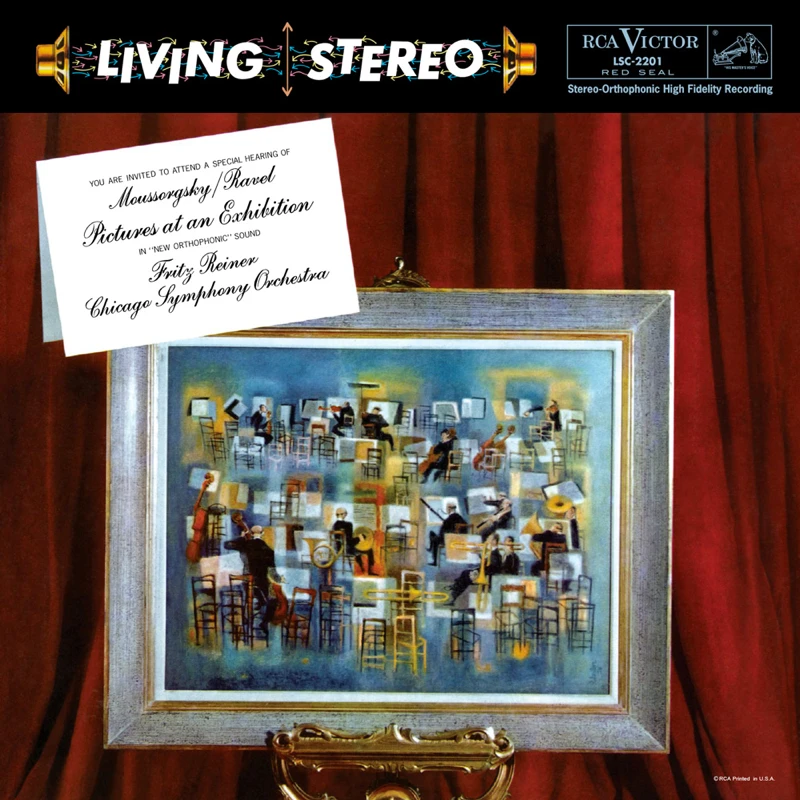
Fritz Reiner and the Chicago Symphony Orchestra recorded the suite for RCA at Chicago’s Orchestra Hall in 1957. Producer Richard Mohr and engineer Lewis Layton belong to the documented recording team; the release as LSC-2201 followed in 1958. Reiner had been the orchestra’s music director since 1953. The recording thus belongs to the Chicago period that produced much of his still widely collected RCA catalogue. It represents a conductor, an orchestra and a recording team working together on one clearly defined composition, rather than a retrospective assortment of unrelated concert performances.

Fifteen stations and a returning idea
The opening “Promenade” already invites attention to the relationship between an individual voice and the ensemble. Its idea returns later, with each new setting changing its effect. “Gnomus” opens a very different world from the old castle of “Il vecchio castello.” The activity of the “Tuileries” and the market at Limoges contrasts with the weightier movement of “Bydło.” The titles offer useful bearings without requiring the listener to settle on a single mental picture. Mussorgsky’s music is more particular than abstract programme music, yet more open than a straightforward illustration of objects on a wall.
Ravel makes these contrasts tangible through the orchestra itself. Woodwinds, brass, strings and percussion assume changing responsibilities; a colour that was accompanying one moment can define an entire section the next. The “Ballet of the Chicks in Their Shells” provides an especially vivid counterpart to the scale of the conclusion. Between them lie the two characters of “Samuel Goldenberg und Schmuÿle” and the darker perspective of “Catacombae.” Each section does not require the same dimensions. The difference between a brief gesture and a more extended construction is part of what keeps the walk moving.
“Cum mortuis in lingua mortua” changes the relationship with memory once again before Baba-Yaga’s hut leads towards the great gate. “The Great Gate of Kiev” consequently becomes more than an impressive ending designed to function independently of everything before it. After the suite’s changing viewpoints, the suggestion of a broad, shared space acquires a different significance. The work overview below lists the fifteen sections in order. These musical divisions provide bearings within the work and its transitions between pictures.

Reiner, Chicago and the spaces between the pictures
A recording as celebrated as this can acquire a reputation that precedes the music. One useful approach is therefore to take its transitions seriously. How does the movement change between a promenade and a picture? Which instrumental voice introduces a new character? When does the orchestra act as a single body, and when as an interaction of separate colours? Such questions direct attention towards the composition and its performance without prescribing a personal listening experience. They remain useful even when the suite is familiar enough for its most famous moments to arrive with strong expectations already attached.
Reiner’s Chicago years produced a substantial body of RCA recordings, but this album allows that history to be approached through one manageable work. The confirmed performing forces are the Chicago Symphony Orchestra under his direction. Audible instrumental solos do not by themselves provide a securely named list of soloists, so the credits retain the conductor and orchestra as the established participants. With a historical recording, this is more reliable than assembling names retrospectively from unrelated concert programmes. It does nothing to diminish the musical interest of the ensemble.
For a collection, the recording offers several points of connection: Mussorgsky’s piano original, Ravel’s orchestral imagination, Reiner’s work in Chicago and RCA’s early stereo recording practice. It can become a starting point for other interpretations or be heard within the wider Living Stereo catalogue. The final climax need not be the only point of reference. Brief character pieces, reflective links and larger arcs are equally important to the work’s identity. Following the whole visit to the exhibition gives the conclusion a richer context than playing its familiar last pages as an isolated demonstration.
Living Stereo on hybrid SACD with a three-channel programme
CAPC 2201 SA is the Analogue Productions hybrid SACD. The publisher credits Ryan Smith at Sterling Sound with remastering from the original master tape and explicitly identifies the inclusion of the three-track programme. The historical recording configuration is therefore part of this edition’s particular interest. It is not a newly created 5.1 remix. Alongside stereo playback, the three-channel programme can be accessed with suitable SACD equipment, while the CD layer allows playback on a conventional CD player.
The work and performance remain the same: Mussorgsky’s suite in Ravel’s orchestration, Fritz Reiner and the Chicago Symphony Orchestra, recorded at Orchestra Hall in 1957. The differences from the separately offered double LP concern the medium and its playback possibilities. Vinyl weight, pressing plant and 45 RPM are consequently not specifications of this SACD. The two illustrations likewise belong to the album and are shared across formats without suggesting a different recording session.
The fifteen musical sections can be followed here without record-side interruptions. For a suite whose promenades connect the individual pictures, that provides a practical way into the larger continuity. The work overview also helps locate particular stations for a return visit. Collectors thus have a clearly identified digital edition within the Living Stereo series, with an additional point of interest in its historical three-channel programme. How stereo and three front channels present themselves on an individual system remains a matter of actual playback; the format designation cannot replace personal listening.
You order from Michael 45 in Germany. We arrange the US import and dispatch from Hilden.
Artist page: All titles by Fritz Reiner
Customer question: Buying Analogue Productions records in Europe
Musicians
Participants and documented credit status. Track references correspond to the tracklist.
- Fritz ReinerPortrait: 1958conductorParticipation: Complete work
- Chicago Symphony OrchestraorchestraParticipation: Complete work

Work overview in 15 sections. No unverified soloist identities assigned. Hybrid SACD including a three-channel programme; not a newly produced 5.1 mix.
More from the series: RCA Living Stereo Series
Also in another edition: Mussorgsky/Ravel: Pictures at an Exhibition
More SACDs with Fritz Reiner: Lieutenant Kijé / Song of the Nightingale · Pines of Rome & Fountains of Rome · Festival · Spain

Reviews
There are no reviews yet.