
A great voice in an intimate setting
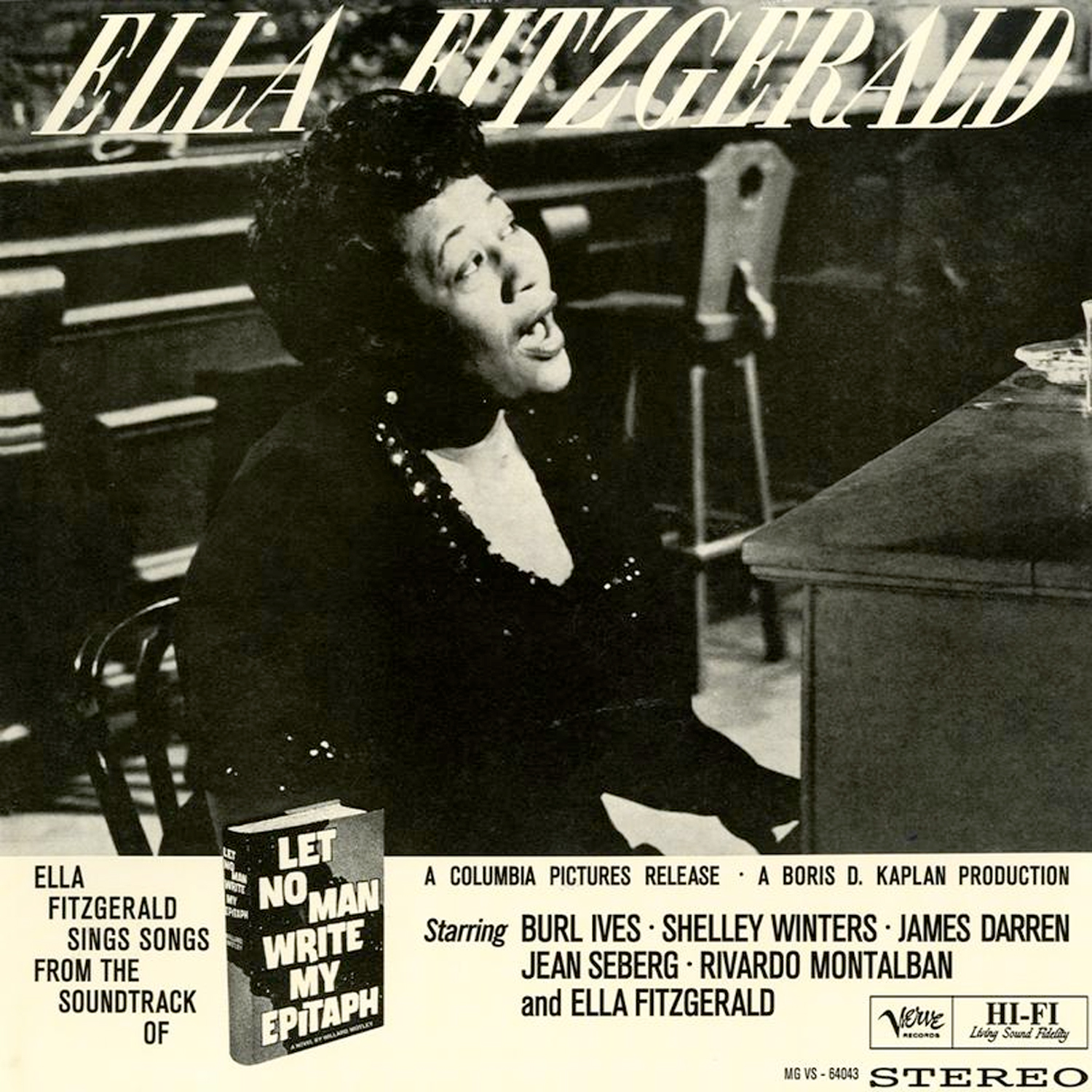
Ella Fitzgerald and a piano: this album needs no larger ensemble to bring thirteen songs into a shared musical space. On Let No Man Write My Epitaph, Paul Smith accompanies a singer whose name is often associated with orchestras, the Songbooks and extraordinary vocal agility. Here, the scale is deliberately smaller. Without horns, strings or drums, attention falls on the relationship between a sung line and the piano’s response. That concentration gives the record a distinctive place among Fitzgerald’s Verve recordings.
The full original title, Ella Fitzgerald Sings Songs from the Soundtrack of “Let No Man Write My Epitaph”, points to a film. Fitzgerald played the singer Flora in the drama released in 1960 and also performed musically on screen. The album nevertheless has an independent life. No knowledge of the plot is required to enter Black Coffee, Angel Eyes or Misty. These songs carry situations and emotional worlds of their own, and Fitzgerald and Smith give them a setting that works without the cinema’s accompanying images.
For listeners who first encountered Ella through her celebrated larger projects, this reduction in scale is particularly inviting. The space between singer and accompanist becomes part of the musical interest: an entrance after a piano chord, a sustained note, or a moment when the keyboard continues an idea begun by the voice. This is not a claim to reveal a supposedly more authentic Ella beneath her other recordings. The duo offers another aspect of her expression, concentrated on melody, language and the possibilities of accompaniment.

Paul Smith and the 1960 recordings
The sessions took place in Hollywood in April 1960, with Norman Granz producing. Fitzgerald sings and Paul Smith plays piano; there are no additional musicians on the album. The brevity of that personnel list stands in an interesting relationship to the responsibility shared by its two participants. Smith supplies harmony, movement and transitions without a rhythm section to support him. Fitzgerald can respond immediately to the changes he introduces. Each contribution is exposed, but neither exists independently of the other.
A piano in this context is therefore more than a reduced orchestral backing. It can be followed as a partner with a voice of its own. Where does Smith support the shape of a melody? Where does he answer briefly, and where does he leave the singer more time? These are approachable questions that require no formal study of harmony. A small ensemble makes individual decisions easier to identify, while the effect of those decisions comes from the way they work together.
The programme moves through a broad selection of American popular song. I Can’t Give You Anything But Love, My Melancholy Baby and I’m Getting Sentimental Over You sit alongside Black Coffee and One for My Baby (And One More for the Road). That variety does not loosen the album’s identity. Its unchanging instrumentation supplies continuity while the songs suggest different shades of intimacy, memory and disappointment. Fitzgerald and Smith can explore those differences without changing the ensemble or constructing a more elaborate sonic setting around each selection.

Thirteen songs, carefully placed
Black Coffee opens side one, followed by Angel Eyes and I Cried for You. The sequence encourages attention not only to the beauty of a voice but also to the way it approaches each song. How does the emphasis within a phrase change? How much time is given to a melodic idea? Fitzgerald’s technical resources are familiar; in this setting, they serve the act of interpretation. A standard acquires a particular manner through choices that may be small individually but meaningful in combination.
Side two begins with Misty and September Song. One for My Baby then takes its place in a sequence that continues through Who’s Sorry Now and I’m Getting Sentimental Over You to Reach for Tomorrow. This order gives the record a shape of its own. Hearing the whole side before returning to favourite individual songs can be rewarding. Even a familiar number takes on a different character when placed between two others and heard through the same voice-and-piano partnership.
The changing reception of these recordings is part of their history. The contemporary DownBeat review was more reserved than several later assessments. Listeners need not adopt either verdict. The difference is a reminder that restraint and emotional expression are not perceived in the same way by everyone. For a Fitzgerald collection, that makes the album particularly useful: it broadens the portrait of the singer through a concentrated programme in which a small ensemble leaves considerable room for discovery.
The Acoustic Sounds Series LP at 33⅓ RPM
This edition belongs to the Verve Acoustic Sounds Series, with Acoustic Sounds reference AVER 36901 and Verve catalogue number B003736901. It is a single 180-gram LP playing at 33⅓ RPM, retaining two album sides with seven and six songs respectively. The speed is part of the identity and listening sequence of this particular release: each longer side keeps several of these intimate musical conversations together before the record needs to be turned over.
Bernie Grundman handled mastering and lacquer cutting. The publisher identifies the original analogue tapes as the source, and the documented runouts carry the initials “BG”. This edition is pressed at Quality Record Pressings and supplied in a Stoughton Printing tip-on gatefold jacket. These are the specifications of the reissue released in 2023. Other versions of the same album, including a separate 45 RPM edition and a hybrid SACD, have their own characteristics and should be distinguished when choosing a copy.
For collectors, the LP places this duo recording within the presentation of the Verve series without turning weight, speed or mastering credits into a blanket promise about sound. The musical invitation remains direct: Ella Fitzgerald, Paul Smith and thirteen songs given room to breathe. Anyone looking to extend a Fitzgerald collection with a quieter encounter that rewards close attention will find a distinct perspective on her repertoire here. You order from Michael 45 in Germany. We arrange the US import and dispatch from Hilden.
More by Ella Fitzgerald: Fine and Mellow · Take Love Easy
Series: Verve – all 34 records: voices, organ and bossa nova
Musicians
Participants and documented credit status. Track references correspond to the tracklist.
- Ella FitzgeraldvocalsParticipation: All 13 tracks
- Paul SmithpianoParticipation: All 13 tracks


Vocals and instruments are credited to the tracks listed above.

Reviews
There are no reviews yet.