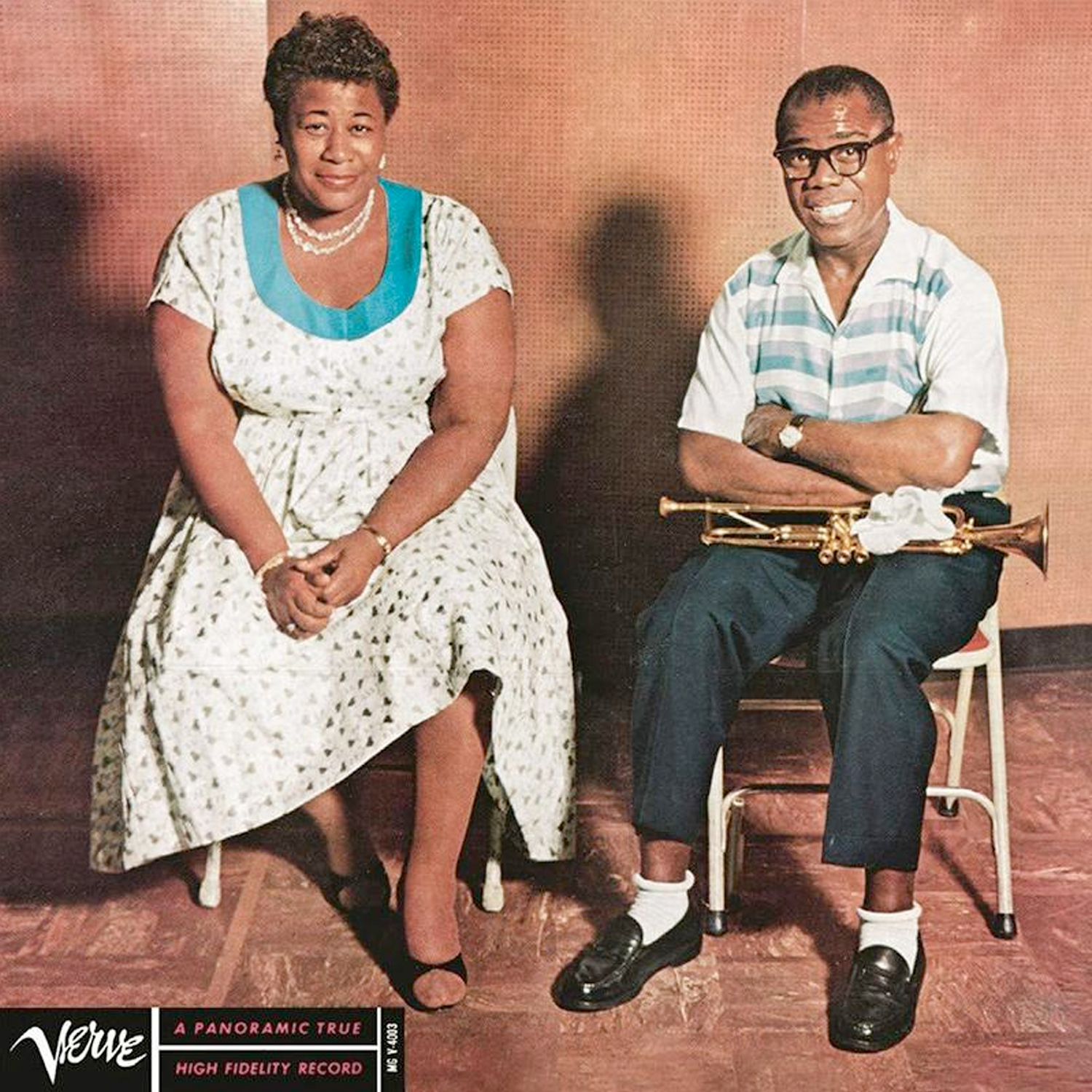

Ella & Louis: two voices making room for each other
When Ella Fitzgerald and Louis Armstrong share a standard, a particular kind of intimacy becomes possible. Their voices do not need to resemble each other to belong together. Fitzgerald shapes a melody with clear contours and a supple line; Armstrong brings his unmistakably rough texture and a sense of timing that gives weight even to a brief turn of phrase. On Ella & Louis, that difference becomes a conversation. The attraction lies in how they respond to the same words and how little apparent effort it takes to make a familiar tune personal again. These are two independent storytellers paying attention to the person opposite them.
The recording was made on August 16, 1956, at Capitol Studios in Hollywood. That date connects the eleven songs to a concentrated encounter, however relaxed the finished record may feel. Four other musicians sustain the exchange: Oscar Peterson on piano, Herb Ellis on guitar, Ray Brown on bass and Buddy Rich on drums. Those six people constitute the personnel. Behind the familiar album title stands a small ensemble whose responsibilities have to fit together closely. An orchestral background would offer a different range of possibilities; this accompaniment remains in immediate contact with the singers.
Within a jazz collection, this Verve recording makes a rewarding starting point for considering different approaches to singing. You do not need specialist terminology or a catalogue of famous solos. Listen to a line twice and notice how each singer handles its beginning, pauses and ending. Armstrong’s trumpet adds another way of telling the story. It belongs to the same musical personality as the voice heard a moment before, making the relationship between sung and instrumental melody particularly revealing. The record rewards attention to those connections as much as admiration for either artist in isolation.

Eleven standards moving through invitations, memories and distant places
Can’t We Be Friends opens the programme with a question containing the outline of an entire relationship. It offers both voices opportunities to change the meaning of an apparently simple expression. Isn’t This a Lovely Day establishes a different frame: a moment is considered, enjoyed together and kept in musical motion. Rather than simply recognising the titles, it is rewarding to notice their different forms of address. One song resembles an invitation, another a recollection, another a tentative assessment of where two people stand. The duo can move between those perspectives without losing its shared conversational character.
Moonlight in Vermont and They Can’t Take That Away from Me follow, placing particular emphasis on images and memories. A place, a gesture or a familiar habit can communicate more than an extended explanation. They offer opportunities to follow the relationship between intelligible words and melodic freedom. The accompaniment can support a line without underlining every word. Under a Blanket of Blue continues the first side before Tenderly brings it to a close. These six performances form a connected stretch in which warmth grows out of changing characters rather than an insistence that every song should evoke the same feeling.
The second side begins with A Foggy Day and proceeds through Stars Fell on Alabama to Cheek to Cheek. The sequence itself travels between a city scene, recollection and dancing. The Nearness of You then brings immediate companionship into focus, before April in Paris closes the album. There are eleven selections in all, with no additional bonus performances attached. That limit is part of the record’s form. Listeners arriving from an extensive streaming selection may appreciate how effectively a fixed programme works: the last song really is an ending, and the side change creates a modest pause between two deliberately ordered sequences.

Peterson, Ellis, Brown and Rich: accompaniment that stays alert
Oscar Peterson, Herb Ellis, Ray Brown and Buddy Rich each bring a distinct musical personality to the accompaniment. The piano can clarify harmonies, shape transitions and offer short replies. Guitar provides another kind of attack and connection, while bass and drums establish a shared sense of direction. Personnel credits alone cannot tell us exactly what happens at every point in every performance. They do, however, suggest useful things to listen for: the balance between a supporting foundation and small comments, the coordination of plucked strings with piano, and the movement beneath a sustained vocal phrase.
With familiar standards, it is especially rewarding to move those supporting tasks into the foreground. Follow Ray Brown’s bass line first, then return to the same passage with your attention on the voice. Or notice when a guitar attack emerges beside the piano as a distinct colour. Such changes of perspective can make a familiar record newly discoverable. Accompaniment here involves keeping musical possibilities open. The singers need a foundation they can trust, along with enough freedom to give a phrase a different emphasis from the one it carries in another interpretation. A small group allows those decisions to remain close to the surface.
The album consequently needs no contest between its two leading figures. Fitzgerald’s melodic flexibility and Armstrong’s characteristic articulation serve different purposes. Their meeting becomes interesting precisely where a song accommodates both approaches. Listeners who usually favour instrumental jazz can enter through rhythm and phrasing; those drawn first to the songs can discover the ensemble from there. The record offers both routes without surrendering its compact shape. All six players appear in the personnel section below. An album credit for Armstrong’s voice and trumpet should not be turned into a claim that he performs both functions throughout every selection, or that every instrumental contribution has been assigned to an individual track.
Ella & Louis on vinyl: the Acoustic Sounds Series mono edition
The record offered here carries catalogue number AVER 74801 and belongs to the Verve Acoustic Sounds Series. It is a mono LP playing at 33⅓ RPM on 180-gram vinyl. That identification matters: this edition of Ella & Louis should not be approached with an expectation of stereo. Its shared musical centre belongs to the historical recording’s presentation. When comparing reissues, look beyond the album title to the specific catalogue number, channel information and production details. Different carefully made editions of the same recording do not necessarily follow the same manufacturing process.
For this release, the publisher names Ryan K. Smith at Sterling Sound, with mastering from the original analogue tapes. The vinyl is pressed at Quality Record Pressings, and the packaging is a Stoughton tip-on gatefold jacket. Those details concern this Acoustic Sounds edition. The separately available Verve Mastercut release is a different product, and its manufacturing process does not belong in the description of this LP. A clearly identified production route offers useful grounds for choosing a record without requiring a blanket promise that it will sound better than every earlier pressing.
A single LP preserves the eleven standards in two extended musical stretches. Side one contains six selections and side two five, requiring just one side change. That suits a record whose appeal depends on a continuing exchange. It is approachable on a first visit and offers different rewards as attention deepens. If you want to buy Ella & Louis on vinyl, this edition presents the original programme in a carefully specified reissue: two unmistakable voices, four attentive partners and familiar songs renewed through personality. The physical format keeps that encounter together while leaving space for another hearing. You order from Michael 45 in Germany. We arrange the US import and dispatch from Hilden.
Series: Verve – all 34 records: voices, organ and bossa nova
Musicians
Participants and documented credit status. Track references correspond to the tracklist.
- Ray BrownExisting portrait; not a session depictionBassParticipation: Album personnel; individual scope unspecified
- Buddy RichPortrait reference: 1947DrumsParticipation: Album personnel; individual scope unspecified
- Herb EllisExisting portrait; not a session depictionGuitarParticipation: Album personnel; individual scope unspecified
- Ella FitzgeraldExisting portrait; not a session depictionvocalsParticipation: Album personnel; individual scope unspecified
- Louis ArmstrongExisting portrait; not a session depictionvocals, TrumpetParticipation: Album personnel; individual scope unspecified
- Oscar PetersonExisting portrait; not a session depictionPianoParticipation: Album personnel; individual scope unspecified


Six musicians; complete album credits without individual track assignments. Mono recording made August 16, 1956, Capitol Studios, Hollywood. Reissue: Ryan K. Smith / Sterling Sound, original analogue tapes; QRP, 180 g; Stoughton gatefold (publisher specifications).
🎧 Review video: The 20 Best Audiophile Analogue Production Editions (Still in Print 2021)
This video is hosted by YouTube (Google). It only loads once you switch on “Functional” in the cookie settings.

Reviews
There are no reviews yet.