
A distinctive title and a band worth knowing
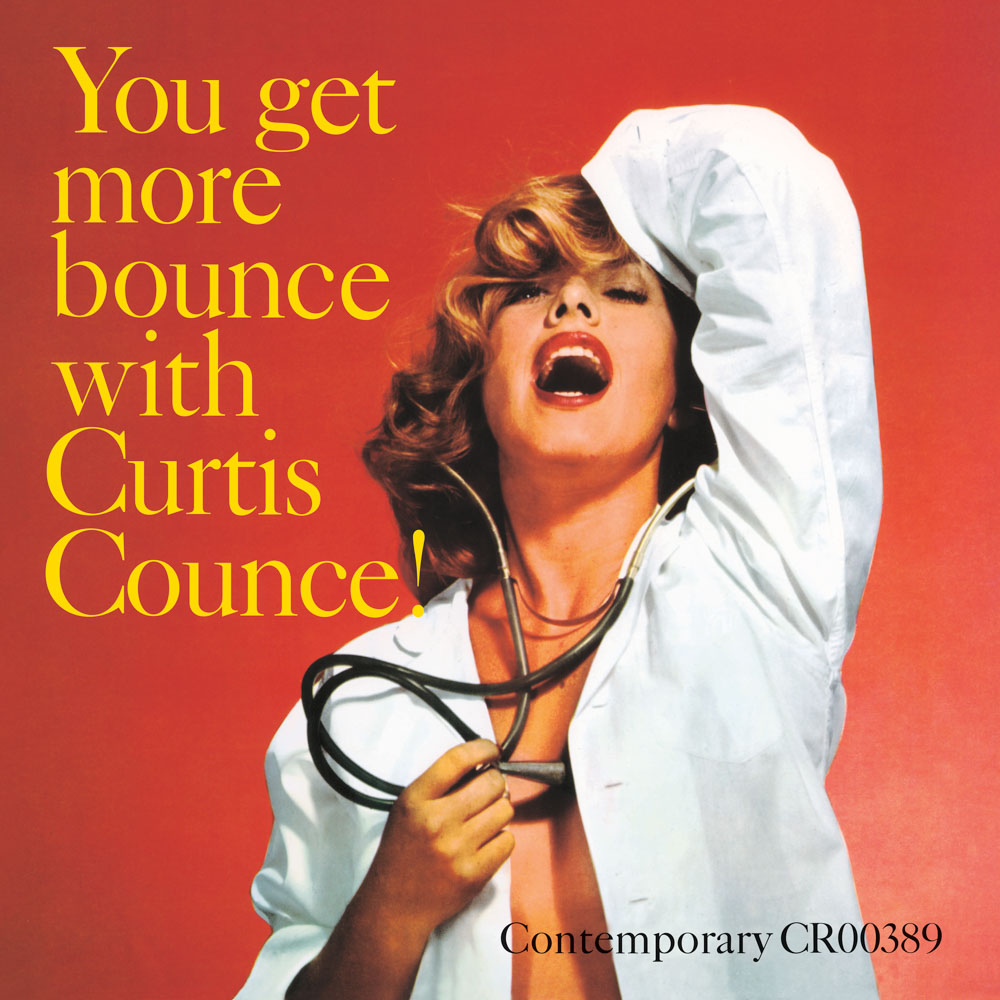
The title has wit; the music behind it has substance. You Get More Bounce With Curtis Counce! presents a group whose interest cannot be measured simply by the fame of its leader. Curtis Counce plays double bass, with Jack Sheldon on trumpet, Harold Land on tenor saxophone, Carl Perkins on piano and Frank Butler on drums. Five musicians with their own places in the Los Angeles jazz scene meet in an ensemble that allows both a shared identity and individual voices to emerge.
The album appeared on Contemporary Records in 1957. Listeners who associate “West Coast Jazz” primarily with a particular kind of cool surface will find reasons to broaden that picture here. Hard bop, standards and the blues belong to this group’s world alongside carefully shaped ensemble playing. The double bass is more than a foundation beneath two horns. With the bassist leading the band and contributing two compositions, attention is directed towards his role in the music as a whole.
For collectors, groups like this reward exploration beyond the most frequently encountered names. You Get More Bounce offers a clearly defined starting point: seven pieces, an ensemble whose parts can be followed, and a programme bringing familiar standards together with original writing. The title promises movement; the discovery begins with the musicians who create it. Those who know Land or Sheldon from other records can hear them in another partnership while becoming better acquainted with Counce, Perkins and Butler.

Contemporary in Los Angeles, 1956 and 1957
The recordings come from five Los Angeles sessions held during 1956 and 1957. Big Foot was recorded on October 8, 1956, and Stranger in Paradise on October 15. Too Close for Comfort and Counceltation followed on April 22, 1957; Complete and How Deep Is the Ocean on May 13; and Mean to Me on September 3. Lester Koenig produced for Contemporary Records, with Roy DuNann handling the recording. The personnel remained unchanged across all five dates. The album is therefore not the record of one self-contained day in the studio. Material made at different dates was brought together into the released programme. That history is a useful reminder not to imagine every album as one precisely reconstructable session. In this case, continuity comes particularly from the group and the repertoire through which it works.
Trumpet and tenor saxophone form a classic two-horn front line. Sheldon and Land can establish themes together before moving into individual statements. Beneath them, Perkins, Counce and Butler share the responsibilities of harmony, pulse and momentum. The Carl Perkins heard here is the jazz pianist, not the rockabilly musician of the same name. Familiar names and ensemble formats can make such distinctions easy to overlook, but accuracy leads back to the particular people making the music.
One illuminating approach is to follow the movement between ensemble passages and individual voices. How is a theme introduced together? What does the bass do when one of the horns moves into a solo? Where do the drums bind a passage together, and where does the piano offer an independent accent? Album personnel credits name the participants; they do not imply that every role is equally prominent at every moment. Part of a small jazz group’s interest lies in the changing distribution of its responsibilities.

Originals, standards and a Charlie Parker finale
Side one opens with Complete, a composition by Counce himself. Irving Berlin’s How Deep Is the Ocean follows, before Too Close for Comfort and Mean to Me complete the side. These pieces bring different histories into the programme, without requiring listeners to know them in advance. A standard is not treated as an unchanging object but as material for a particular group. Melody and harmonic structure provide orientation, while the performance establishes relationships of its own.
The second side begins with Stranger in Paradise. Counce then returns as composer with Counceltation. Placing his writing on both sides gives it a meaningful presence throughout the album. It also invites attention to the bassist beyond his instrumental contribution: these are musical situations he offers to his fellow players. Surrounded by familiar repertoire, the originals gain a clear context without being reduced to connective material between more recognisable titles.
Charlie Parker’s Big Foot closes the programme. At a little over nine minutes, it is the longest selection on this edition. The album’s range thus extends from Counce’s own writing through American popular song to a composition from the bebop world. That mixture offers more than one reason to return. A familiar tune might provide the first entrance, while an individual player’s contribution becomes the focus on another occasion. The record is a lively reminder that jazz history extends beyond a handful of celebrated leaders and their best-known albums.
The all-analogue reissue at 33⅓ RPM
This edition belongs to Craft Recordings’ Contemporary Records Acoustic Sounds Series. Its catalogue number is CR00389, with Acoustic Sounds distribution reference ACONC 389. Released in 2023, it is a 180-gram stereo LP playing at 33⅓ RPM. Four selections appear on side A and three on side B, retaining a straightforward two-sided programme in which each of the leader’s compositions has its own position.
Bernie Grundman handled mastering and lacquer cutting. The publisher explicitly specifies all-analogue mastering from the original tapes. That is more specific than a statement merely identifying an analogue source: an analogue mastering path is expressly claimed for this release. The documented runouts bear the initials “BG”. Quality Record Pressings manufactured the LP, which comes in a Stoughton Printing tip-on jacket. No particular limited pressing quantity is promised for this edition.
The Contemporary series makes recordings such as this available in a clearly identified reissue. Weight, lacquer-cutting credits and packaging describe the physical edition; the musical reason to choose it remains the band. For anyone interested in small jazz ensembles and the Los Angeles scene, these seven pieces bring together familiar repertoire and original compositions in a rewarding setting. Counce’s name appears on the cover, but all five musicians contribute to the story. You order from Michael 45 in Germany. We arrange the US import and dispatch from Hilden.
Series: Contemporary – all 24 records: sunny jazz from Los Angeles
Musicians
Participants and documented credit status. Track references correspond to the tracklist.
- Curtis Councedouble bass, bandleaderParticipation: Album personnel · all five sessions
- Jack SheldontrumpetParticipation: Album personnel · all five sessions
- Harold Landtenor saxophoneParticipation: Album personnel · all five sessions
- Carl PerkinspianoParticipation: Album personnel · all five sessions
- Frank ButlerdrumsParticipation: Album personnel · all five sessions


The instrument list describes the album personnel. Individual track assignments are included where documented.

Reviews
There are no reviews yet.