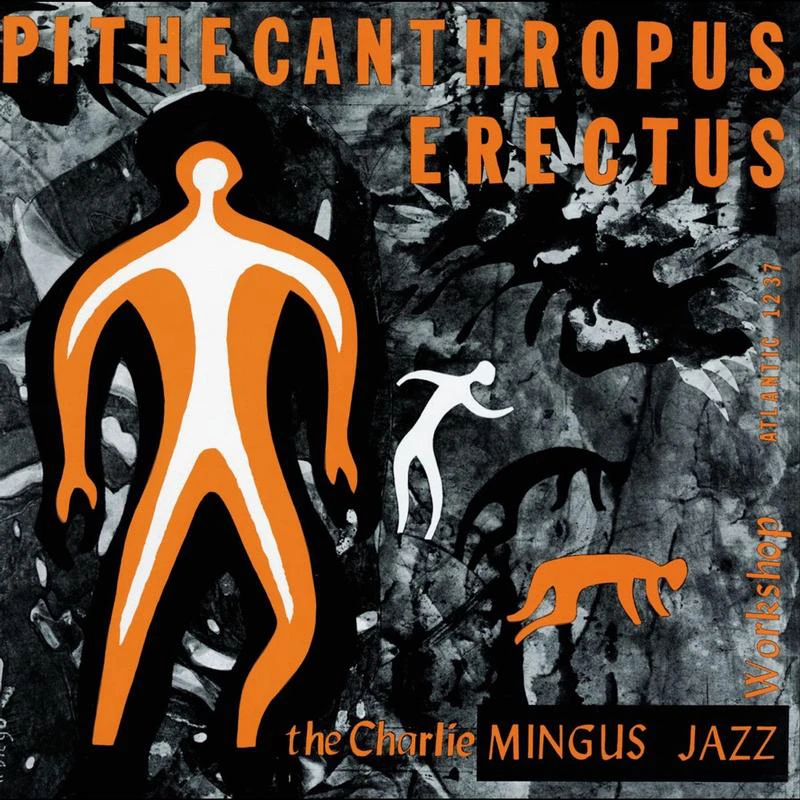
Charles Mingus’ breakthrough as a leader, as a hybrid mono SACD from the Atlantic 75 Series: Pithecanthropus Erectus brings the four pieces of the 1956 Jazz Workshop session together in one continuous sequence – from the dramatic title work to the long “Love Chant”.
Music passed on by ear
Charles Mingus described his Jazz Workshop method as a way of passing ideas on by ear. He would play the framework at the piano and give his musicians room to develop their own lines inside it. Recorded in New York on January 30, 1956, Pithecanthropus Erectus is an important document of that approach: the pieces have clear shapes and purposes, yet the personalities of the players are part of how the compositions come to life. The album invites you to hear the relationship between a leader’s conception and the musicians who realise it.
Mingus plays double bass, with Jackie McLean on alto saxophone, J. R. Monterose on tenor, Mal Waldron on piano and Willie Jones on drums; Nesuhi Ertegun supervised the production for Atlantic. The session at Audio-Video Studios produced the four pieces on the record, while an additional performance of “What Is This Thing Called Love” was left off. Four pieces are enough for real range: their contrasting lengths and functions show the Workshop in several different settings within one focused album.

Rise and fall in four stages
Mingus described the title piece as a musical account of human development, arrogance and destruction, and his own notes divide the idea into four stages. The title refers to the historical name for Java Man, but the composition uses the association to explore a broader drama of human self-importance. Knowing the programme offers one way in: follow the recurring material, the changes in collective activity and the relationships between the individual voices as parts of a larger design.
The connection between composition and collective improvisation is central. Mingus gives the players responsibilities that go well beyond waiting for a solo spot. Waldron and Jones had already been working with him at the Café Bohemia, where “Love Chant” and “A Foggy Day” were played in December 1955 with a different horn line-up. The studio album belongs to an ongoing workshop practice in which material moved between performances and ensembles – it captures one stage of that work rather than four unrelated tunes assembled for a recording date.

A city scene, a portrait and a long finale
George Gershwin’s “A Foggy Day” is the only piece on the album not written by Mingus. The arrangement puts the familiar song into a new dramatic setting – commentators have heard city sounds in the instrumental effects. Next to the title piece, it shows how readily Mingus thought in images and situations: a recognisable melody becomes the centre of a scene the ensemble builds around it.
“Profile Of Jackie” turns to one particular musician, Jackie McLean, who was 24 at the time of the session. The short portrait contrasts with the extended “Love Chant” that closes the programme. Together the four pieces show several sides of Mingus’ work – a programmatic composition, a transformed standard, a compact dedication and a longer exploration – which makes the record an ideal introduction to his musical world. The players keep their own identities, while selection and sequence reveal the organising imagination of the bassist and bandleader.
The Atlantic 75 hybrid mono SACD
CAPA 059 SA is a hybrid mono SACD from the Analogue Productions Atlantic 75 Series. The SACD layer plays on SACD-capable players, the CD layer on any conventional CD player. The disc contains the four pieces of the original album in their original order, without the unused fifth recording from the session.
You order from Michael 45 in Germany. We arrange the US import and ship from Hilden.
More from the series: Atlantic 75 Series
Also in another edition: Pithecanthropus Erectus
More SACDs by Charles Mingus: Blues & Roots · Oh Yeah · The Clown
Customer question: Buying Analogue Productions records in Europe
Musicians
Participants and documented credit status. Track references correspond to the tracklist.
| Name | Instrument / role | Participation |
|---|---|---|
| Charles Mingus | double bass, bandleader | Album personnel |
| Jackie McLean | alto saxophone | Album personnel |
| J. R. Monterose | tenor saxophone | tracks 1, 2, 4 |
| Mal Waldron | piano | Album personnel |
| Willie Jones | drums | Album personnel |
Monterose is documented on tracks 1, 2 and 4; participation on track 3 is disputed.



Reviews
There are no reviews yet.