
A distinctive trio on a December date
The title looks ahead to a new year, but the recording belongs to December: Trio ’64 was made in New York on December 18, 1963. Bill Evans plays piano, Gary Peacock double bass and Paul Motian drums. Those three names explain the album’s special place within the pianist’s extensive catalogue. Peacock is the bassist here, rather than Scott LaFaro or Chuck Israels. For listeners following the changing personnel of Evans’ groups, this is more than another instalment identified by a year. It is a rare combination with a musical identity of its own.
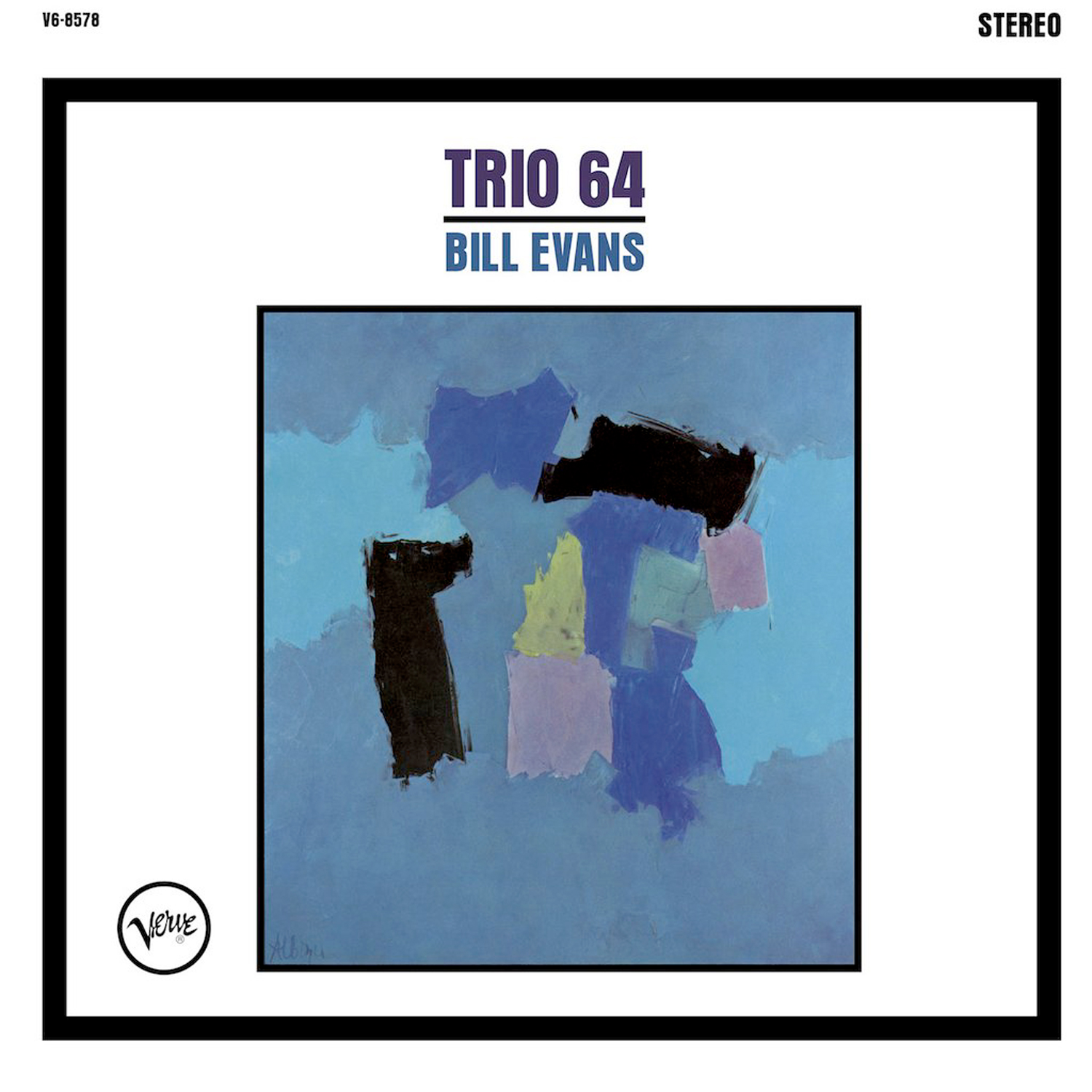
Verve released the album in 1964 as V6-8578. Creed Taylor produced it and supplied the accompanying notes; Bob Simpson was the recording engineer, with Val Valentin credited as engineering director. Olga Albizu created the abstract cover artwork. The combination of clearly identified trio, familiar repertoire and independent visual character makes this an attractive document of Evans’ early Verve period. Within that straightforward presentation, the music leaves room for matters central to his work: harmonic flexibility, the weight given to a phrase and the response to another player’s idea.
There are eight pieces, with no Evans original defining the programme. Instead, melodies from different parts of popular song provide the starting points. “Little Lulu” sits beside “A Sleepin’ Bee,” while Irving Berlin’s “Always” shares a side with “Santa Claus Is Coming to Town.” Their proximity may look surprising on paper. For the trio, the different origins supply different melodic shapes to explore. The musicians create the continuity, rather than relying on a common source or a single composer to give the record its character.
That offers a useful way into the album. Familiarity with a song does not make its interpretation predictable. A recognisable tune can reveal particularly clearly how phrases are displaced, harmonies weighted and instrumental responsibilities exchanged. These changes do not need theoretical names to become audible. The known melody provides a point of orientation while the players find their own routes through it. What initially looks like a modest collection of standards becomes a concentrated portrait of musical attention, with each instrument contributing to the direction of the conversation.

Peacock and Motian as individual voices
Gary Peacock is the clearest difference from many other Evans trio recordings. His name also leads towards work with Paul Bley and Albert Ayler, musicians associated with other approaches to freedom and movement. Those connections should not be imposed on every bar of Trio ’64. They do, however, help explain why his presence matters beyond a personnel footnote. A bassist brings an individual sense of line, space and response, even when the shared material is a song that all three musicians already know.
The relationship between piano and bass therefore provides a rewarding listening focus. When does Peacock follow a harmonic movement, when does his line introduce an independent idea, and how does that change the effect of a piano phrase? Such questions allow the bass to emerge as a voice rather than a foundation taken for granted. Evans’ trio approach offers a particularly revealing setting for this. The piano need not occupy every available gap for the music to feel complete; a bass response can carry the argument forward just as decisively.
Paul Motian connects this combination to an important earlier period in Evans’ work. His significance is not confined to memories of other famous trio records. Here he is responding to Peacock and to this particular ensemble. Small transitions, the degree of emphasis in an accent and the balance between maintained pulse and open space all deserve attention. Listening only for a steady underlying beat misses the shifting decisions through which the three musicians keep finding one another inside the form of a tune.
All eight selections come from the same session. This is not a retrospective collection of changing trios assembled beneath a single title. That makes the record especially clear in scope and rewarding for collectors: across two sides, the same three personalities address differently shaped material. The album is also singled out as Evans’ only album recording with Peacock. That rarity contributes to its importance within a discography rich in encounters, while the complete session offers a fuller perspective than any isolated track could provide on its own.

Eight songs, eight opportunities for conversation
“Little Lulu” opens the record with a melody whose popular-entertainment origins sit at an engaging distance from the solemn image sometimes attached to the reflective jazz pianist. Evans does not require ceremonial source material to find musical possibilities. Harold Arlen and Truman Capote’s “A Sleepin’ Bee” follows. That first pairing already establishes the programme’s breadth: different origins and different verbal associations become material for the same small group. The relationship is made in performance, rather than guaranteed by the songs’ original settings.
Irving Berlin’s “Always” and “Santa Claus Is Coming to Town” complete side A. The session’s proximity to Christmas is a documented fact, but it cannot by itself establish why the seasonal song was chosen. The more interesting question is musical: what happens when a highly familiar melody is separated from its customary function? Recognition can sharpen awareness of changes in articulation, harmony and accompaniment. A tune often heard as part of an annual routine becomes an opportunity to notice decisions that routine listening might otherwise conceal.
Side B brings “I’ll See You Again,” “For Heaven’s Sake,” “Dancing in the Dark” and “Everything Happens to Me.” The writing credits lead to Noël Coward; Bretton, Edwards and Meyer; Howard Dietz and Arthur Schwartz; and Matt Dennis with Tom Adair. Together, these names show how the repertoire extends beyond any one songwriter or theatrical tradition. The instrumental frame remains deliberately small. No additional horns or orchestral parts are needed for three players to examine the same melody from different directions and sustain a complete album.
“Everything Happens to Me” makes a fitting final point in that journey. Its title alone is a reminder that many jazz standards began as stories told in words. In an instrumental performance, that history and its implied verbal rhythm do not simply disappear. Listen for how Evans allows the melody to breathe, and for the answers that bass and drums can offer around it. This is an invitation to personal discovery rather than a prescription for a particular emotion. The open relationship between a song and its interpretation is part of what makes repeated listening rewarding.
Verve history on a single 33⅓ RPM LP
The edition offered here is AVER 12301 in the Verve/UMe Acoustic Sounds Series. It presents the stereo album on one 180-gram LP running at 33⅓ RPM. Ryan K. Smith at Sterling Sound handled the mastering from analogue tapes, with pressing at Quality Record Pressings and a Stoughton gatefold jacket completing the presentation. These are specifications for this particular reissue. Manufacturing details associated with other Evans titles or other audiophile series should not be transferred to it without checking the actual edition.
A single LP is a sympathetic format for Trio ’64. Four tracks occupy each side, and the session can be heard as a coherent programme with only one side change. That continuity can be particularly valuable with three musicians: after a few pieces, their shared habits become more familiar, and each new tune can be heard in relation to what preceded it. The preserved sequence allows the surprising selection of songs to form a coherent whole. From “Little Lulu” to the closing “Everything Happens to Me,” the consistent personnel provides a dependable point of reference.
Olga Albizu’s artwork also belongs to the record’s identity. It does not merely depict an event in the studio, but offers an independent visual statement beside the performance. The LP format gives that design space without allowing the packaging to replace the main reason for collecting the record: the meeting of Evans, Peacock and Motian. Listeners who also know Trio ’65 can follow how a related album idea produces different relationships with a changed rhythm section. The adjacent years identify connected but distinctly separate recordings.
Eight songs, one December date and an unusual Evans trio: that clearly defined scope makes the album a rewarding companion to the familiar Riverside recordings. Peacock’s bass gives it a special place, while Motian’s presence connects it to an established musical partnership. Evans remains the common centre, but the two other voices offer a further perspective on his work. You order from Michael 45 in Germany. We arrange the US import and dispatch from Hilden.
More by Bill Evans: At The Montreux Jazz Festival · Interplay
Artist page: All titles by Bill Evans
Series: Verve – all 34 records: voices, organ and bossa nova
Musicians
Participants and documented credit status. Track references correspond to the tracklist.
- Bill EvansPortrait: 1964pianoParticipation: All tracks
- Gary PeacockPortrait: 2003 · later portrait referencedouble bassParticipation: All tracks
- Paul MotiandrumsParticipation: All tracks
- Creed TaylorproductionParticipation: Recording production
- Bob Simpsonrecording engineerParticipation: Recording production


All eight tracks: Bill Evans, Gary Peacock and Paul Motian, New York, December 18, 1963.
How Michael hears this edition
Listening impression · paraphrased from the video
Michael highlights the soundstage and especially its depth. Gary Peacock’s bass remains clear even in prominent passages, without becoming muddy. This combination of weight and clarity positively surprises him.
🎧 Review video: Bill Evans: Trio 64 (Acoustic Sound Series) + New Camera!
This video is hosted by YouTube (Google). It only loads once you switch on “Functional” in the cookie settings.

Reviews
There are no reviews yet.