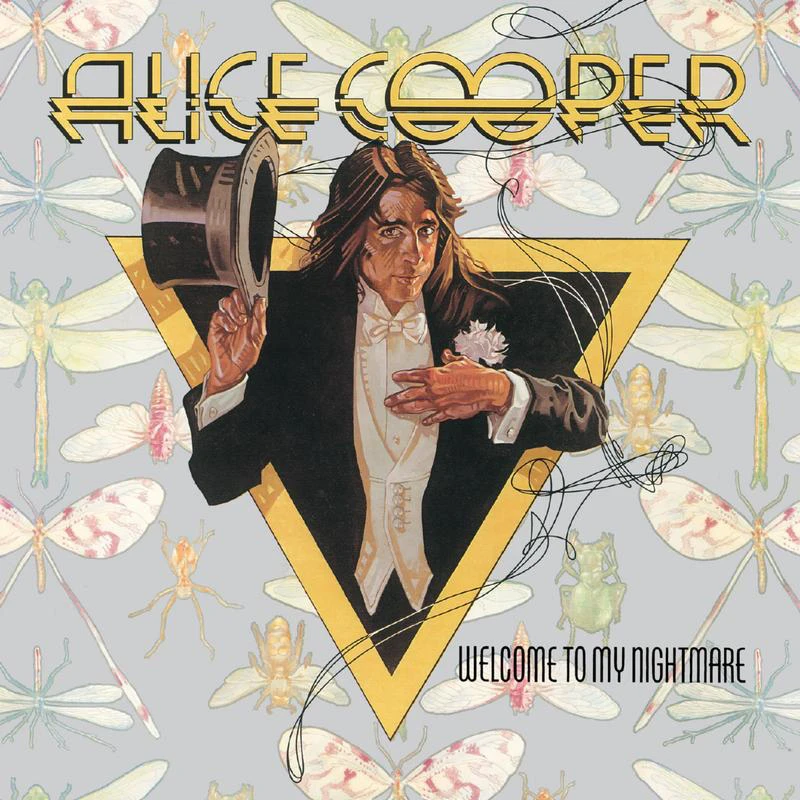
Welcome To My Nightmare as a hybrid stereo SACD from the Atlantic 75 Series: Chris Bellman at Bernie Grundman Mastering mastered Alice Cooper’s 1975 concept album direct to DSD. All eleven tracks unfold as one continuous piece of musical theatre – from the opening invitation, via Vincent Price as “The Curator”, to Escape.
Enter Steven
An invitation can be deeply unsettling. On Welcome To My Nightmare, Alice Cooper does more than greet his audience with another rock record: he leads it into a world whose rules change from song to song. Seductive melodies sit next to abrasive guitars, a familiar voice turns threatening, and behind the spectacle waits the vulnerable figure of Steven. Released in 1975, the album lives on these shifts between entertainment and unease, and its appeal reaches far beyond the props of shock rock. Heard in sequence, the eleven tracks reveal a carefully built piece of musical drama.
The record also marks an important change of personnel. Alice Cooper had originally been the name of a band; Welcome To My Nightmare is its singer’s first solo album. The partnership with producer Bob Ezrin continued, but a new cast of players was assembled around him. Atlantic released the album in North America, with Anchor involved internationally. Behind the familiar character a different way of working was taking shape: Cooper could combine songs, spoken theatre, elaborate arrangements and changing studio line-ups within one connected programme.
Dick Wagner became especially important, contributing guitar and songwriting to several of the central pieces. The distance between the title track and Only Women Bleed alone shows the range of their shared vocabulary – an ambiguous invitation into a nightmare at one end, a serious, vulnerable ballad at the other. Cooper needed musicians who could make both sides convincing, and the new ensemble gives him that flexibility: it supports the character without letting the human feelings behind it disappear.

Bob Ezrin’s ensemble for every scene
The link to Lou Reed’s musical circle is a good way into the album’s history. Guitarists Dick Wagner and Steve “Deacon” Hunter had already made their name as a partnership; bassist Prakash John and drummer Pentti “Whitey” Glan came from the same circle. Their experience meets Ezrin’s strong sense for transitions, instrumental colour and dramatic emphasis. The guitars need not dominate all the time – their interplay with keyboards, vocals and spoken passages gives the arrangements their flexibility and lets every scene find its own character.
Nor does a single rhythm section play throughout. The original credits name Tony Levin on bass and Johnny “Bee” Badanjek on drums for Welcome To My Nightmare, The Black Widow and Escape, while John and Glan lay the foundation elsewhere. Jozef Chirowski adds several keyboard instruments, and Ezrin also plays keyboards and sings. A close look at individual songs therefore reveals a deliberately assembled ensemble rather than a fixed band – which is why the personnel information below keeps these distinctions instead of assigning every musician to every track.
Recording took place in Toronto and New York. Soundstage in Toronto was a central location; the credits also name Record Plant East, Electric Lady and A&R in New York. Engineers include Dave Palmer, Jim Frank, Corky Stasiak, Ed Sprigg, Rod O’Brien and Phil Ramone, and Ezrin and Allan Macmillan receive arrangement credits. Together these contributions explain how the project could grow from a rock line-up into a larger theatrical world while every song kept its own shape.

From the chamber of horrors to real feeling
Vincent Price is the ideal guest for this setting. His spoken role as “The Curator” sits in the transition from Devil’s Food towards The Black Widow, with the performance credit attached to Devil’s Food. Its dramatic function matters as much as the famous name: the narrator’s composed authority makes the sinister material sound almost courteous, and Cooper can then develop musically what the voice has prepared. This meeting of character acting and songwriting is an essential part of the album, not a decorative interruption between songs.
Some Folks brings another theatrical colour before Only Women Bleed turns to a very real kind of suffering. Inside this imaginative setting the ballad carries particular weight: the record can be exaggerated, absurd and macabre, and yet it closes the distance between mask and recognisable feeling. The Summerhill Children’s Choir joins Department Of Youth and changes the perspective again – additional voices widen the scene beyond the single singer and show how carefully the album uses changes of scale as well as changes of mood.
Later, Years Ago, Steven and The Awakening bring the central character into sharper focus, with Trish McKinnon as the voice of “Mom” on Years Ago. Casting details take on narrative meaning here: a different voice or instrumental texture can change the apparent size of the whole scene. Escape provides an energetic closing gesture. On a return visit it pays to listen for the links between the tracks rather than waiting for the familiar choruses – they reveal how consistently the record organises its tensions, and how much of its identity depends on the complete running order.
The Atlantic 75 hybrid stereo SACD
CAPA 015 SA is a hybrid stereo SACD from the Analogue Productions Atlantic 75 Series. According to the publisher, Chris Bellman at Bernie Grundman Mastering mastered it direct to DSD. The SACD layer plays on SACD-capable players, the CD layer on any conventional CD player. The disc contains all eleven tracks of the original album in their original order.
You order from Michael 45 in Germany. We arrange the US import and ship from Hilden.
More from the series: Atlantic 75 Series
Also in another edition: Welcome To My Nightmare
Customer question: Buying Analogue Productions records in Europe
Musicians
Participants and documented credit status. Track references correspond to the tracklist.
- Alice Cooperlead vocalsParticipation: 1–11
- Dick Wagnerelectric and acoustic guitar, vocalsParticipation: 1–11
- Steve “Deacon” Hunterelectric and acoustic guitarParticipation: 1, 3–7, 9–11
- Prakash JohnbassParticipation: 2, 4–7, 9, 10
- Pentti “Whitey” GlandrumsParticipation: 2, 4–7, 9, 10
- Tony LevinbassParticipation: 1, 3, 11
- Johnny “Bee” BadanjekdrumsParticipation: 1, 3, 11
- Jozef Chirowskikeyboards, vocalsParticipation: Instruments vary by track; track 1: original credits differ between Clavinet and clarinet
- Bob Ezrinkeyboards, vocals, arrangements; productionParticipation: Album credit; not a blanket assignment to every track
- Allan MacmillanarrangementsParticipation: Album credit; not a blanket assignment to every track
- Vincent Pricespoken role “The Curator”Participation: 2 · Devil’s Food
- Trish McKinnonspoken role “Mom”Participation: 8 · Years Ago
- Gerry LyonsvocalsParticipation: 2 · Devil’s Food
- Michael Shermanvocals; production assistanceParticipation: 2, 4, 6, 9, 11
- The Summerhill Children’s ChoirchoirParticipation: 6 · Department Of Youth
- David EzrinvocalsParticipation: Named in album personnel lists; exact track assignments unconfirmed
- A Cast Of Thousandsunnamed vocal contributorsParticipation: 3 · The Black Widow


Produced by Bob Ezrin. Arrangements: Bob Ezrin and Allan Macmillan. Recorded at Soundstage Toronto; Record Plant East, Electric Lady and A&R New York. Engineers: Dave Palmer, Jim Frank, Corky Stasiak, Ed Sprigg, Rod O’Brien and Phil Ramone. Original mastering: Mike Reese, The Mastering Lab. Artwork: Drew Struzan / Pacific Eye & Ear; photography: Bret Lopez. This edition: DSD mastering by Chris Bellman, Bernie Grundman Mastering.

Reviews
There are no reviews yet.