From Kingston to Miami
Rastaman Vibration followed a year in which the Wailers' concerts and Live! had brought them to a wider international audience. Recording took place in Kingston in late 1975 and early 1976, at Harry J and Joe Gibbs' studios, with Sylvan Morris and Errol Thompson engineering. Mixing then moved to Criteria Studios in Miami, where Aston “Family Man” Barrett and Chris Blackwell worked with Alex Sadkin and Jack Nuber. The record was shaped across those different rooms without losing the identity of the band at its centre.
That journey helps place the album within Marley's career. The music was rooted in Jamaican group playing while being prepared for an increasingly large public. Marley sang and played guitar; the credited participants include the Barrett brothers, Tyrone Downie, Earl “Chinna” Smith, Alvin “Seeco” Patterson and the I Threes. Commercially, the album became his first American top-ten entry. The wider audience did not make the social concerns within the songs incidental to the project.

A blues guitarist inside the Wailers
Donald Kinsey came from another musical family. His father, Big Daddy Kinsey, was a blues musician, and Donald had already worked with Albert King. He is credited on lead guitar here, with more detailed personnel accounts particularly associating his overdubs with “Johnny Was” and “Roots, Rock, Reggae”. His later work also connects him with Peter Tosh. Through Kinsey, Jamaican and American musical histories meet in the contribution of one identifiable player, rather than in an abstract description of influences.
That background suggests a useful listening route. Follow the guitar as part of the arrangement, alongside bass, drums, keyboards and voices, instead of waiting only for a solo. “Roots, Rock, Reggae” makes music itself its subject; “Johnny Was” asks the group to carry a very different kind of narrative. The I Threes' replies remain part of the songs' construction. Their role is worth tracing across changes in subject and mood, just as closely as the more immediately identifiable instrumental contributions.

A speech becomes a song
“War” draws on Haile Selassie's address to the United Nations on 4 October 1963. Marley turns its rejection of racial hierarchy into a musical statement, bringing a political text from more than a decade earlier into the album's present. The song occurs near the end, but it does not close the record: “Rat Race” follows it. That distinction matters to the sequence of the original ten-track programme, which this tape edition retains.
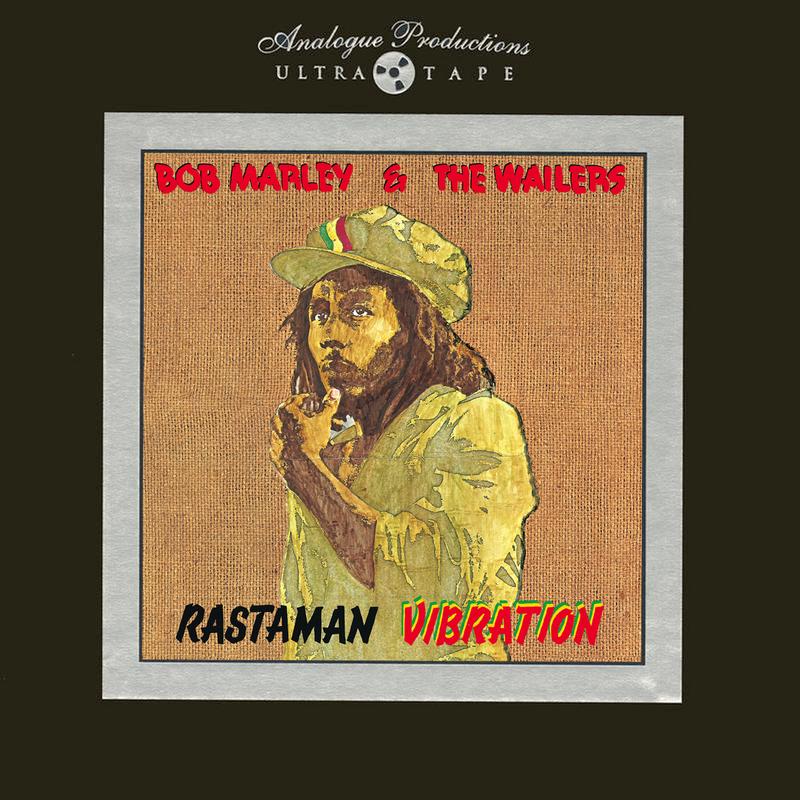
Other songs revisit the Wailers' own past. “Cry to Me” renews an earlier recording, while “Who the Cap Fit” is connected with “Man to Man” from the Lee Perry period. The original cover has an equally specific origin. Neville Garrick placed his image of Marley against burlap, relating the material to Rastafarian sackcloth. Earlier songs, current conflicts and deliberately chosen visual references consequently sit together within the album. Hearing it in sequence reveals those different layers more clearly than treating it simply as a collection of familiar tracks.
The two-reel Ultra Tape edition
Analogue Productions' RRAP 0044 uses quarter-inch tape at 15 ips in two-track stereo, with IEC equalisation specified. Reel one runs from “Positive Vibration” through “Want More”; reel two begins with “Crazy Baldhead” and ends with “Rat Race”. The publisher describes an ATR-modified Ampex machine with Flux Magnetics heads and a custom slipcase. The programme contains the original album, without later CD bonus tracks or the additional mixes associated with expanded editions.
Source descriptions on the product page are not entirely consistent. A headline bullet refers to original master tapes, while the main text explicitly mentions a copy of the original analogue master. A direct copy from the original, or a precise copying generation, therefore cannot be promised. Nor is a separate tape-mastering engineer identified. For playback, the practical requirements are a compatible half-track stereo machine, 15 ips and IEC equalisation. A reference to NAB reels concerns the reel mounting system and should not be mistaken for a statement that NAB playback equalisation is required.
You order from Michael 45 in Germany. We arrange the US import and dispatch from Hilden. Editions not currently in stock are dispatched after the goods arrive.
In the magazine: Bob Marley: Burnin’ and Natty Dread on UHQR
Also on SACD: Rastaman Vibration
More by Bob Marley and The Wailers: Burnin’ · Exodus
Artist page: All titles by Bob Marley & The Wailers
Customer question: Buying Analogue Productions records in Europe
Musicians
Documented participants. Some personnel details or individual track assignments remain unresolved.
| Name | Instrument / role | Participation |
|---|---|---|
| Bob Marley | lead vocals, rhythm guitar, acoustic guitar, percussion | Individual tracks unspecified |
| Aston „Family Man" Barrett | Fender bass, guitar, percussion | Documented on: B4 |
| Carlton Barrett | drums, percussion | Documented on: B4 |
| Tyrone Downie | keyboards, bass, percussion, backing vocals | Documented on: B4 |
| Earl „Chinna" Smith | lead guitar, rhythm guitar, percussion | Documented on: B4 |
| Donald Kinsey | lead guitar | A2, A3 |
| Alvin „Seeco" Patterson | percussion | Documented on: B4 |
| Rita Marley | backing vocals (I Threes) | Documented on: B4 |
| Marcia Griffiths | backing vocals (I Threes) | Documented on: B4 |
| Judy Mowatt | backing vocals (I Threes) | Documented on: B4 |
| Al Anderson | lead guitar | B1 |
| Tommy McCook | saxophone | A2 |
Many sleeve credits do not identify individual tracks. B4 is “War”; documented appearances there do not mean those musicians play only on that track.
🎧 Review video: Inside Abbey Road: Re-Mastering Bob Marley with Chad Kassem & Michael Ludwigs
This video is hosted by YouTube (Google). It only loads once you switch on “Functional” in the cookie settings.

Reviews
There are no reviews yet.