
A meeting with a history behind it
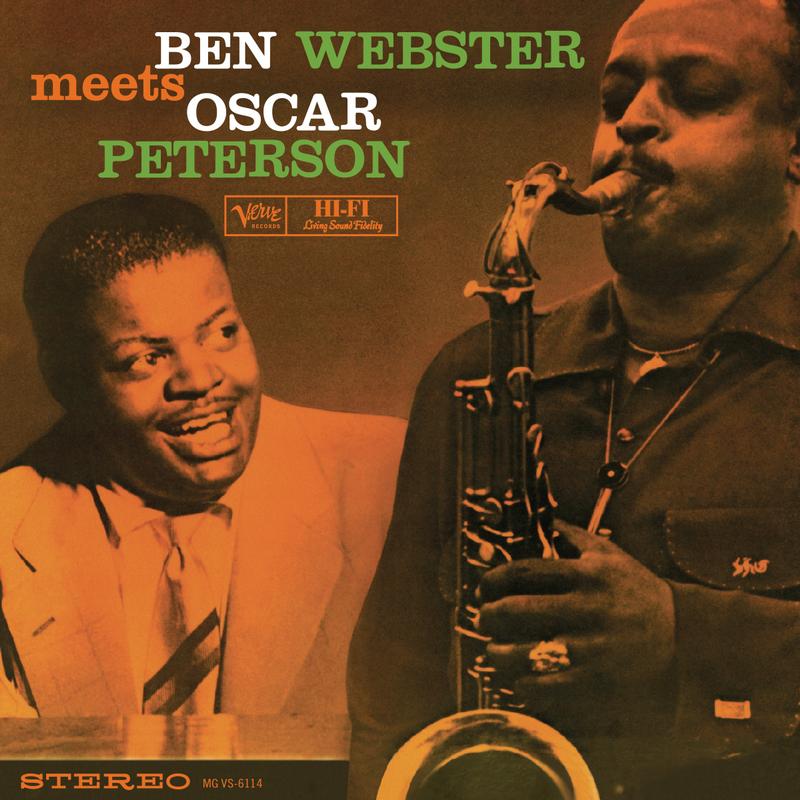
The title Ben Webster Meets Oscar Peterson suggests an introduction. In reality, the two musicians had already worked together extensively. Peterson had accompanied Webster on recordings for Norman Granz during the 1950s, including Soulville. When they recorded the seven selections here on November 6, 1959, they were familiar colleagues. The particular setting gave the encounter its identity: Peterson's trio now comprised piano, Ray Brown's bass and Ed Thigpen's drums. There is no guitarist on this date. Webster's tenor saxophone becomes the fourth voice, entering an ensemble built around the interactions of those three instruments.
That background explains part of the album's appeal. Its title announces a meeting, while the musicians bring an established working relationship to the session. Webster arrives with his experience as an orchestral player and featured soloist. Peterson, Brown and Thigpen supply a trio framework with its own musical relationships. The original credits name Norman Granz as producer. The record belongs to the Verve period in which his catalogue repeatedly brought distinctive players together around a shared repertoire. In this instance, a single recording date produced a complete seven-song programme, giving the album a particularly clear sense of its participants and occasion.

Familiar standards and a recent Sinatra song
Most of the repertoire originated in the 1920s and 1930s. “Bye-bye Blackbird”, “The Touch Of Your Lips”, “When Your Lover Has Gone” and “How Deep Is The Ocean” each bring their own earlier history. “This Can't Be Love” comes from the Rodgers and Hart musical The Boys from Syracuse. In a jazz setting, a familiar song provides orientation while leaving room for individual choices. A listener can retain the tune's shape and follow the way Webster places a phrase, Peterson responds, or Brown and Thigpen carry an idea forward. The composition becomes common ground for the four performers.
“In The Wee Small Hours Of The Morning” is the younger exception. Introduced through Frank Sinatra's 1955 album, it was only four years old when this session took place. The selection therefore places a recent song among older standards. “Sunday” opens a different route through Webster's catalogue: he recorded it again a few weeks later with Gerry Mulligan. Those two performances offer a rewarding comparison for collectors. The same saxophonist returns to the same composition with different partners, allowing the tune to serve as a fixed point while its musical surroundings change. The album contains several such connections without requiring them as preparation for listening.

Four roles across seven performances
Brown had worked with Peterson since the early 1950s. Thigpen belonged to the newer trio configuration in which drums occupied the place previously held by guitar. That change matters beyond the simple question of personnel. The piano can carry harmonic movement while bass and drums develop other aspects of the music's progress. Webster enters this existing relationship as a soloist whose choices will be shaped by the setting around him. The album invites attention to accompaniment as an active part of the performance: an entrance or a pause means something partly because of what the other musicians are doing alongside it.
The programme also allows different amounts of space to its songs. “How Deep Is The Ocean” is comparatively brief, while “This Can't Be Love” provides the extended conclusion. That difference gives the sequence a shape beyond seven successive standards. Hearing both sides in order allows the shorter performances to establish their relationship with the longer ending. A compact piece can act differently in context than it does when selected alone. This reissue preserves the original album's seven selections without bonus material, keeping the particular sequence that turns a single session into a complete listening programme with its own beginning, development and close.
The Acoustic Sounds Series edition
This release is part of the Verve Acoustic Sounds Series, presented as one 180-gram LP playing at 33⅓ rpm. Ryan K. Smith handled the mastering at Sterling Sound. The publisher identifies the original analog tapes as the source. Quality Record Pressings manufactures the record, and Stoughton Printing supplies a tip-on gatefold jacket. Chad Kassem supervises the release within the series. These details describe the work behind this later edition; the quartet's performances belong to the November 1959 recording date. Keeping those two stages distinct helps place the reissue within the longer history of the album.
For a record collection, the particular combination of repertoire and personnel gives the title its place. Webster and Peterson had recorded together before, but here Webster's tenor meets the Brown–Thigpen trio over a complete standard programme. The album documents a specific chapter in that partnership. This single-LP edition maintains the relationship between the original two sides and includes the substantial jacket presentation associated with the Acoustic Sounds Series. For listeners who know these musicians from larger compilations, it offers a more focused setting: four players, one recording date and seven songs whose separate histories come together in a shared session.
You order from Michael 45 in Germany. We arrange the US import and dispatch from Hilden. Editions not currently in stock are dispatched after the goods arrive.
More by Ben Webster: Gentle Ben · King Of The Tenors
Musicians
Participants and documented credit status. Track references correspond to the tracklist.
| Name | Instrument / role | Participation |
|---|---|---|
| Ben Webster | tenor saxophone, bandleader | Album personnel |
| Oscar Peterson | piano | Album personnel |
| Ray Brown | double bass | Album personnel |
| Ed Thigpen | drums | Album personnel |
The same quartet on all seven selections.


Reviews
There are no reviews yet.