

Seven pieces and a new point of reference
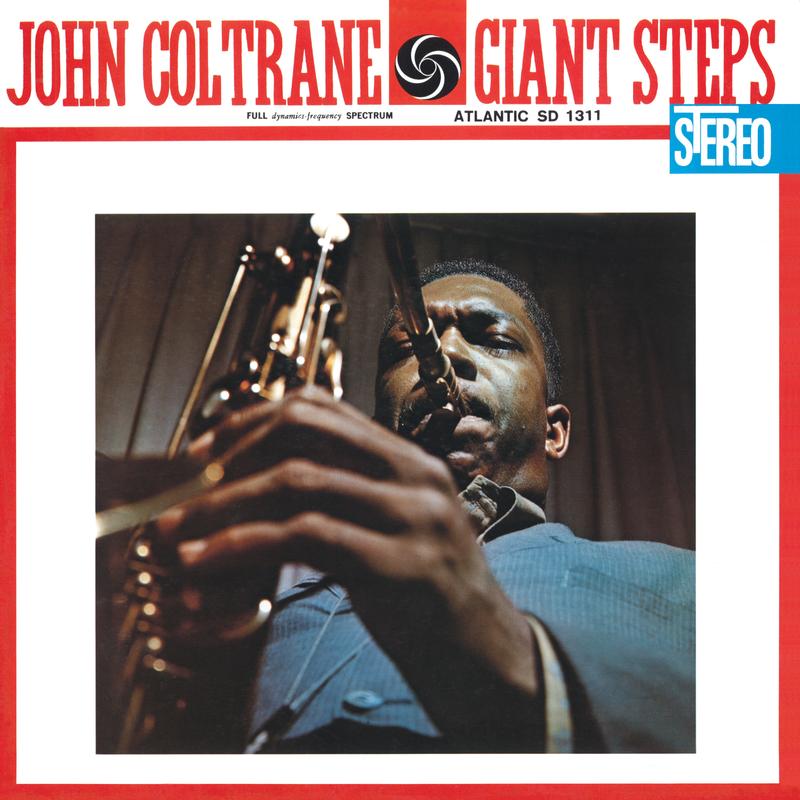
The title sounds like a declaration. On Giant Steps, it becomes music that often seems to have taken its next stride while the listener is still absorbing the last. John Coltrane sends his tenor saxophone through rapidly changing harmonic territory, sets compact figures against one another and joins them into long, insistent lines. Yet treating this record solely as a test for aspiring saxophonists misses much of its character: the blues, the memorable themes and the almost motionless tenderness with which “Naima” brings its momentum to a temporary halt.
Recorded in 1959 and first released by Atlantic in February 1960, the album captures a period when Coltrane’s harmonic investigations and his unmistakable instrumental voice were drawing increasingly close together. All seven pieces are his own compositions, making this an unusually concentrated musical self-portrait. There is no Broadway standard to provide an initial patch of familiar ground. Coltrane establishes that ground himself, sometimes through a simple melodic turn, sometimes through a blues form and sometimes through the unexpected distances between chords.
The apparently abstract programme also carries distinctly personal names. “Cousin Mary” refers to his cousin Mary, “Syeeda’s Song Flute” to his stepdaughter and “Naima” to his then wife. “Mr. P.C.” salutes bassist Paul Chambers. These connections do not turn the album into an illustrated family history, but they give its contrasting temperaments a human relationship. The giant steps lead into a musical space in which affection and investigation can comfortably coexist. Knowing whom a title honours is not necessary to enjoy its melody, although it can change the way that melody is approached.
That is one reason to hear the complete record rather than return only to its famous opening track. It presents Coltrane as a composer who understands contrast and as a soloist whose energy benefits from a carefully shaped setting. The fastest passages become more compelling because they sit alongside tunes that remain memorable without any theoretical explanation. The ballad, in turn, acquires a particular stillness from the motion surrounding it. Ambition and accessibility are both essential to the album’s lasting appeal.

Two rhythm sections with a shared centre
The personnel on this edition can be distinguished clearly by track. Coltrane and Paul Chambers appear throughout. On the sessions of May 4 and 5, 1959, at Atlantic Studios in New York, Tommy Flanagan plays piano and Art Taylor plays drums. Six of the album’s selections come from those dates. For the released version of “Naima,” recorded on December 2, Wynton Kelly and Jimmy Cobb take their places. The original programme therefore contains two quartet line-ups sharing the same saxophonist and bassist, rather than a single group playing one continuous session.
The distinction is musically useful. Chambers holds the lines together without reducing the bass to a simple timekeeping function. His steady forward movement gives the swift changes a physical foundation. Taylor makes the pulse equally clear, allowing Coltrane to compress phrases, extend them and carry them across bar lines. The sensation of speed comes from more than the number of notes. It depends on the relationship between a readily grasped underlying motion and a voice that keeps working above it. Listening to the bass for a chorus can make the saxophone’s next entrance feel different.
Flanagan’s contribution also points directly to the demands of the material. The title composition requires rapid movement among widely separated tonal centres. The piano responds differently from Coltrane’s already highly developed approach to those changes. That difference belongs to the historical performance: these are musicians encountering an idea whose possibilities had not yet become common jazz vocabulary. The recording preserves an exacting musical exchange, with its individual responses and particular pressures, rather than a later demonstration of something everyone already knows from a textbook.
“Naima” moves the emphasis elsewhere. Kelly and Cobb accompany a piece whose tension comes from sustained melodic arcs and subtle harmonic movement rather than a succession of fast chord changes. Chambers supplies the link between the two groups. Nesuhi Ertegun produced the album, with Tom Dowd and Phil Iehle credited for engineering. Earlier alternate recordings featuring Cedar Walton and Lex Humphries belong to the broader history of the project, but they are not among the seven selections on this vinyl edition and should not be folded into its performing personnel.

Rapid motion, direct melodies and the stillness of Naima
“Giant Steps” places its governing idea at the front of the record. Its tonal centres are related by major thirds, and the melody turns the movement between them into a sharply defined theme. The listener does not need to calculate those relationships to hear their effect. Coltrane conveys direction and repeated changes of direction at the same time. Small figures recur under altered harmonic conditions; not every new note introduces a new idea. Much of the performance’s extraordinary drive comes from following the consequences of an idea already set in motion.
“Cousin Mary” brings the blues into focus, showing how firmly Coltrane’s harmonic work remains connected to a familiar musical language. “Countdown” then concentrates the forward drive into little more than two minutes. Its brevity gives it the character of a tightly framed experiment, bringing rhythm and harmonic movement into immediate contact. “Spiral” allows more space for a line to unfold and for the exchange between theme, accompaniment and improvisation. These pieces offer different ways of organising tension, rather than a simple sequence of increasingly difficult exercises.
On the second record, “Syeeda’s Song Flute” occupies a side of its own. Its readily identifiable melody adds a playful quality and demonstrates how much melodic simplicity Coltrane can allow within a demanding programme. “Naima” follows on side D. It avoids grand gestures: expression depends on the way a note begins, is sustained and passes into the next. After attending to the saxophone’s agility elsewhere, this is an opportunity to hear its ability to maintain an extended inner tension with comparatively little material. The change in scale is central to the album’s pacing.
“Mr. P.C.” closes proceedings with a fast minor blues and its named tribute to Chambers. Coltrane thus brings the programme back to a shared, immediately intelligible form. A rewarding listening route is to follow the themes on a first pass, then turn towards bass and piano on the next. The music loses none of its excitement, but its construction becomes easier to follow. Beneath the stream of saxophone notes, recurring forms and the other players’ contributions emerge as essential parts of what makes the performances move.
The Atlantic 75 edition on two 45 RPM records
This Analogue Productions edition is part of the Atlantic 75 series and carries catalogue number AAPA 010-45. The original seven-track programme is spread across two 180-gram stereo records playing at 45 RPM. Ryan K. Smith handled mastering at Sterling Sound, with the original analogue master tape identified by the label as the source. Quality Record Pressings manufactures the records. The package includes a laminated Stoughton tip-on gatefold jacket with two pockets, retaining the physical scale associated with this series of reissues.
The four-side arrangement is specific to this edition. “Giant Steps” and “Cousin Mary” occupy side A; “Countdown” and “Spiral” are on B; “Syeeda’s Song Flute” has C to itself; and “Naima” and “Mr. P.C.” share D. These are short, clearly defined sections, although playing the entire album also involves additional side changes. The higher speed is a technical choice for this vinyl release, not a substitute for judging playback on an actual system. Mastering and pressing specifications likewise do not constitute a universal sound guarantee for every copy and installation.
Numbering is documented for the first 2,000 copies. Without inspecting the specific stock batch, that should not be taken as a promise that a currently supplied copy will be numbered. This version must also be distinguished from the separately offered SACD: the album and its players are the same, while format, mastering details and practical handling belong to their respective releases.
This edition offers Coltrane’s seven compositions within the Atlantic 75 programme on 45 RPM vinyl. At its centre remains the remarkable balance between harmonic boldness and personal expression. Giant Steps invites detailed study, but its themes, blues forms and ballad stillness remain equally persuasive when the listener sets theory aside and simply follows the music.
You order from Michael 45 in Germany. We arrange the US import and dispatch from Hilden.
Artist page: All titles by John Coltrane
Customer questions: Atlantic 75: which titles are worth buying? · Buying Analogue Productions records in Europe
Series: Atlantic 75 Series – all 75 albums, time journey and the people behind Atlantic
Musicians
Participants and documented credit status. Track references correspond to the tracklist.
- John ColtraneExisting portrait reference 1960tenor saxophoneParticipation: All seven original tracks
- Paul ChambersExisting portrait reference 1958double bassParticipation: All seven original tracks
- Tommy FlanaganExisting identified portrait; date unconfirmedpianoParticipation: A1–C1 and D2 · May 1959
- Art TaylorExisting portrait reference 1963drumsParticipation: A1–C1 and D2 · May 1959
- Wynton KellyExisting portrait reference 1962pianoParticipation: D1 · Naima · December 1959
- Jimmy CobbExisting identified portrait; date unconfirmeddrumsParticipation: D1 · Naima · December 1959


May 1959: Tommy Flanagan and Art Taylor; Naima, December 2, 1959: Wynton Kelly and Jimmy Cobb. John Coltrane and Paul Chambers on all seven tracks. Nesuhi Ertegun: producer; Tom Dowd and Phil Iehle: engineering. All seven compositions by John Coltrane. Cedar Walton and Lex Humphries belong to alternate recordings, not this LP. Ryan K. Smith / Sterling Sound: mastering for this 45 RPM reissue.
How Michael hears this edition
Listening impression · paraphrased from the video
Looking back on his comparisons, Michael describes this Atlantic 75 edition of Giant Steps as retaining the sound of the original while adding a little more information and detail. He mentions it alongside My Favorite Things in his video about Coltrane Plays the Blues. This is a recollection of his listening experience, rather than a new comparison conducted in that video.

Reviews
There are no reviews yet.