

A whole ballet repertoire in one substantial recording
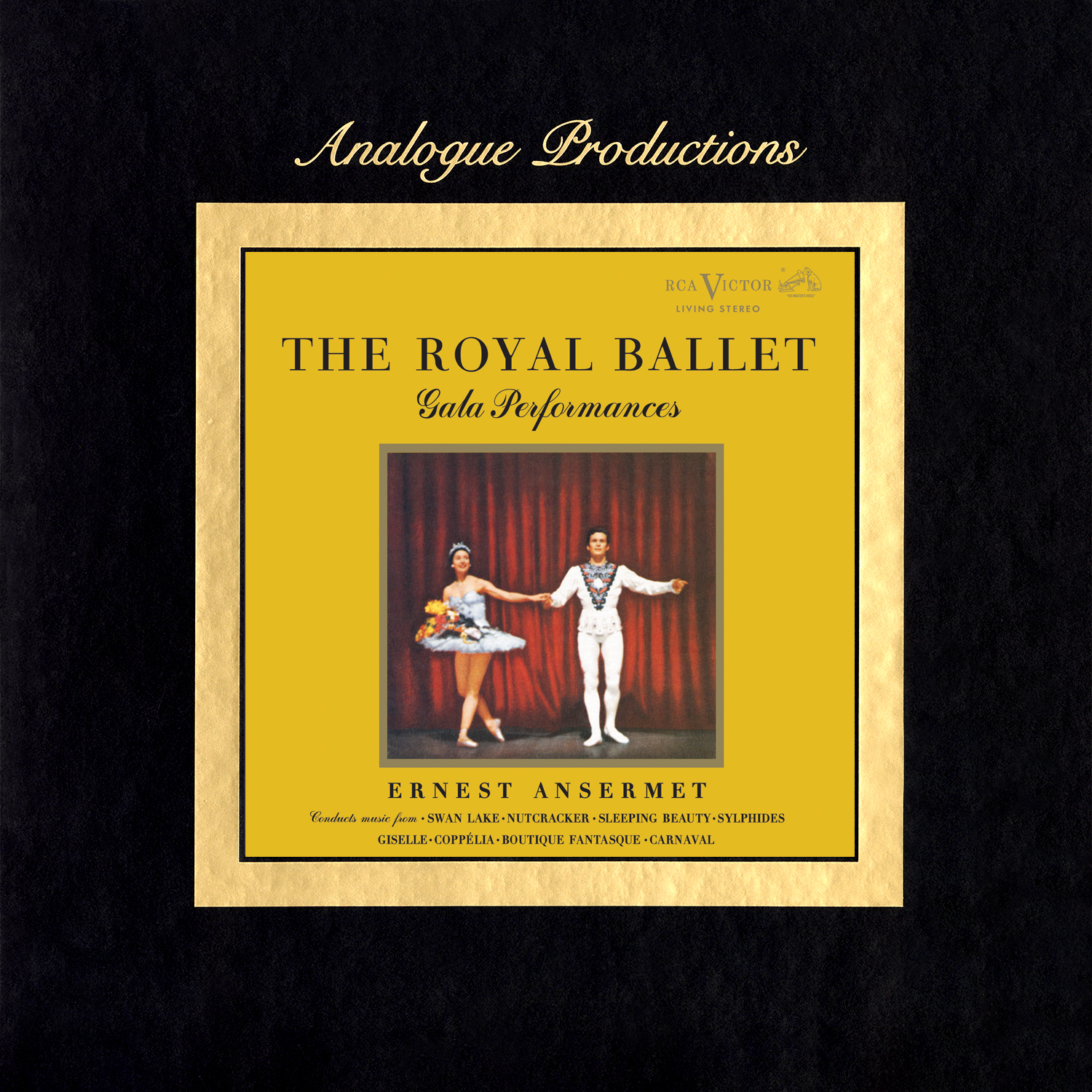
A march raises the curtain, a waltz opens out the space, and a few minutes later a single musical gesture suggests an entirely different stage. The Royal Ballet Gala Performances brings together selections from eight ballets. Tchaikovsky appears alongside Delibes and Adam; Rossini, Schumann and Chopin enter through music adapted for ballet. Rather than following one continuous story, the programme explores the different ways an orchestra can carry movement, character and atmosphere. In a record collection, it offers both an introduction to a repertoire and the pleasure of returning to many of its finest individual numbers.
In January 1959, Ernest Ansermet recorded the programme with the Orchestra of the Royal Opera House, Covent Garden, at Kingsway Hall in London. The original stereo edition appeared as a two-LP set on RCA Victor Red Seal, LDS-6065. Michael Williamson produced the recording, with Kenneth Wilkinson as engineer. Their involvement connects the project with Decca’s British recording tradition, although the original release carries RCA’s name. For collectors, that distinction is more revealing than simply placing the record beneath a famous label: the recording team, the orchestra and the releasing company are different elements of the same history.
Ansermet is especially closely associated with the Orchestre de la Suisse Romande. Here, however, he conducts London’s opera-house orchestra. A theatre ensemble brings a particular background to this music: in ballet, phrases provide time for steps, lifts and transitions as well as melodic shape. These sessions were made in a recording venue, rather than captured during a stage performance. Nevertheless, the theatrical connection is useful to keep in mind. Each selection needs to stand as an orchestral piece while retaining something of the movement for which it was conceived.

Ernest Ansermet and the musical understanding of dance
Ansermet’s name is no incidental addition to this programme. The Swiss conductor’s familiarity with ballet extended back to his work with the Ballets Russes. That experience provides a meaningful background to a collection moving between Tchaikovsky’s large-scale ballets, French theatre music and orchestrated piano pieces. The demands change considerably along the way: a waltz calls for a different internal swing from a character miniature, and a pas de deux requires a different span from a brisk ensemble dance. One rewarding listening approach is to follow how weight, articulation and phrase length distinguish those different tasks.
The programme begins with selections from The Nutcracker: the March, Dance of the Sugar Plum Fairy, Arabian Dance, Chinese Dance, Dance of the Reed Pipes and Waltz of the Flowers. This sequence alone places contrasting orchestral colours side by side. The Sugar Plum Fairy is associated with the bright sound of the celesta; the Reed Pipes turn attention towards the woodwind, while the Waltz of the Flowers unfolds on a larger scale. These are selected numbers rather than a complete performance of the ballet. Their close proximity makes the changes of instrumentation and character particularly easy to follow.
La Boutique fantasque introduces Rossini’s music in Respighi’s adaptation. Tarantella, Andante mosso and Can-Can bring another kind of theatre into the sequence, with figures and gestures already suggested by their titles. Coppélia follows through introductions, a mazurka, waltzes, a csárdás and the doll’s waltz. In Delibes’ music, dance and dramatic characterisation sit closely together. The selections provide enough space to enter that world without claiming the structure of a complete evening in the theatre. This is part of the attraction of a carefully assembled gala: each excerpt opens a window of its own.

From Giselle to Les Sylphides: eight different stage worlds
Adolphe Adam’s Giselle brings the Romantic ballet tradition explicitly into focus. The introduction and waltz from Act I sit beside the pas de deux and variation from Act II. Swan Lake is represented by the Dance of the Little Swans, a pas de deux and a waltz. Familiar melodies make a welcoming starting point, but they need not be the end of the discovery. Follow the accompanying figures beneath a sustained melodic line, or notice how a short introduction establishes the proportions of the number that follows. These relationships give each excerpt a shape beyond its best-known tune.
Carnaval introduces Schumann’s piano music in orchestral form. Pierrot, Reconnaissance, Aveu and Pantalon et Colombine are the selected character pieces. The orchestration, involving Glazunov and Rimsky-Korsakov among others, changes the means through which the material is expressed: effects created at the piano through touch, register and pedal are distributed among instrumental colours and groups. Within this album, that makes an especially rewarding change of perspective. A familiar musical idea remains recognisable while its contours emerge differently when carried by a larger ensemble.
The programme returns to Tchaikovsky for The Sleeping Beauty. The introduction with the Lilac Fairy, the Rose Adagio and the waltz combine ceremonial scale with expansive movement. Three Chopin pieces from Les Sylphides, orchestrated by Roy Douglas, bring the collection to its conclusion: the Prelude in A major, Op. 28 No. 7, the Mazurka in C major, Op. 67 No. 3, and the Grande Valse brillante in E-flat major, Op. 18. The music’s origins at the piano remain part of its identity. Across eight stage works, the connecting thread is a succession of contrasting forms: march and waltz, character piece and adagio, broad tableau and small gesture.
The Analogue Productions edition on five LPs
This edition is AAPC 6065-45, presenting the stereo programme across five LPs playing at 45 RPM. Bernie Grundman is responsible for mastering, with the publisher identifying the original analogue tape as the source. Nine sides contain the musical programme. The tenth repeats the contents of the first; it does not supply an additional, previously unknown ballet selection. That unusual feature belongs to this particular edition and is useful to know when planning a complete evening with the recording.
Spreading the programme over nine sides creates different cutting conditions from the original two-LP set. At an equivalent groove position, 45 RPM moves the groove past the stylus faster than 33⅓ RPM. That fact alone does not establish a verdict on sound quality. In daily use, the more immediate differences are shorter sections and additional side changes. Listeners interested in individual dances and orchestral colours can make deliberate use of those divisions. The order of the works is retained while the physical experience becomes more segmented.
The presentation includes a slipcase, Stoughton Printing tip-on gatefold jackets and a 22-page illustrated book integrated into the jacket construction. Texts by Arnold L. Haskell and Ansermet complement the musical selections. Different pressing runs are documented under this catalogue number, so a particular numbering scheme or pressing plant is not promised for every copy here. The defining features are securely assigned: five stereo LPs at 45 RPM, Grundman’s mastering and the substantial illustrated book. You order from Michael 45 in Germany. We arrange the US import and dispatch from Hilden.
Also on SACD: The Royal Ballet Gala Performances
Also in another edition: The Royal Ballet Gala Performances
Customer questions: 45 or 33⅓ RPM: which edition is worth it? · Buying Analogue Productions records in Europe
Musicians
Participants and documented credit status. Track references correspond to the tracklist.
- Ernest AnsermetconductorParticipation: Complete programme
- Orchestra of the Royal Opera House, Covent GardenorchestraParticipation: Complete programme

Conductor and orchestra are documented; individual orchestra members are not securely identified. The tracklist lists the eight works. Movement-by-movement boundaries of the 45 RPM sides remain unconfirmed; nine sides contain the programme and the tenth repeats the first.

Reviews
There are no reviews yet.