Three pieces from a New York jazz club
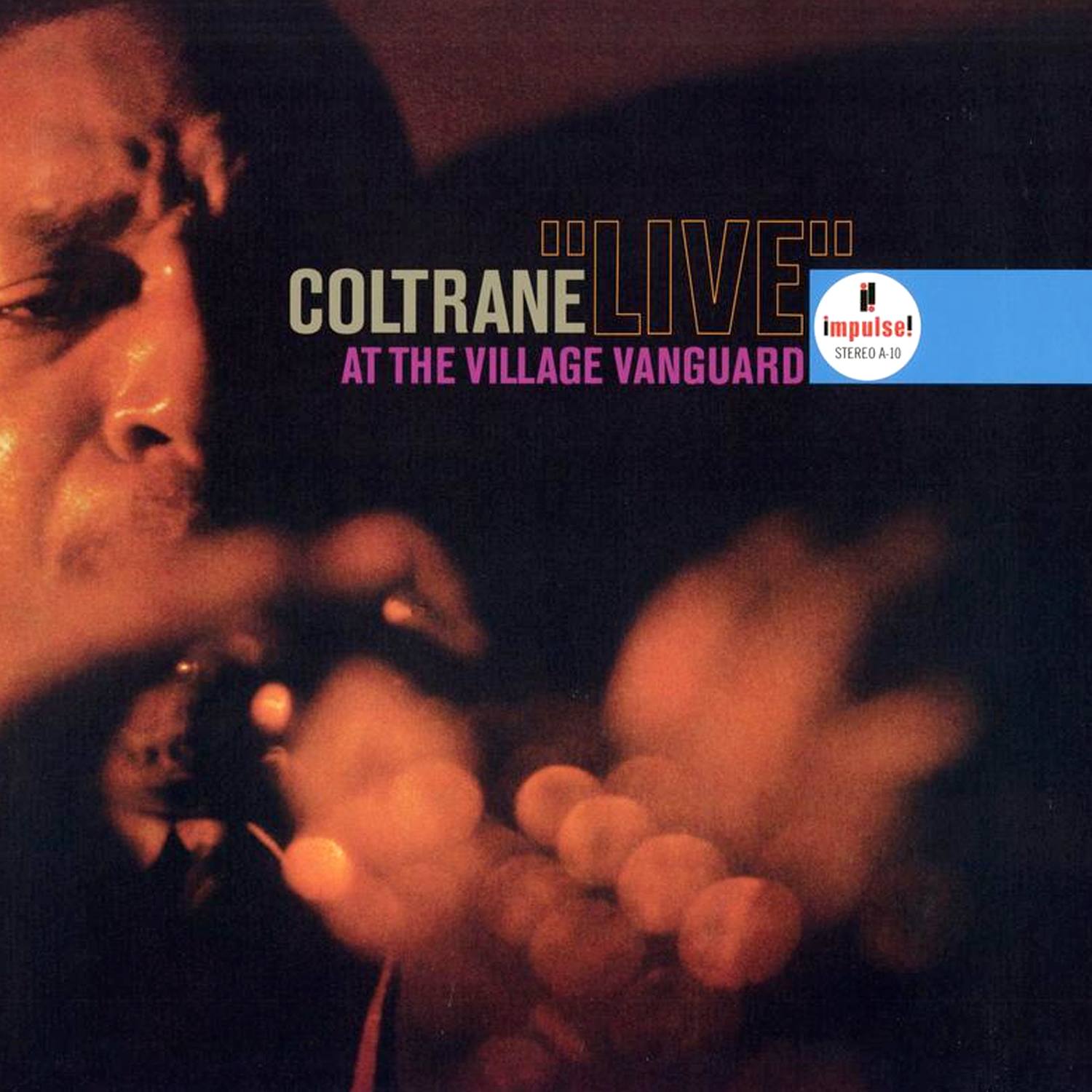
November 1961, the Village Vanguard, New York: John Coltrane brings his music into a club whose name would remain closely associated with these recordings. “Live” at the Village Vanguard appeared on Impulse! in 1962, concentrating its programme into three pieces. That small number says little about the record’s musical range. “Spiritual”, “Softly as in a Morning Sunrise” and “Chasin’ the Trane” open markedly different spaces. Together they form an album that does not attempt to represent every performance from the engagement. Instead, it presents a particular selection as a complete release in its own right.
Bob Thiele produced the album, with Rudy Van Gelder responsible for recording. Van Gelder’s name identifies the engineer here, not the venue: the music was recorded at the Village Vanguard, rather than at his Englewood Cliffs studio. This distinction is more than a discographical detail. The album preserves live performances in which the musicians develop their forms through the actual duration of a rendition. The release gives those performances the shape of two record sides, an arrangement that still offers its own distinctive approach to this period of Coltrane’s work.
Coltrane plays tenor and soprano saxophones; Eric Dolphy contributes bass clarinet to “Spiritual”. McCoy Tyner, Reggie Workman, Jimmy Garrison and Elvin Jones also belong in the credits, though not all of them play together on every selection. With a body of live material that was subsequently expanded across numerous releases, it matters to take the original LP seriously. This record is neither an arbitrary abridgement of a complete edition nor a document of one unchanging ensemble. Each of its three performances has its own instrumental shape. That is central to its interest: a shared artistic direction remains audible as an idea, while the means available to the musicians change.

Spiritual, a standard and a full side of Trane
“Spiritual” opens the first side and runs for a little over thirteen minutes. Dolphy’s bass clarinet expands the ensemble’s resources with a low woodwind voice distinct from the addition of another saxophone. The piece is credited to Coltrane. An initial point of listening interest is the combination of voices: how can an extended piece and an additional instrumental colour sustain a particular arc? The bass clarinet is not simply a decorative detail. Its presence changes the possibilities of interaction and gives this performance a specific identity within the album. Following those relationships offers a way into the piece without reducing it to a historical label.
“Softly as in a Morning Sunrise”, by Sigmund Romberg and Oscar Hammerstein II, follows. Coltrane’s soprano saxophone is now part of a quartet with Tyner, Workman and Jones. At approximately six and a half minutes, this is the shortest section of the LP. After the extended opener, the standard provides a different formal reference. An inherited melody and its harmonic movement meet musicians whose expression goes beyond simply restating the tune. That change makes side one more than a sequence of live tracks: the relationship between repertoire and instrumentation is itself part of the programme’s shape.
The second side belongs entirely to “Chasin’ the Trane”. A reduced core ensemble carries the performance for almost sixteen minutes: Coltrane’s tenor saxophone, Jimmy Garrison’s double bass and Elvin Jones’ drums. There is no piano. The balance between harmonic definition and melodic-rhythmic movement consequently shifts. A piece of this length invites attention to development, repetition and change; counting the minutes of a solo cannot adequately describe its purpose. On vinyl, the concentration becomes tangible. Turning the record over begins a single extended sequence that occupies the whole side. That decision is an essential part of the original album’s form.

Personnel belong to the particular take
The performances selected for this LP were recorded on 2 and 3 November 1961. “Softly as in a Morning Sunrise” and “Chasin’ the Trane” come from 2 November, with “Spiritual” recorded the following day. For “Spiritual”, the session discography lists Coltrane on tenor and soprano saxophones, Dolphy on bass clarinet, Tyner on piano, Workman on bass and Jones on drums. The standard retains the quartet without Dolphy. These particular assignments prevent musicians or instruments from other performances during the engagement from being accidentally imported into the three original album tracks.
The bass personnel are especially easy to confuse. Reggie Workman plays the two pieces on side one; Jimmy Garrison plays “Chasin’ the Trane”. Garrison is not simply an additional bassist alongside Workman on that selection. McCoy Tyner likewise does not belong to its core ensemble. The session discography records one further, narrowly defined detail: Dolphy is credited with the final note of “Chasin’ the Trane” on alto saxophone. That supplementary credit is not a reason to describe him as a second soloist throughout the piece. The musicians section preserves these distinctions rather than flattening them into a single album-wide personnel list.
There is no need to memorise these details before listening. They help, however, to connect the music with appropriate expectations. A piano quartet offers different relationships from saxophone, bass and drums; a bass clarinet adds another range of possible voices. Elvin Jones links the three performances as drummer, while the instrumental balance and form change around him. The record encourages those changes to be understood as musical events. Listeners who already know Coltrane through other albums encounter more than a famous live recording here: they meet three identifiable situations within a wider period of artistic exploration, each with its own practical possibilities.
The single stereo LP at 33⅓ RPM
This edition, AIMP 78201, presents the original programme in the Acoustic Sounds Series on a 180-gram stereo LP at 33⅓ RPM. Ryan K. Smith at Sterling Sound is responsible for mastering from the original analogue tapes. The record is manufactured at Quality Record Pressings and housed in a Stoughton tip-on gatefold jacket. These details belong to this particular reissue; the performances remain the live recordings of November 1961. Recording, first release and present-day manufacture are three stages that complement one another without needing to be confused.
For a collection, the appeal of this presentation is easy to understand. It preserves the original choice of three pieces instead of adding further performances from the same nights to the tracklist. Expanded releases can fulfil a different documentary purpose; here, the album’s original proportions are the focus. Its two sides are deliberately unequal in construction. The first moves between an extended piece and a more compact standard, while the second contains one long performance. The format supports that arrangement. Within this LP side, “Chasin’ the Trane” is not interrupted by another side change, allowing its full duration to remain a single listening commitment.
You order from Michael 45 in Germany. We arrange the US import and dispatch from Hilden. “Live” at the Village Vanguard invites concentrated attention to form, personnel and the flexibility of a musical language. Its importance is not exhausted by the club’s name or the bandleader’s reputation. The three selected performances provide specific reasons to spend time with it: Dolphy’s bass clarinet, Coltrane’s change of saxophone voice, the quartet with Tyner and Workman, and finally the reduction around Garrison and Jones. Following those differences makes this single 33⅓-RPM LP a clearly organised yet expansive encounter with one part of Coltrane’s development.
More by John Coltrane: A Love Supreme · Ballads
Artist page: All titles by John Coltrane
Series: Impulse! – all 19 records: the house that Trane built
Musicians
Participants and documented credit status. Track references correspond to the tracklist.
- John Coltranetenor and soprano saxophonesParticipation: A1: tenor/soprano · A2: soprano · B1: tenor
- Eric Dolphy1960bass clarinet; alto saxophone (final note of B1 per session discography)Participation: Bass clarinet A1 · B1: supplementary discography credit
- McCoy Tyner1973 · later portrait referencepianoParticipation: A1, A2
- Reggie Workmandouble bassParticipation: A1, A2
- Jimmy Garrisondouble bassParticipation: B1
- Elvin Jones1964 · later portrait referencedrumsParticipation: All tracks


The original LP comprises three specific takes: A1 from 3 November, A2/B1 from 2 November 1961. Garrison plays B1, Workman A1/A2; Tyner does not play on B1. Dolphy’s bass clarinet is credited on A1. Jazzdisco additionally credits only the final note of B1 to Dolphy on alto saxophone. Other personnel from the engagement have not been imported into this LP.
How Michael hears this edition
Listening impression · paraphrased from the video
Michael hears excellent separation, soundstage depth and overall quality. On the opening track Spiritual, however, he notices a left-heavy layout with a small spatial gap that takes some getting used to. He has not yet made a mono comparison.
🎧 Review video: John Coltrane Live at the Village Vanguard Acoustic Sound Series
This video is hosted by YouTube (Google). It only loads once you switch on “Functional” in the cookie settings.

Reviews
There are no reviews yet.