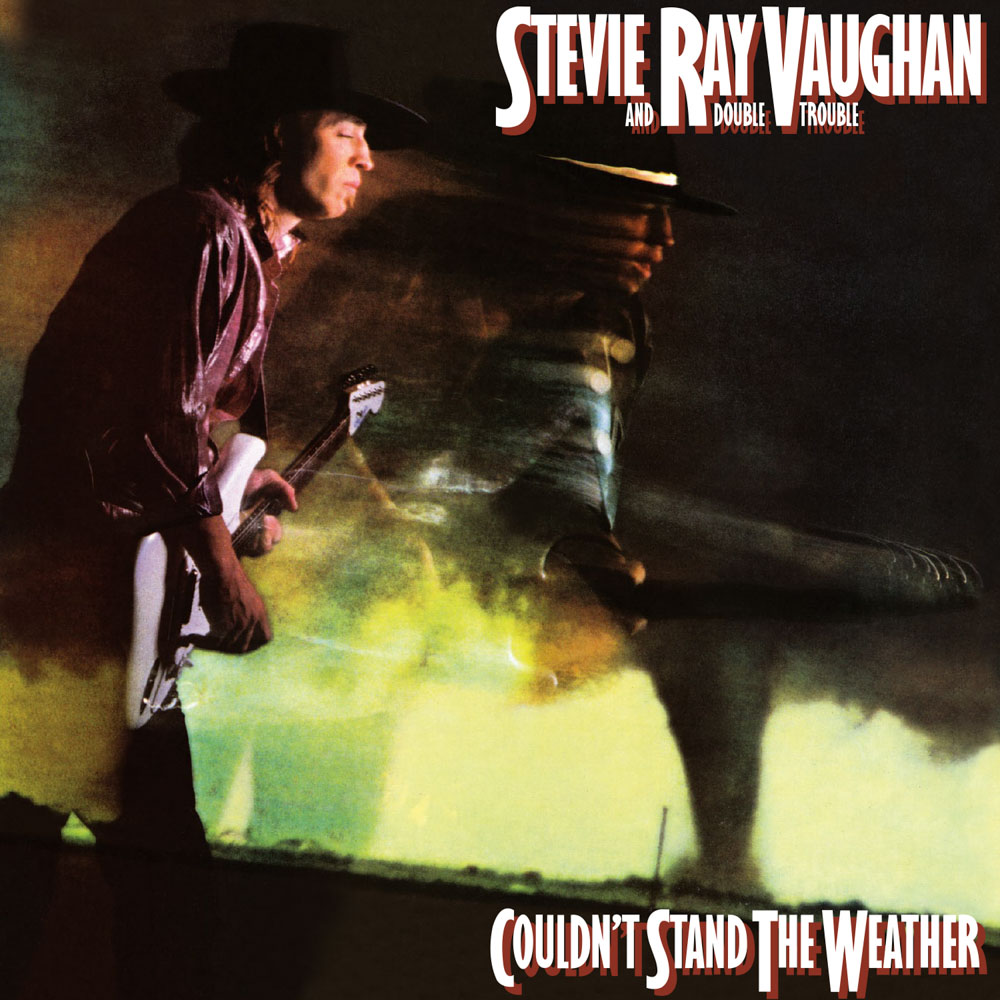

Couldn’t Stand the Weather: blues with a wider horizon
Stevie Ray Vaughan puts no lengthy introduction between the listener and his music on this album. Scuttle Buttin’ opens the record as a compact instrumental, placing the guitar immediately at its centre. The title track then opens a different space: vocals, rhythmic tension and a band that refuses to reduce blues to a single approach. Couldn’t Stand the Weather brings concise songs together with extended instrumental passages and a notably slow blues. Its eight tracks form a programme whose differences matter as much as the distinctive voice of its guitarist. That variety is an excellent reason to hear the entire record.
The sessions took place in January 1984 at the Power Station in New York. Epic released the original album on 15 May 1984. Vaughan is joined at its centre by Tommy Shannon on bass and Chris Layton on drums, making the name Double Trouble an essential part of the record’s identity. Bass and drums provide the foundation that gives a guitar phrase weight, pushes an entrance forward or sustains the tension of a slower performance. Vaughan’s guitar makes the music immediately recognisable, but its movement emerges from the relationships between the musicians. Those relationships deserve as much attention as any individual solo.
This Analogue Productions edition spreads the album across two LPs playing at 45 RPM. It also changes the experience of playing the record at home: the eight tracks occupy four sides, with Tin Pan Alley given a side of its own. That creates a different listening rhythm from the original single-LP sequence. The additional handling is part of the format. Anyone seeking a 45-RPM edition receives the complete original eight-track programme here, without bonus material altering its shape. Track order, mastering and the identity of this particular release are therefore equally useful when deciding which version belongs in a collection.

From a compact opening to a whole side for Tin Pan Alley
Side A brings together Scuttle Buttin’, Couldn’t Stand the Weather and The Things (That) I Used to Do. The instrumental opener lasts just 1:49 and places its emphasis differently from the two vocal performances that follow. These first three selections already show the album moving between immediate guitar energy and more fully developed songs. One rewarding approach is to notice how the relationship between voice and guitar changes. The instrumental voice may take the foreground on its own, answer a sung line or prepare the next entrance. Those exchanges keep the music mobile even within a familiar blues vocabulary.
Side B contains Voodoo Chile (Slight Return) at 7:58 and Cold Shot at 3:57. Two tracks create a chapter of their own, with their contrasting lengths providing an initial clue to the difference in scale. The tracklist for this edition requires particular care: the documented rear sleeve mistakenly assigns Cold Shot to D1. Its correct position is B2. The track information on this page follows the actual sequence. Such details are useful to collectors, since a printed error can otherwise migrate into later descriptions and make a straightforward listening session more confusing than it needs to be. The four sides are clearly identified below.
At 9:10, Tin Pan Alley occupies side C alone. It rewards a different sense of proportion from the brief opening instrumental. Listen for the spaces between phrases and for the weight a single note can acquire within a slow-moving performance. Side D returns to shorter forms with Honey Bee and Stang’s Swang. The closing instrumental adds another facet to the album rather than simply repeating the character of its beginning. Four sides thus create four manageable listening chapters. Their proportions make the variety of the programme particularly clear, from its concentrated opening statement to its expansive slow blues and compact final pair.

Double Trouble and the guests behind the eight tracks
Vaughan, Shannon and Layton form the central band, but a complete account also acknowledges the additional musicians. Jimmie Vaughan is credited with rhythm guitar, Stan Harrison with tenor saxophone and Fran Christina with drums. With album personnel of this kind, the connection to an individual track matters: a guest credit does not mean that the musician plays throughout the record. The musician section therefore gives documented assignments and identifies their evidence limits. Vaughan’s vocal credit likewise does not mean that every selection includes singing. Instrumental pieces are an important part of the programme and should remain recognisable as such in the credits.
A second play with deliberately shifted attention is an effective way to become better acquainted with the band. Follow the bass instead of waiting for the next striking guitar phrase, then concentrate on the way drums and guitar connect their entrances. These changes of perspective need not turn a familiar album into an academic exercise. They simply reveal more of its internal movement. Music with such a commanding lead voice can make the work of accompanying players seem almost self-evident. Their decisions nevertheless help determine whether a short song feels complete and whether a slow performance sustains its shape across several minutes.
The production credits name Stevie Ray Vaughan, Tommy Shannon, Chris Layton, Richard Mullen and Jim Capfer, with John Hammond listed as executive producer. Richard Mullen handled recording engineering, assisted by Rob Eaton. These responsibilities belong to the album’s creation and are documented separately from its performing personnel. The Power Station is the actual recording location; our illustrations do not attempt to reconstruct a particular moment inside it. They offer independent visual interpretations of the artist and his instrumental world. The guitar illustration should not be read as evidence for a specific instrument or amplifier used on an individual track.
The Analogue Productions 45-RPM edition
For this reissue, Ryan K. Smith at Sterling Sound handled mastering, with Gary Salstrom documented for the metalwork. Quality Record Pressings manufactured the records. Catalogue number APB 097-45 and shop identifier AAPB 097-45 distinguish this double LP from other releases of the album. A gatefold sleeve forms part of the documented edition. Its original standalone release is dated to 2016; the programme had previously appeared in the Texas Hurricane box. The product considered here is the separate double LP, rather than the complete box or a different reissue carrying an expanded selection of bonus performances. Those distinctions matter when comparing editions.
The higher playback speed is a definite format specification, rather than an automatic promise about every system or every individual pressing. Two LPs bring more side changes and a different allocation of playing time. The dedicated side for Tin Pan Alley is especially appealing for listeners who enjoy concentrating on one extended performance. Anyone who prefers to hear a longer album sequence without interruption should also understand the handling involved. That is why the four-sided layout is described explicitly here and kept separate from sweeping sound-quality claims. The music provides ample reasons to explore this edition without needing an unsupported technical superlative.
If you want to buy Stevie Ray Vaughan and Double Trouble’s Couldn’t Stand the Weather on vinyl, this is the 45-RPM double LP, accompanied by clear edition information, the complete tracklist and expanded musician credits. Michael 45 dispatches from Hilden in Germany, so customers ordering within Germany and the EU do not need to arrange their own US import. The stock and delivery information beside the purchase controls determines current ordering availability. This product story remains useful even during a temporary absence from stock, helping identify the edition precisely. Its appeal combines memorable songs, distinctive instrumentals and an unusually clear division into four listening chapters.
Customer question: Buying Analogue Productions records in Europe
Musicians
Participants and documented credit status. Track references correspond to the tracklist.
- Stevie Ray VaughanPortrait reference: 1983vocals, guitarParticipation: Guitar: entire album; vocals on vocal tracks, excluding A1 and D2
- Tommy ShannonPortrait reference: um1983bassParticipation: all eight tracks
- Chris LaytonPortrait reference: um1983drumsParticipation: Album credit; Fran Christina is additionally credited for D2
- Stan Harrisontenor saxophoneParticipation: Original-LP album credit; track assignment not sufficiently documented
- Jimmie VaughanPortrait reference: 2012rhythm guitarParticipation: A2, A3 · supplementary album documentation
- Fran ChristinadrumsParticipation: D2 · supplementary album documentation


Production: Stevie Ray Vaughan, Tommy Shannon, Chris Layton, Richard Mullen and Jim Capfer. Executive producer: John Hammond. Recording: Richard Mullen; assistant: Rob Eaton. Cover: Holland Macdonald; photography: Benno Friedman. Mastering: Ryan K. Smith, Sterling Sound; metalwork: Gary Salstrom; pressing: QRP. Guest credits supplemented from album documentation; Stan Harrison is also credited on the original LP.

Reviews
There are no reviews yet.