A 1962 album, a session from 1958
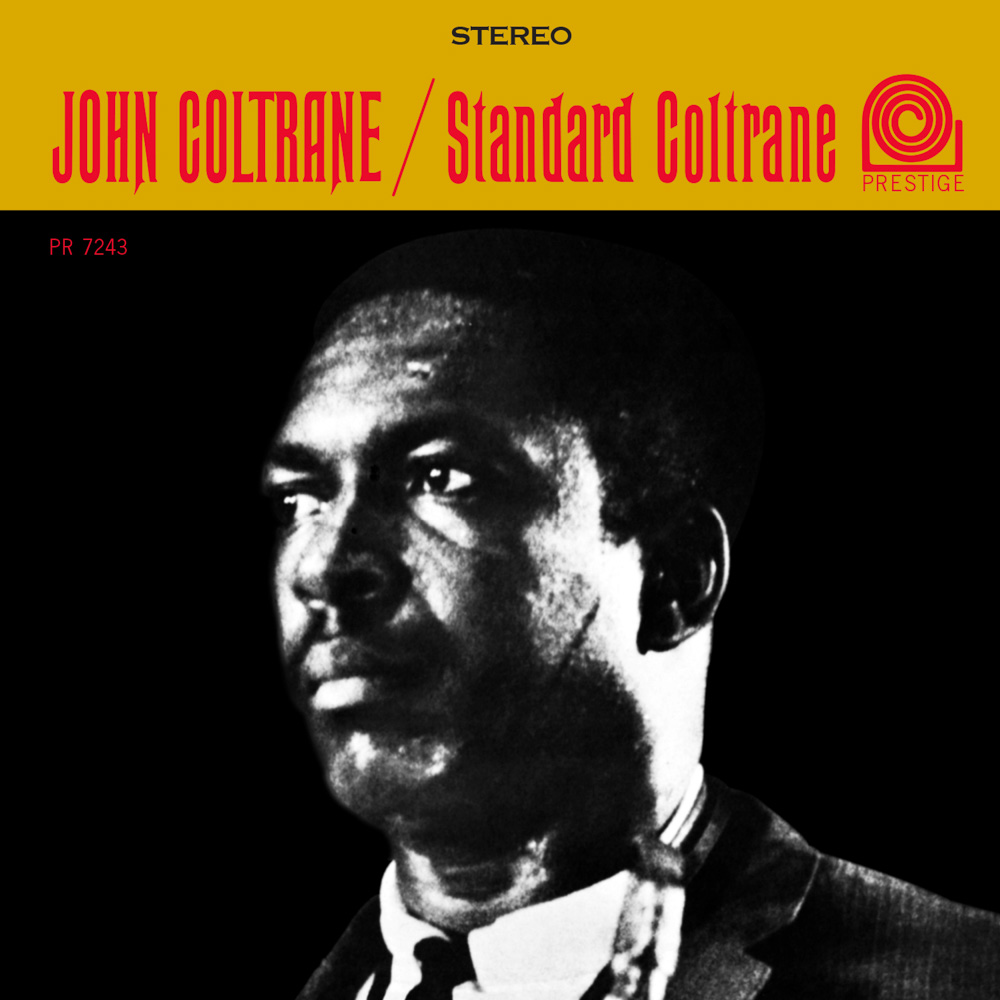
With Standard Coltrane, the release date and recording date belong to different chapters of the same career. Prestige issued the album in 1962; the music had been recorded on 11 July 1958 at Rudy Van Gelder’s studio in Hackensack, New Jersey. This distinction matters beyond discographic neatness. It prevents the recording from being automatically associated with the band and musical circumstances for which Coltrane became celebrated in the early sixties. Here he plays tenor saxophone in a quintet with Wilbur Harden, Red Garland, Paul Chambers and Jimmy Cobb. Four standards provide their shared starting point and give the programme its particular identity.
The title therefore describes a genuine organising principle. “Don’t Take Your Love from Me”, “I’ll Get By”, “Spring Is Here” and “Invitation” come from the repertoire of professional songwriters; there is no Coltrane original in the selection. Attention falls on a particularly rewarding aspect of his work: the ability to give an already shaped melody an individual direction. These songs have recognisable outlines, and that very definition creates room for invention. An improvised line can press against a familiar turn, extend it or explore its harmonic possibilities. The composition remains an active partner in the performance, rather than merely an excuse for the next solo.
For collectors, Standard Coltrane consequently occupies a place of its own. There is no need either to promote it as the hidden key to the entire career or to dismiss it as an incidental archive release. It documents a particular group of musicians on a particular day. Bob Weinstock produced the session, Van Gelder recorded it, and Robert Levin wrote the liner notes for the original album release. Several years separate the musicians’ work together from its appearance in this Prestige LP programme. Keeping those two timelines distinct allows the music to emerge more clearly: as a working quintet’s moment in time and as an album deliberately centred on standards.

Four familiar forms, four individual journeys
“Don’t Take Your Love from Me” was written by Henry Nemo. As the opening selection, it establishes the space in which the two horns and rhythm section meet. With this instrumentation, the theme deserves attention as more than an introduction. It defines melodic proportions to which the subsequent passages remain related. Interest comes not only from the number of notes played, but from where a phrase begins, where it leaves space and how it responds to a harmonic movement. A standard supplies a common language for those decisions without determining in advance the exact words each musician will choose in reply.
“I’ll Get By” brings together the writing credits of Fred Ahlert and Roy Turk. The second LP side then begins with “Spring Is Here”, by Richard Rodgers and Lorenz Hart. Rather than racing through the largest possible number of selections, the album lets four song forms carry the entire programme. This offers a satisfying scale for sustained attention: a listener can remain with a theme, follow its transformations and consider differences between the voices more closely. A piano entry, bass movement or shift of rhythmic emphasis matters within that context, without requiring a description to invent an unsupported sequence of solos or exact instrumental entrances.
“Invitation”, by Bronislau Kaper and Paul Francis Webster, completes the record. Together, the four songs offer the musicians melodic orientation and harmonic possibilities in equal measure. Coltrane’s prominence on the sleeve should not obscure the fact that five participants shape the result. An album without changing large ensembles makes it possible to notice how much character can arise from the relationship between only a few voices. Repeated listening can therefore move its centre of attention: first towards the melodic line, then towards the accompaniment, then towards the exchanges between the horns. The repertoire remains unchanged, while different connections within it become available to the ear.

Five musicians sharing a working space
John Coltrane plays tenor saxophone; Wilbur Harden is documented on trumpet and flugelhorn. The sources available here do not reliably allocate Harden’s two instruments to every individual selection. A careful account leaves that boundary intact. The established line-up is already musically meaningful: the tenor is partnered by a brass player rather than a second saxophonist. Their different approaches to producing a tone are part of the quintet’s design. At the same time, Harden and Coltrane remain individual musicians whose contributions should not be reduced to an abstract contrast between instrumental families. Their presence together is a specific part of this session’s character.
Red Garland plays piano, Paul Chambers double bass and Jimmy Cobb drums. Their names deserve to be as visible as those of the horn players. In this music, a rhythm section does not merely provide an unchanging floor underneath everything else. It helps shape time, harmonic direction and the transitions between passages. Garland’s chords and lines, Chambers’ bass function and Cobb’s rhythmic contribution are distinct responsibilities within a common movement. Listening from the perspective of these three musicians therefore reveals more than background support. It directs attention towards the relationships that keep a theme open to improvisation while allowing it to remain recognisable as a shared composition.
The recording location also deserves precision. In July 1958 this session took place in Hackensack, not at Van Gelder’s later studio in Englewood Cliffs. A familiar engineer’s name is no reason to merge different rooms and different years. The actual location belongs to this recording’s history just as its date and personnel do. It does not, however, supply a ready-made verdict on sound. A more useful invitation is to consider the balance between horns and rhythm section, the legibility of individual contributions and the ensemble’s overall coherence. Historical and technical information can then support listening, rather than replacing it with a collection of prearranged superlatives.
Prestige on one stereo LP at 33⅓ rpm
This Analogue Productions edition carries catalogue number APRJ 7243. Its four selections appear on a single stereo LP running at 33⅓ rpm, cut by Kevin Gray from the original analogue tapes and pressed at Quality Record Pressings. A tip-on jacket and presentation drawing on the Prestige tradition form part of the edition. These concrete details are useful in a collection containing several generations of reissues. They distinguish the offered release from both the original Prestige album and other later editions, without assigning the same generic characteristics to every record that happens to carry the title Standard Coltrane on its sleeve.
The information about vinyl weight is not entirely consistent. The current supplier heading specifies 180 grams, whereas older descriptions and documented earlier copies refer to 200 grams. Likewise, numbering associated with a previous pressing should not automatically be promised for a current delivery. The established manufacturing credits therefore take priority; the exact execution of a supplied copy remains open where the descriptions disagree. This is especially sensible for reissue programmes that remain available over many years. A catalogue title can continue in circulation while particular features of a pressing change, or while older descriptive copy is carried forward without being fully revised.
Two selections on each side allow the album to unfold in manageable, connected spans. The 33⅓ LP is consequently a practical presentation for a programme concentrated on four standards; that observation does not imply an automatic sonic advantage over another format. You order from Michael 45 in Germany. We arrange the US import and dispatch from Hilden. Standard Coltrane offers a precise encounter with Coltrane’s work in 1958: with established song forms, a second horn player of individual significance and a rhythm section whose participation holds the music together. Its special value lies in that particular musical community, rather than in a legend imposed on the recording after the event or in the reputation of later ensembles with different members.
More by John Coltrane: A Love Supreme · Ballads
Artist page: All titles by John Coltrane
Customer question: Buying Analogue Productions records in Europe
Series: Analogue Productions Prestige – all 50 records, musicians and session paths
Musicians
Participants and documented credit status. Track references correspond to the tracklist.
- John ColtranePortrait: 1950stenor saxophoneParticipation: All four tracks
- Wilbur Hardentrumpet, flugelhornParticipation: Album personnel; individual instrument assignments unconfirmed
- Red GarlandPortrait: 1950spianoParticipation: All four tracks
- Paul ChambersPortrait: 1958double bassParticipation: All four tracks
- Jimmy CobbPortrait: existing verified portraitdrumsParticipation: All four tracks


Album recording personnel. Listing multiple instruments does not imply that each is played on every track.

Reviews
There are no reviews yet.