A wind ensemble with symphonic ambitions
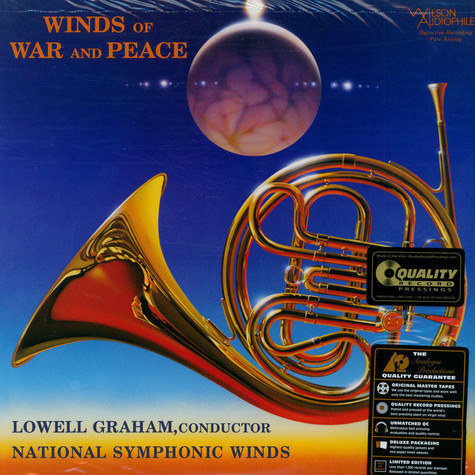
Winds Of War And Peace brings together seven pieces reflecting different ideas of public music: fanfare, march, symphonic narrative and dance. Lowell E. Graham conducts the National Symphonic Winds and also serves as producer. The title establishes a broad frame, but the programme cannot be reduced to martial impact. Ceremonial gestures, rhythmic precision and more extended musical development all have a place within its design.
The ensemble drew its musicians from leading American military bands and the Virginia Symphony. That background establishes a particular starting point, bringing experience in wind-band culture to symphonic demands. This instrumentation has different weights from a string-led orchestra with added winds. Breath, attack and percussion shape articulation; colours have to be differentiated within those resources rather than relying on a familiar alternation between a mass of strings and a wind section.
The recording belongs to the Wilson Audiophile catalogue, originally as W-8823. That history matters, but the appeal begins with its repertoire. John Williams, Samuel Barber, Roger Nixon, Richard Rodgers, Alfred Reed, Luigi Radaelli and Clifton Williams do not represent one uniform style. Their pieces call for different kinds of tension: an immediate opening, a clearly defined pace, an extended span or movement derived more directly from dance.
That variety makes the album attractive to listeners interested in a wind ensemble as more than a source of effects. Large outbursts can command attention; the musical question is how they are prepared and returned to a continuing argument. The seven pieces offer several answers. Graham and the ensemble must therefore do more than regulate volume. They need to distinguish individual characters while giving a varied selection a coherent setting and a convincing sequence.

From the Statue of Liberty to Victory At Sea
The programme opens with John Williams’ Liberty Fanfare, arranged by James Curnow. Written in 1986 for the centenary of the Statue of Liberty, it belongs to Williams’ music for public occasions rather than to his film scores. A fanfare has to open a space quickly: its beginning gathers attention and its gestures need to register clearly. That function is especially well suited to the first encounter with an album.
Samuel Barber’s Commando March, from 1943, introduces another historical setting and another type of movement. It was Barber’s first work for wind band. Its rhythmic organisation demonstrates that a firm step need not exclude musical sophistication. Accents and internal motion can create tension within a clearly established outward form. Roger Nixon’s Festival Fanfare March follows, bringing together ceremony and the march in a combination announced by its title.
Side B is devoted entirely to Victory At Sea, by Richard Rodgers in Robert Russell Bennett’s arrangement. At just over ten minutes, it has considerably more time than any of the three opening pieces. Its origins in the television documentary project suggest another kind of musical storytelling: music can evoke action, distance and changing situations without requiring pictures during listening. The longer form also changes the album’s sense of scale.
This first half of the programme moves from a concentrated opening towards a more expansive design. The 45 RPM edition makes the distinction particularly clear: three pieces on the first side, followed by one extended span on the second. Turning the record marks more than an arbitrary break in a compilation. It accompanies a change in dimensions, allowing the ensemble to move beyond concise opening statements into a broader musical development.

Dance, colour and the shaping of a shared pulse
Alfred Reed’s El Camino Real occupies the whole third side. Its duration of a little over ten minutes places it beside Victory At Sea as the programme’s other extended focal point. The relationship between rhythmic energy and longer development offers a useful way of listening. A piece can be driven by active figures while still requiring more than a sequence of brief peaks. Recurrence, contrast and accumulation provide direction across a larger span.
The final side pairs A Santa Cecilia, by Luigi Radaelli, with Symphonic Dance No. 3, by Clifton Williams. The album consequently does not finish with another fanfare alone. It returns to contrasting forms of communal, rhythmically defined music and closes with the idea of a symphonic dance. The different dimensions of the seven selections help them form a complete programme rather than a group of similar pieces gathered beneath a dramatic title.
With a wind ensemble, the beginning and ending of notes deserve attention. Shared entrances have to agree in weight and duration as well as timing. Equally interesting is the way a voice emerges from the collective sound and returns to it. Darker registers can support a passage while brighter instruments trace another movement above them. Percussion adds contour and a further sense of space without needing to remain permanently in the foreground.
Winds Of War And Peace therefore offers several levels of engagement. A first hearing can follow the immediate character of each piece; later listening can concentrate on the distribution of musical responsibilities. An ensemble’s ability to turn many individual breaths into one pulse is as interesting as a single emphatic accent. The programme accommodates both: the clear public gesture and the detailed work taking place inside a many-voiced instrumental body.
The 45 RPM edition recut by Kevin Gray
This is AAPC 8823-45: two 200-gram LPs at 45 RPM, recut by Kevin Gray at Cohearent Audio from the original analogue tape. Quality Record Pressings manufactured the records, with a Stoughton gatefold jacket completing the presentation. Those details identify this particular Analogue Productions edition. Doug Sax’s name belongs to the original Wilson release, rather than to the recut offered here.
The four-sided arrangement is easy to understand musically. Each of the two longest works receives its own side, while shorter pieces form groups at the beginning and end. The speed is consequently more than a specification on a label: it also influences the listening sequence, with two compact programme blocks and two extended work sides. Choosing this version means choosing that particular rhythm of sustained listening and record turning.
The album’s reception also deserves to be associated with the appropriate edition. The frequently mentioned 2017 award concerned the 33 RPM version. It explains some of the attention surrounding the recording but does not stand in for an assessment of this later 45 RPM release. The present edition’s concrete features are its credited recut, pressing plant, packaging and distinctive selection of repertoire, each of which can be considered on its own terms.
For a collection, the record opens a territory between American wind-band tradition, the concert hall and music for public occasions. Its force may provide the initial attraction, while its contrasting forms and instrumental tasks sustain interest. You order from Michael 45 in Germany. We arrange the US import and dispatch from Hilden.
Customer question: Buying Analogue Productions records in Europe
Musicians
Participants and documented credit status. Track references correspond to the tracklist.
- Lowell E. GrahamLater portrait; year unspecifiedconductor, producerParticipation: All seven pieces
- National Symphonic Windswind ensembleParticipation: All seven pieces

Lowell E. Graham: conductor and producer. National Symphonic Winds: musicians from leading US military bands and the Virginia Symphony; no verified individual roster. Kevin Gray / Cohearent Audio: current cutting from the original analogue tape; Doug Sax: original Wilson edition, not this recut. QRP: pressing. Recording date, hall and engineer not established here. The 2017 award concerned the 33 RPM edition.

Reviews
There are no reviews yet.