
A hotel as a signpost
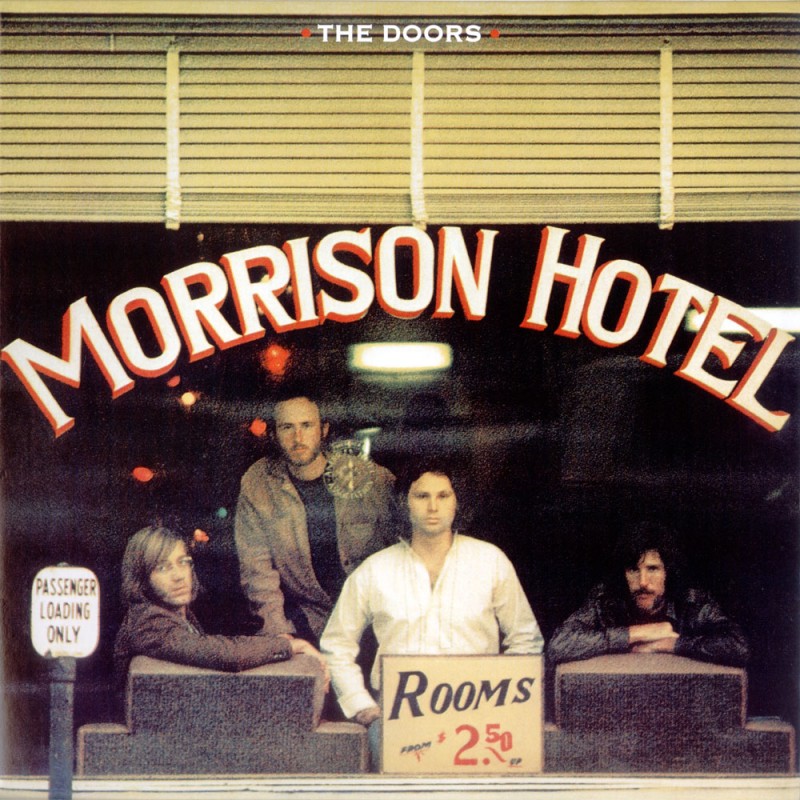
An unassuming hotel in downtown Los Angeles gave the Doors’ fifth studio album its name. Henry Diltz’s photograph turned a window into a stage, but the music behind that celebrated sleeve was recorded elsewhere: at Elektra’s studios, with Paul A. Rothchild producing and Bruce Botnick engineering. Released in 1970, Morrison Hotel redirected attention towards the band after the horns and strings of The Soft Parade: blues forms, guitars, keyboards and the interaction of its rhythm players.
This did not mean abandoning the Doors’ individuality. The eleven-track sequence reveals several ideas of what a song could be. A direct opening gives way to images, interruptions and quieter passages. Morrison remains a defining voice, yet the record becomes especially rewarding when Manzarek, Krieger and Densmore receive equally close attention. A seemingly familiar instrumental line-up has ample resources for creating contrasting musical spaces.
The original LP named its sides “Hard Rock Café” and “Morrison Hotel”. Those headings connected the programme to the photographed locations without imposing a continuous narrative on the songs. This double-LP edition distributes the music across four sides while retaining the original running order: from “Roadhouse Blues” to “Maggie M’Gill”, with numerous changes of direction between them. The physical layout changes; the album’s sequence remains intact.

The people behind the blues
“Roadhouse Blues” provides a useful introduction to the personnel. Alongside the four Doors, Lonnie Mack plays bass and John Sebastian contributes harmonica. Sebastian also appears in the credits under the name G. Puglese. Mack was famous as a guitarist, but his contribution here is on bass. Such distinctions matter: a familiar name becomes informative only when it is connected to the instrument actually played.
Ray Neapolitan also participated in the sessions, supplying bass on much of the album. Mack is additionally documented on “Maggie M’Gill”, creating a specific personnel link between opening and closing tracks. These guests broadened the foundation beneath Manzarek’s piano and organ, Krieger’s guitar and Densmore’s drums. Their participation reflects an expanded studio ensemble, rather than a change in the band’s official membership.
Rothchild and Botnick had different responsibilities, and production and engineering should be distinguished from instrumental performance. The later reissue brings another set of technical credits. Reading the names on a record therefore means encountering several moments in its history at once. The personnel panel identifies performers, while the account of recording and mastering explains the other contributions in their proper context. This keeps the musicians visible without overlooking the people who helped their work become a record.

Eleven songs, several perspectives
After “Roadhouse Blues”, “Waiting for the Sun” leads elsewhere. Its title had already named the Doors’ third album, but the song itself found a place here. That displacement is a reminder that albums are not necessarily assembled entirely from ideas conceived within one short period. Material can be set aside, reconsidered and eventually find its function in a different setting.
“You Make Me Real” changes direction again. The subsequent pairing of “Peace Frog” and “Blue Sunday” is particularly inviting: their position in the sequence draws attention to the transition between them. No fixed biographical interpretation is required to notice the movement from restless language towards a more restrained gesture. “Ship of Fools” enlarges the picture before “Land Ho!” begins the second half of the original LP.
“The Spy” and “Queen of the Highway” belong to this record as fully as its familiar opening number. “Indian Summer” reaches further back, with origins in the band’s early studio period. The closing blues of “Maggie M’Gill” then offers another connection to the beginning. Give that sequence time. Its interest comes from relationships among the pieces, rather than a single explanation imposed on them. Within a Doors collection, Morrison Hotel deserves attention as an album with its own carefully graded movement, beyond its position between two other celebrated sleeves.
Four sides at 45 RPM
This Analogue Productions stereo edition carries catalogue number AAPP 75007-45. Its eleven album tracks occupy two 180-gram LPs playing at 45 RPM. Doug Sax handled mastering at The Mastering Lab; Sangwook “Sunny” Nam is also named in the edition credits. Bruce Botnick supervised the reissue project. The publisher identifies the original analogue master tapes as the source and Quality Record Pressings as the pressing plant.
The records are housed in a gatefold jacket. Earlier pressings within this catalogue family were also marketed at 200 grams; the current specification is 180 grams. This release is distinct from other Doors formats, expanded anniversary editions and the separate SACD. It presents the original album programme without additional session takes. Dividing it across four record sides creates manageable groups of songs, offering a reason to give “The Spy”, “Indian Summer” or “Blue Sunday” the same attention as “Roadhouse Blues”.
You order from Michael 45 in Germany. We arrange the US import and dispatch from Hilden.
Also on SACD: Morrison Hotel
More by The Doors: Strange Days · Waiting For The Sun
Artist page: All titles by The Doors
Customer question: Buying Analogue Productions records in Europe
Musicians
Participants and documented credit status. Track references correspond to the tracklist.
- Jim MorrisonvocalsParticipation: Album personnel; individual track assignments not specified
- Robby KriegerguitarParticipation: Album personnel; individual track assignments not specified
- Ray Manzarekpiano, organParticipation: Album personnel; individual track assignments not specified
- John DensmoredrumsParticipation: Album personnel; individual track assignments not specified
- Ray NeapolitanbassParticipation: Album personnel; individual track assignments not specified
- Lonnie MackbassParticipation: A1, D3
- John SebastianharmonicaParticipation: A1


Album credits do not imply every instrument on every track.

Reviews
There are no reviews yet.