
Five pieces and the courage to prescribe less
Kind of Blue is one of those jazz albums whose reputation can almost obscure the music itself. The title, sleeve and standing are familiar. Yet the recording begins with an invitation to listen, not an explanation of its importance. Miles Davis gave his musicians a framework in which melodic development and an idea of sound could matter more than negotiating a dense succession of chord changes as rapidly as possible. This was not a retreat from improvisation. It created a different task: shaping a convincing musical journey within fewer prescribed harmonic changes.
The five pieces were recorded on 2 March and 22 April 1959 at Columbia’s 30th Street Studio in New York. “So What”, “Freddie Freeloader” and “Blue in Green” belong to the first session; “All Blues” and “Flamenco Sketches” to the second. When Columbia released the album on 17 August 1959, those two recording days stood behind a record that would reach far beyond the usual jazz audience. The proximity of the sessions and the clearly defined personnel give the programme continuity without flattening the differences between its pieces.
Davis plays trumpet, John Coltrane tenor saxophone, Cannonball Adderley alto saxophone, Paul Chambers double bass and Jimmy Cobb drums. Bill Evans and Wynton Kelly share the piano duties, but not interchangeably: Kelly plays on “Freddie Freeloader”; Evans plays on the other four tracks. Adderley, meanwhile, is absent from “Blue in Green”. That adjustment in personnel matters musically. Placing every listed musician on every track would overlook the distinctions between the individual situations created on the album.
Evans had belonged to Davis’s group in 1958 and returned for these recordings. Kelly was now the band’s pianist. Both personalities have a particular place here. It is rewarding to follow the piano as more than a harmonic background. A different attack, a different response to a soloist or another spacing of notes changes the character of the interaction. The celebrated stillness of some passages does not arise from uniformity. It depends on different musicians making very deliberate use of their individual resources.

The musicians behind the familiar name
“So What” offers an especially clear way into the album’s underlying approach. Its straightforward modal framework gives improvisers time to develop an idea within an established space. Follow the way a solo takes shape through repetition, small alterations and changes in phrase length. The transition from Davis to the saxophonists is more than a change of instrumental colour. It places different ideas about how much movement a passage can accommodate next to one another, within a shared structure that remains easy to recognise.
Chambers and Cobb are as important to that relationship as the horns. The bass gives direction and weight; the drums shape movement without having to fill every available opening. Directing attention to those two voices on another listen can change the relationship in which familiar solos are heard. Accompaniment is not an unchanging foundation. It responds, supports and leaves room. With a recording so often described as an effortlessly unified whole, there is particular value in noticing the specific work of each participant.
“Freddie Freeloader” introduces Kelly’s piano and an explicit connection to the blues. His appearance is not an incidental footnote to an otherwise uniform line-up. It belongs to the identity of the piece. “Blue in Green” draws the circle more tightly: Evans plays piano and Adderley’s alto sits out. The authorship of this composition has its own history, since the original Davis credit did not fully represent Evans’s contribution. Listening need not wait for a resolution of that dispute; the pianist’s role and the particular design of the piece deserve attention in any case.
Irving Townsend produced the sessions and Fred Plaut handled the engineering. Teo Macero’s name appears in the album’s later release history, but should not automatically replace Townsend as producer of these recording dates. This is another example of the usefulness of precise credits. The record is so familiar that associated names can easily be added from habit. Its actual creation becomes more interesting when the participants and their responsibilities are kept distinct instead of being folded into a general account of Davis’s Columbia years.

From the blues to an open sequence of modal spaces
The second session produced “All Blues” and “Flamenco Sketches”. Both extend the setting established by the first three tracks rather than simply repeating their effects. “All Blues” combines its blues framework with a distinctive triple movement. It is worth first recognising that motion independently of the current soloist. How firmly does it continue, where do the accents shift, and how do bass and drums carry its course? Then return the solos to the foreground and consider what that shared pulse makes possible for each player.
“Flamenco Sketches” uses a succession of modal areas. Its title should not imply that the musicians are reproducing a fixed flamenco composition. The interest lies in the time they spend within the available spaces and the way they negotiate their transitions. The form calls for decisions about duration, breathing and continuation. The album consequently ends without a demonstrative summary, in a setting where close attention to individual notes and their relationships can disclose a great deal.
In his original liner notes, Evans described the short interval between the preparation of Davis’s musical settings and the recording itself. That observation is sometimes enlarged into a legend of complete unpreparedness. It is more useful to recognise a particular working method: experienced musicians receive a framework and must bring it to life together. Spontaneity here does not mean an absence of knowledge. It depends on experience, trust and the ability to incorporate another player’s contribution immediately into one’s own developing statement.
For collectors, that is one reason Kind of Blue can support repeated listening and encounters with different editions. A comparison need not immediately become a ranking. An edition can be considered in terms of how it organises access to the complete programme, while the music is first allowed to stand on its own. Five tracks provide very different settings: a clear modal opening, Kelly’s blues, the smaller ensemble on “Blue in Green”, the revolving movement of “All Blues” and the open transitions of the closing piece. Familiarity with the album’s reputation need not exhaust any of them.
This UHQR: four sides, 45 RPM and a significant correction
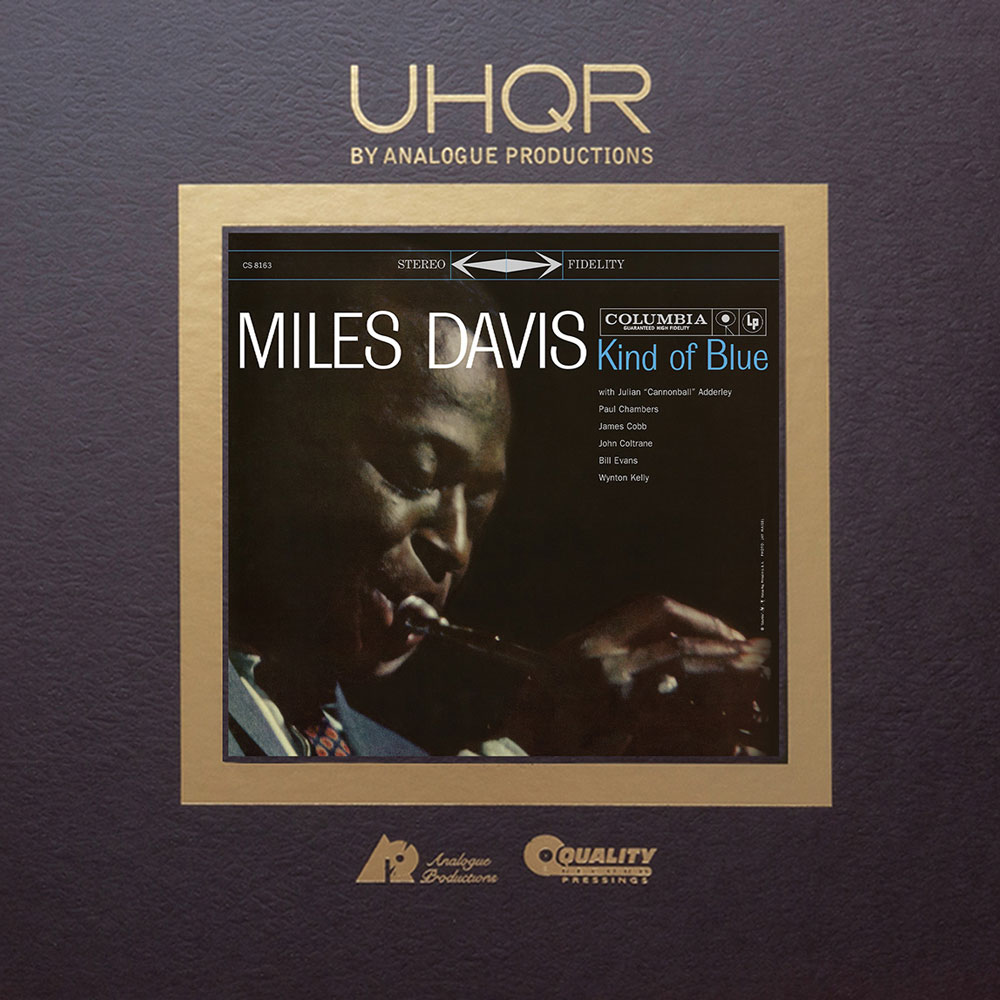
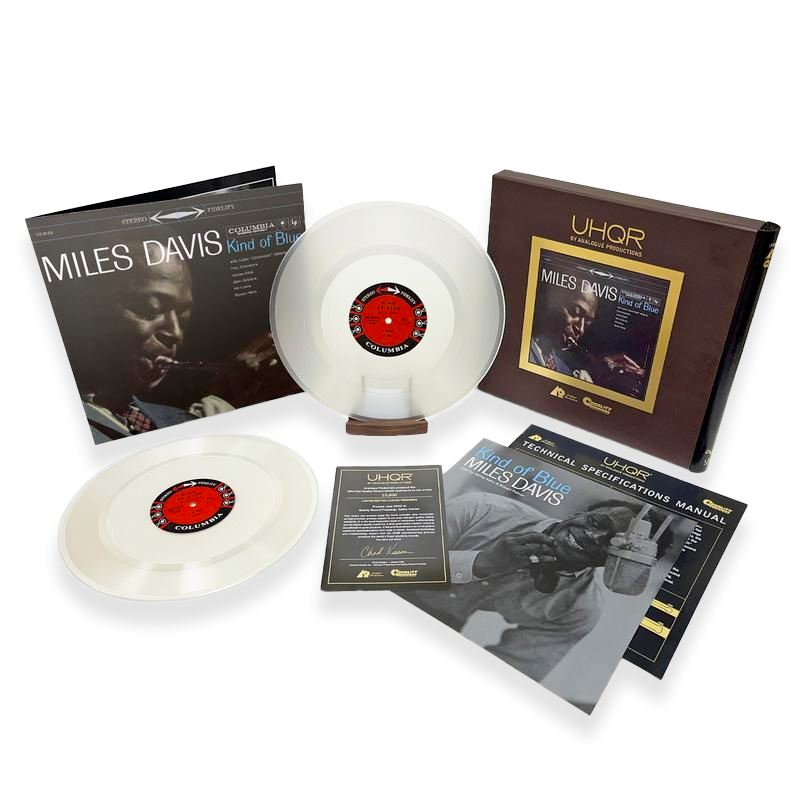
Analogue Productions AUHQR 0004-45 presents the album on two stereo LPs at 45 RPM, using 200-gram Clarity Vinyl, pressed at Quality Record Pressings. The edition was limited to 25,000 numbered copies. Bernie Grundman mastered directly from the original three-track master tapes according to the publisher. This 45 RPM release must be distinguished from the earlier 33⅓ RPM UHQR and from other releases described as “Corrected Speed”. A shared album title does not identify a shared edition or an identical production history.
A tape machine running too slowly during the first session is part of the recording’s history. When played back at the normal speed, the three affected tracks consequently sounded too high in pitch. The publisher states that this UHQR addresses and corrects the speed discrepancy. No particular technical correction method is inferred from that statement here. In particular, a specific analogue or digital procedure is not presented as independently established. The supported claim is the publisher’s account of speed correction for this edition, with the method left unspecified.
“So What” occupies side A by itself; “Freddie Freeloader” and “Blue in Green” share B; “All Blues” is on C; and “Flamenco Sketches” completes D. The arrangement gives the music generous space but changes the listening pattern of the original single LP. Additional side changes are part of choosing the 45 RPM version. The package includes a Stoughton tip-on gatefold, the UHQR slipcase and a 20-page booklet featuring contributions by Robert Palmer and Ashley Kahn, session photographs and reproductions of Grundman’s mastering notes. The edition thus combines a precisely identified playback format with documentation that helps place the recording and its preparation in context.
You order from Michael 45 in Germany. We arrange the US import and dispatch from Hilden.
In the magazine: Miles Davis: A History in Records
Also in another edition: Kind of Blue
More by Miles Davis: Birth Of The Blue · Cookin’ With The Miles Davis Quintet
Artist page: All titles by Miles Davis
Customer question: Collecting UHQR records: limited editions of great albums
Series: UHQR – all 31 editions with pressing run and mastering
Musicians
Participants and documented credit status. Track references correspond to the tracklist.
- Miles DavistrumpetParticipation: album personnel
- John Coltranetenor saxophoneParticipation: album personnel
- Cannonball Adderleyalto saxophoneParticipation: A, B1, C, D (not B2)
- Bill EvanspianoParticipation: A, B2, C, D
- Wynton KellypianoParticipation: B1
- Paul Chambersdouble bassParticipation: album personnel
- Jimmy CobbdrumsParticipation: album personnel


Recorded 2 March and 22 April 1959 at Columbia 30th Street Studio, New York. Producer: Irving Townsend; engineer: Fred Plaut. Original liner notes: Bill Evans; cover photograph: Jay Maisel. UHQR mastering: Bernie Grundman; pressed at Quality Record Pressings. Wynton Kelly appears only on Freddie Freeloader; Cannonball Adderley does not play on Blue in Green.
How Michael hears this edition
Listening impression · paraphrased from the video
Compared with the MoFi 45, Michael hears a particularly effortless, natural presentation: Miles’ entries arrive immediately and the band remains clearly separated in space. He finds the soundstage, space and musical coherence more convincing on the UHQR.

Reviews
There are no reviews yet.