

A blues is given an entire side
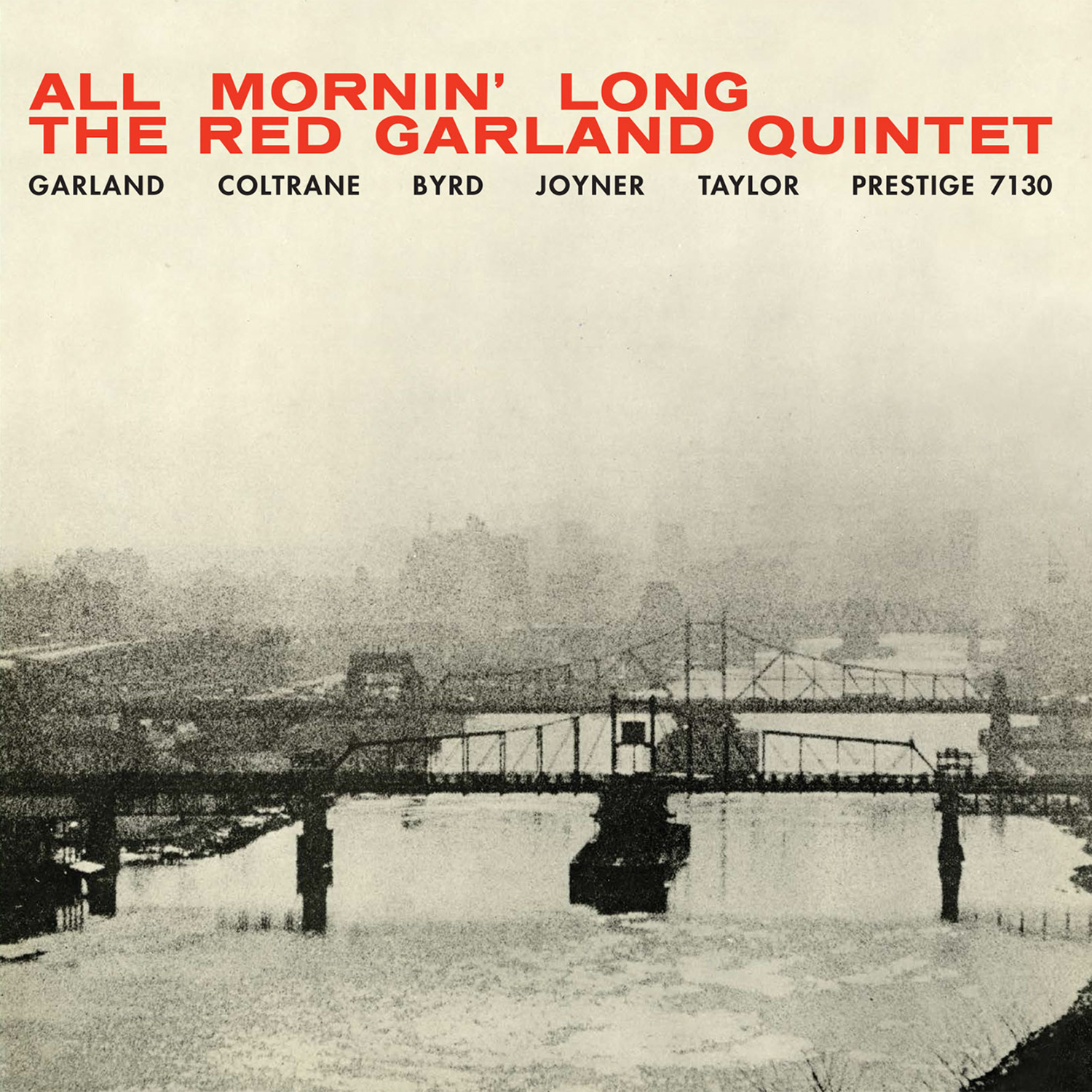
Three pieces are enough for All Mornin’ Long. This is not a short programme but a generously conceived one: the title blues occupies the whole first side of the LP. Red Garland gives his group time to build a shared musical world without having to move to another theme after only a few minutes. From the piano he leads a quintet featuring John Coltrane on tenor saxophone, Donald Byrd on trumpet, George Joyner on double bass and Art Taylor on drums. The names are distinguished, but the real attraction lies in the relationships between them and in what those relationships make possible.
The recording was made on November 15, 1957, at Rudy Van Gelder’s studio in Hackensack. Garland and Coltrane had worked together in Miles Davis’ quintet, Taylor was connected with Garland’s trio, and Byrd also moved within this circle of musicians. The publisher notes that the quintet had played engagements in New York during the autumn of 1957. These are not simply five impressive names assembled on paper. Shared practical experience and related musical attitudes provide the extended performances with a foundation. The players have ways of responding to one another that need not be established from scratch.
Prestige released All Mornin’ Long in 1958 as catalogue number 7130. For a collection, it makes an appealing companion to Garland’s better-known trio work: two horns join the ensemble, yet the pianist remains its centre. A leader does not have to be the most conspicuous voice in every bar. His identity can be expressed through the choice of material, the shape of the programme and the space made available to other musicians. The long title blues allows Garland to be heard as soloist, accompanist and host of the encounter, with those responsibilities continually informing one another.
The session yielded more than these three tracks suggest. Its ten recorded performances also supplied Soul Junction, issued as Prestige 7181, and High Pressure, catalogue number 7209. The later releases distribute music from the same encounter across several albums. That makes All Mornin’ Long a rewarding starting point for collectors: anyone wishing to follow the quintet’s interaction further can find additional perspectives on the same studio date in those two companion records.

Garland remains at the centre
Garland’s piano playing is often associated with his use of block chords. A melodic line acquires a harmonically concentrated shape rather than being carried only by single notes. For the listener, the effect of these changing textures matters more than a technical definition. A run, a placed chord and a more densely voiced passage can give the same harmonic movement different kinds of weight. The quintet allows Garland to use those resources both in his own featured passages and while accompanying other voices. He consequently remains an active presence throughout the album rather than disappearing behind the famous horn players.
Coltrane and Byrd bring two distinct approaches into the shared space. Their instruments already imply different attacks, articulations and possibilities for shaping a long line. Within an extended blues, it is rewarding to follow the changing relationship between individual voice and ensemble as one soloist takes over from another. The theme and harmonic framework remain familiar, but the musical narrative acquires a new emphasis. This is one of the attractions of a lengthy performance: recurrence supplies orientation while the identity of the current player makes the differences significant. Familiarity provides room for individuality rather than cancelling it.
George Joyner, later known as Jamil Nasser, plays double bass, with Art Taylor on drums. This particular personnel deserves to be kept in view instead of automatically expecting Paul Chambers whenever Garland appears. Joyner and Taylor sustain the extended forms while responding to changes in the foreground. A recurring blues structure does not require mechanical repetition. Small differences in emphasis, placement and accompaniment can carry a developing performance across many choruses. On a second hearing, following the rhythm section therefore reveals another perspective on the same solos and on the cohesion of the quintet as a whole.

From Garland’s blues to Gershwin and Dameron
All Mornin’ Long is Garland’s own composition. Giving it an entire side turns the LP side itself into a musical unit. The performance need not be reduced to one exceptional moment. Its appeal may lie in the gradual movement of attention: from the theme to a horn, from piano to bass, from a striking phrase back into the ensemble’s collective motion. Listeners who enjoy following an extended improvisational course will find this design particularly inviting. It asks for time and rewards a willingness to allow the group more than one change of perspective within a single piece.
The second side begins with They Can’t Take That Away From Me by George and Ira Gershwin. After the expansive blues framework of side one, the song offers a different kind of melodic memory. A familiar tune can remain an internal point of reference even as the players move away from it in improvisation. The question is not simply when the theme will return, but how its character is illuminated during the performance. For collectors who know the same standard in several settings, this opens a comparison between musical personalities without turning those differences into a contest over a single definitive version.
Tadd Dameron’s Our Delight concludes the record. The second side thus places an American song alongside a composition from the world of modern jazz. The album’s three selections are not interchangeable examples of the same material. Garland’s blues, the Gershwin song and Dameron’s jazz composition present different possibilities to the band. The five musicians remain the connecting thread throughout. Their continuity makes All Mornin’ Long more than a casual succession of featured soloists. Each form acquires its particular meaning through the group inhabiting it, and the programme gains shape from the encounter between those forms and those players.
The 33⅓ rpm format preserves the programme
This mono reissue belongs to the Analogue Productions Prestige series and carries catalogue number APRJ 7130. The publisher names Kevin Gray as the engineer responsible for cutting from analogue master tapes and Quality Record Pressings as the manufacturer. Its current specification lists 180-gram vinyl and a high-gloss tip-on jacket. The release remains a single, deliberately proportioned album: a side-long blues with two differently shaped selections on the reverse. In a Garland collection, this setting adds another perspective to the trio recordings. With Coltrane and Byrd beside him, the pianist still provides the musical connections that give the quintet its cohesion and the programme its particular character.
With All Mornin’ Long, the musical value of a single LP at 33⅓ rpm is particularly easy to understand. The title blues remains uninterrupted on one side. Its course is not broken by an additional turn of the record, while the two compositions on side two create a contrasting unit of their own. For anyone approaching the album as a continuous experience, this is an appropriate form. The programme’s design is immediately apparent: first an expansive common space, then two differently structured pieces by the same ensemble. Format and musical organisation are closely connected here, rather than being unrelated purchasing details.
The mono recording places the quintet within a shared centre. The gradations between piano, horns and rhythm section matter more than a deliberately wide panorama. A collection built around Coltrane, Byrd or Garland can approach the album from several directions. It offers an encounter with a major tenor saxophonist, a view of Byrd’s early work and a deeper look into Garland’s musical character. It is most rewarding when all these perspectives are allowed to coexist. The pianist then remains the host of a recording whose generosity lies, above all, in giving both musicians and listeners time to explore their company.
You order from Michael 45 in Germany. We arrange the US import and dispatch from Hilden.
Artist page: All titles with John Coltrane
Customer question: Buying Analogue Productions records in Europe
Series: Analogue Productions Prestige – all 50 records, musicians and session paths
Musicians
Participants and documented credit status. Track references correspond to the tracklist.
- George Joynerdouble bassParticipation: Album personnel
- Art TaylordrumsParticipation: Album personnel
- Red GarlandpianoParticipation: Album personnel
- John Coltranetenor saxophoneParticipation: Album personnel
- Donald ByrdtrumpetParticipation: Album personnel


George Joyner is the bassist later known as Jamil Nasser. Recorded November 15, 1957; first released in 1958.

Reviews
There are no reviews yet.