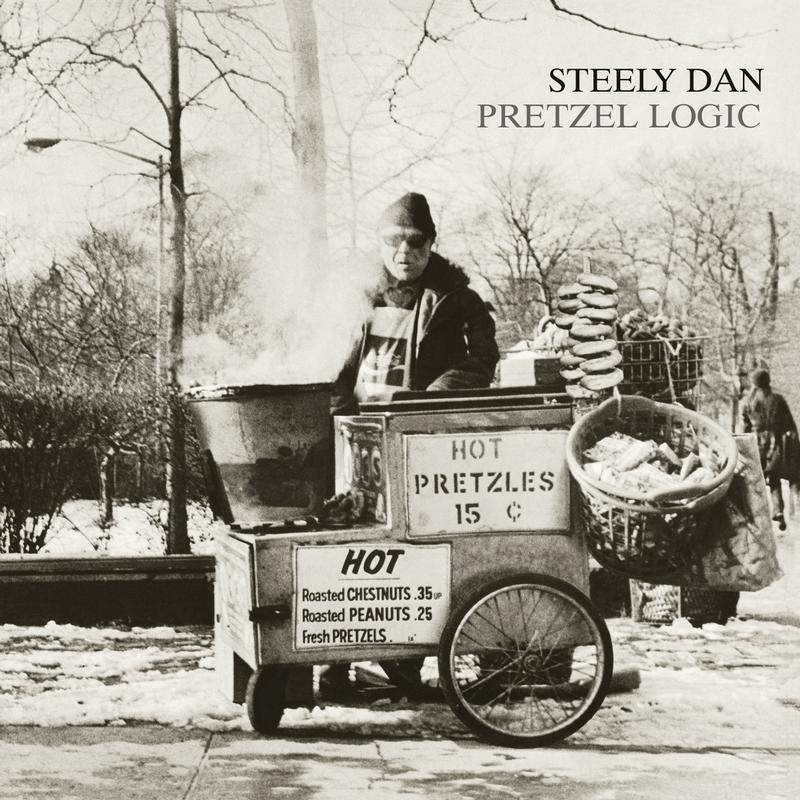




Eleven songs between a band and a studio idea
Some albums reveal their turning point only in hindsight. On Pretzel Logic, that change is audible inside the songs: Steely Dan still had five familiar faces, while Donald Fagen and Walter Becker were beginning to choose the players who best suited each particular recording. Released by ABC in February 1974, their third album brings these two approaches to collaboration together. Denny Dias and Jeff “Skunk” Baxter remain important voices, but session musicians increasingly contribute the piano figures, drum parts and instrumental colours that give individual songs their shape.
After the more extended forms of Countdown to Ecstasy, concentrating on eleven relatively short pieces suggests a different discipline. The music does not need lengthy solo sections to display its possibilities. An unexpected chord, a displaced accent or an instrumental answer to a vocal line can open a second level beneath an accessible melody. Rock, jazz, rhythm and blues, and older American popular music do not occupy neatly separated compartments. Becker and Fagen turn them into songs whose elegance also depends on small points of friction.
Reaching number four on the American singles chart, Rikki Don’t Lose That Number became the group’s biggest hit. It provides an inviting entrance to the album without defining everything inside it. The restraint of Any Major Dude Will Tell You, the compressed motion of Parker’s Band and the crooked blues of the title track occupy very different musical spaces. Their proximity gives this concise record much of its richness. Familiarity arrives quickly, while the arrangements continue to offer details worth returning to.

Players chosen for the moment
The recordings were made between October 1973 and January 1974. The original credits name the Village Recorder in West Los Angeles for recording, with overdubs and mixing at Cherokee in Chatsworth. Gary Katz produced and Roger Nichols handled the recording engineering. In his later liner notes, Fagen recalled how much the studio professionals working around ABC-Dunhill had impressed Becker and him. They now wanted those abilities available for their own music. That decision also changed the place occupied by the existing band members.
The drums make the transition especially clear. Jim Hodder is one of the five musicians named on the original sleeve, but his contribution here should not simply be assumed to match his role on earlier Steely Dan records. Supplementary documentation identifies him as a backing singer on Parker’s Band. Jim Gordon and the very young Jeff Porcaro emerge as the important drummers. Fagen explicitly describes the two playing together on Parker’s Band. That is more than a collector’s footnote: it gives the concentrated rhythmic activity of this short song a specific human background.
The keyboard and guitar colours also extend beyond the two songwriters. Michael Omartian, David Paich, Victor Feldman, Dean Parks and Chuck Rainey are among the participating studio players. Their individual track assignments are not equally well documented. Where contributions are clearly described, however, they show how closely the choice of musicians followed the needs of the music. Feldman’s flapamba opens the album version of Rikki Don’t Lose That Number. That introduction was removed for the contemporary single. The album preserves its unusual, suspended moment before the familiar song takes over.

Ellington, Parker and a blues outside time
East St. Louis Toodle-Oo offers a particularly vivid example of Steely Dan translating musical history into their own language. Written by Duke Ellington and Bubber Miley, the piece is not recreated simply by copying an older recording’s instrumentation. Fagen’s own account describes Becker using talkbox guitar to evoke Miley’s trumpet effect, Baxter taking up the trombone voice on steel guitar, and Fagen transferring a clarinet solo to piano. He also brought out his Selmer alto saxophone to suggest the colour of a 1920s saxophone section. The pleasure lies in the change of means: a listener can follow the memory of an earlier sound while hearing another ensemble make something of its own from it.
The Charlie Parker tribute in Parker’s Band takes a different route. A compressed song structure, mobile harmony and the energy of two drummers meet within a very small frame. Through With Buzz, barely a minute and a half long, acquires another outline through Jimmie Haskell’s string orchestration. These changes show why brevity should not be mistaken for simplicity on this album. The pieces present their particular character without lengthy preparation and move on before an idea has time to become routine.
On the title track, Becker’s guitar solo answers a narrator whose sense of time seems to have slipped its moorings. Fagen described the musical foundation as an altered blues in A minor. With a Gun, Charlie Freak and Monkey in Your Soul then take the closing sequence through further changes of mood. Returning listeners might follow the voices on one occasion, the bass movement on another, or the brief instrumental transitions that join the phrases. The songs support those shifts of attention without surrendering their immediate appeal. That makes Pretzel Logic rewarding both as an introduction and as part of a collection in which familiar music is allowed to reveal new sides over time.
The Analogue Productions Hybrid Stereo SACD
This edition is the Analogue Productions Hybrid SACD, catalogue number CAPP 136 SA. It contains the eleven original album tracks in stereo, without bonus material. Its CD layer plays on a conventional CD player; accessing the high-resolution SACD layer requires SACD-compatible equipment. No multichannel programme is included. The disc is supplied in a Super Jewel Box.
Analogue Productions credits Bernie Grundman with the mastering and describes a direct transfer from the original master tape to DSD. That source statement belongs specifically to this SACD. It differs from the tape copies documented by the publisher for certain other Steely Dan titles in the series. No particular DSD rate or converter is specified, and neither can be inferred simply from the format’s name.
For collectors, keeping this edition distinct from the vinyl releases is useful. This is a digital disc with two playable layers, with its own mastering description and packaging. The musical invitation is to experience eleven carefully constructed songs as a continuous album, from the unusual prelude to Rikki to the compact conclusion of Monkey in Your Soul. The songs’ concentration leaves room for close listening without turning that listening into homework. You order from Michael 45 in Germany. We arrange the US import and dispatch from Hilden.
Also on 45 RPM vinyl: Pretzel Logic
More by Steely Dan: Two Against Nature
Artist page: All titles by Steely Dan
Customer question: Buying Analogue Productions records in Europe
Musicians
Participants and documented credit status. Track references correspond to the tracklist.
- Donald Fagenlead vocals; keyboards; piano (in place of clarinet solo) (5); alto saxophone (section) (5); electric piano (3); Wurlitzer (8)Participation: Album personnel
- Walter Beckertalk-box guitar (5); guitar solo (8); bass (1); backing vocalsParticipation: 1, 5, 8; album credits
- Jeff “Skunk” Baxtersteel guitar (trombone part) (5); pedal steel (10); guitar solo (1, 2, 3, 5, 11); hand drumsParticipation: 1–3, 5, 10, 11
- Denny Diaselectric guitar (3); guitar solo (6)Participation: 3, 6
- Jim Hodderbacking vocals (6)Participation: 6
- Jim Gordondrums (1, 3, 4, 5, 6, 7, 8, 9, 10, 11)Participation: All except track 2
- Jeff Porcarodrums (2, 6)Participation: 2, 6
- Victor FeldmanFlapamba (1); percussionParticipation: 1; album credits
- Michael Omartianpiano (1, 10)Participation: 1, 10
- David PaichClavinet (2); electric piano (3)Participation: 2, 3
- Dean Parksacoustic guitar (1, 3); rhythm guitar (8); banjoParticipation: 1, 3, 8
- Chuck Raineybass (3)Participation: 3
- Wilton Felderbass (8)Participation: 8; other assignments unconfirmed
- Timothy B. Schmitbacking vocals (1)Participation: 1; 4 and 8 unconfirmed
- Ben BenayguitarParticipation: Track assignments unconfirmed
- Plas Johnsonsaxophone (8)Participation: 8; other assignments unconfirmed
- Ollie Mitchelltrumpet (8)Participation: 8; other assignments unconfirmed
- Lew McCrearytrombone (8)Participation: 8; other assignments unconfirmed
- Jerome RichardsonsaxophoneParticipation: Track assignments unconfirmed
- Ernie WattssaxophoneParticipation: Track assignments unconfirmed
- Roger Nicholsgong (5)Participation: 5


Album credits do not mean that every instrument appears on every track. Documented track assignments are given beside the relevant roles; further assignments remain unconfirmed.

Reviews
There are no reviews yet.