
Thirteen string players, no conductor
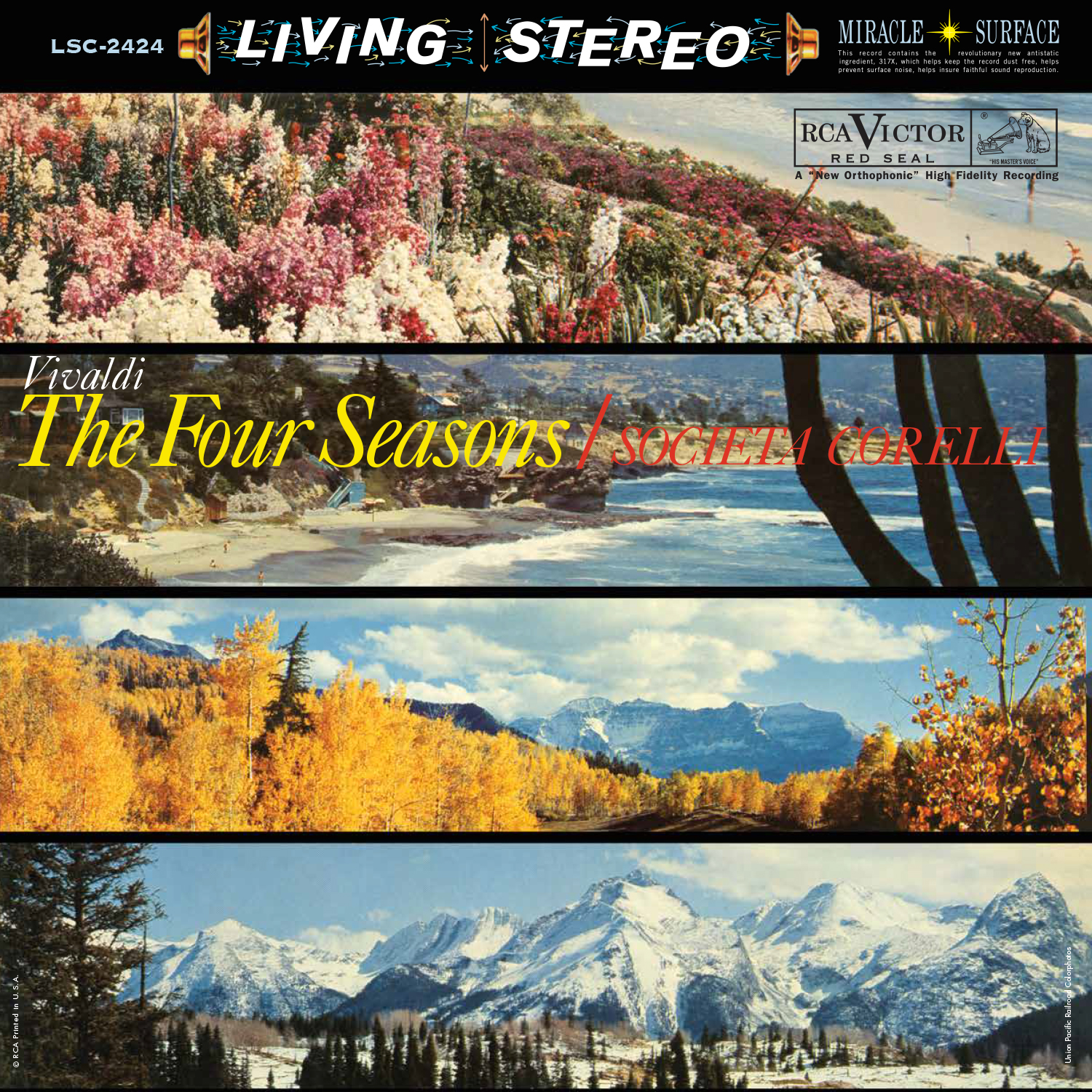
Società Corelli performs Vivaldi’s Four Seasons as an ensemble of thirteen string players without a conductor. This is the compact group behind the RCA album issued in 1960. Recorded in Italy, it brings together four independent concertos now generally heard as a cycle. An exact recording date is not securely established for this edition.
The size and organisation of the ensemble provide a concrete starting point for listening. Follow the exchanges between the solo violin and the collective entries. Vivaldi does not simply place a tune over an unchanging accompaniment. Sometimes the individual violin comes forward; elsewhere the ensemble determines the course of events. Here, the players coordinate those changing responsibilities without a conductor standing in front of them.
The solo violin part is credited to Vittorio Emanuele. The name Società Corelli refers to Arcangelo Corelli, whose importance to Italian string playing the publisher emphasises. The ensemble’s namesake is therefore not the composer of these concertos. It is a small but useful distinction: Vivaldi supplies the works, Corelli the historical reference behind the ensemble name, and the thirteen musicians turn them into a recording of their own period. Sergio Marcotulli is documented as engineer for the Italian production.
An ensemble without a conductor is not automatically a period-instrument group. The available information does not justify claims about gut strings, Baroque bows or a particular historical pitch. The documented organisational principle is interesting in its own right: responsibility for coordination and transitions lies with the players. When approaching a recording from the early stereo period, that gives listening a concrete starting point. Follow shared entries, responses to the solo violin and the length of closing gestures without allowing a label to determine the result in advance.
The RCA stereo edition appeared as LSC-2424, alongside mono LP LM-2424. It belongs to a period in which recordings were bringing Vivaldi’s music to an expanding audience. These four concertos had not always occupied the ubiquitous place in the repertoire they enjoy today. That makes an older ensemble’s approach worth encountering on its own terms. It need not be elevated into a definitive standard or dismissed as obsolete simply because of its age.

Four concertos from a collection of twelve
The Seasons were published in Amsterdam in 1725 as the first four concertos in a collection of twelve, designated Opus 8. A sonnet accompanies each of these four concertos. The authorship of the poems is not securely known. They sit alongside music whose images of nature are explicitly marked in the score at numerous points.
Each concerto has three movements. Spring is in E major, Summer in G minor, Autumn in F major and Winter in F minor. These are therefore not four movements of a single symphony. Their individual three-part forms make hearing a complete season in one sitting particularly sensible.
The collection is called Il cimento dell’armonia e dell’inventione, a contest or testing of harmony and invention. The title itself suggests a productive tension. Returning forms hold the concertos together while descriptive ideas continually set new tasks. A bird call, movement in the wind or unease before a storm is also a musical question about rhythm, register, repetition and contrast. For anyone who knows the pieces primarily as attractive nature painting, that relationship between form and invention can offer renewed interest.
The three movements of each season can be heard as different views of one world. The fast outer movements allow motion and exchange; the slow middle movement concentrates attention on fewer events. Our work listing therefore places all twelve movements beneath their four concerto titles. This is useful when returning to the record, too. You might first follow a complete concerto and later compare the slow movements. Both approaches recognise the internal organisation instead of allowing the best-known themes to blur into one indistinct Vivaldi piece.

A dog, summer heat and sleeping revellers
The imagery extends beyond birdsong and thunderstorms. In the slow movement of Spring, a barking dog is part of the scene described alongside the music. Summer begins under oppressive heat. In Autumn’s slow movement, the revellers settle into rest. Such indications offer a way to notice particular accompaniment figures and changes in the music’s motion more closely.
You can keep the poems beside you, or begin with the musical devices alone. Which part maintains a repeated figure while another moves on? When does motion arise from short exchanges, and when from a longer solo line? The four concertos offer different answers. Even listeners already familiar with their best-known themes can use these small shifts of responsibility to follow the complete works with fresh attention. The natural images are points of reference within the composition, rather than a requirement to translate every note into a single fixed narrative.
The solo violin can bring these different responsibilities into focus. It has to maintain an independent presence against the collective sound and find its way back into it. Meanwhile, the ensemble demonstrates how accompaniment can become an event in its own right. Spring’s dog is a particularly direct example of a repeated supporting figure taking on a specific role. What seems incidental belongs to the story. It is not necessary to identify every passage to notice this changing relationship between foreground and background.
The recording also provides a reason to set familiarity aside for a moment. Recognising a theme can tempt us simply to expect what follows. Try listening instead for the next answer: who takes it, how long does it remain, and which other part changes its effect? With thirteen string players, collaboration takes place on a different scale from that of a large symphony orchestra. That is a useful basis for comparison, not a universal verdict about quality. The particular performance can make its own impression.
For a Living Stereo collection, this Italian production is consequently more than an addition to familiar Chicago or Boston titles. It introduces another ensemble size, another recording location and the coordination of players without a conductor. The music offers familiar points of contact while the recording’s history opens a distinct path. That makes the LP relevant both to a first complete encounter with the concertos and to a deliberate return to a sequence of works already known well.
The 33⅓ edition: one album on one LP
This Analogue Productions release is AAPC 2424, the single stereo LP playing at 33⅓ RPM. It belongs to the second RCA Living Stereo reissue series. The publisher identifies the original three-track master tapes as the source and credits Ryan K. Smith at Sterling Sound with remastering and cutting. Gary Salstrom is named for plating and Quality Record Pressings for manufacture. A Stoughton tip-on jacket continues the historical RCA presentation. These edition-specific production details should not be combined with those of a different playback-speed version.
The separately available double LP AAPC 2424-45 gives each concerto its own side. Here the album occupies one disc, with a single side change across the complete sequence. That is convenient if you enjoy playing the seasons as a connected programme and prefer a compact edition. An exact allocation of the twelve movements to these two sides is not securely established in the documentation consulted for the 33⅓ release, so the 45 RPM layout has not been transferred. The music and its organisation into works remain the same; the physical divisions of an edition are a separate matter.
Analogue Productions currently specifies 180 grams. Earlier numbered pressings from 2019 and subsequent documented editions were listed at 200 grams. The catalogue number alone therefore does not establish the weight of every stocked batch. Nor is any particular early numbering promised. The useful identification is Società Corelli, RCA recording LSC-2424, Analogue Productions AAPC 2424, stereo, one LP at 33⅓ and Ryan K. Smith’s cut. It allows the edition to be chosen deliberately without confusing a format preference with an advance verdict on the performance. You order from Michael 45 in Germany. We arrange the US import and dispatch from Hilden.
Also in another edition: Vivaldi: The Four Seasons
Customer question: Buying Analogue Productions records in Europe
Musicians
Participants and documented credit status. Track references correspond to the tracklist.
- Società Corellistring ensemble (without conductor)Participation: Album personnel
- Vittorio Emanuelesolo violinParticipation: Album personnel
Società Corelli without conductor; Vittorio Emanuele, solo violin. Recorded in Italy; Sergio Marcotulli, engineer. Date and precise venue unconfirmed. This 33⅓ edition: Ryan K. Smith, Sterling Sound; QRP. Work listing without unverified LP side assignments.

Reviews
There are no reviews yet.