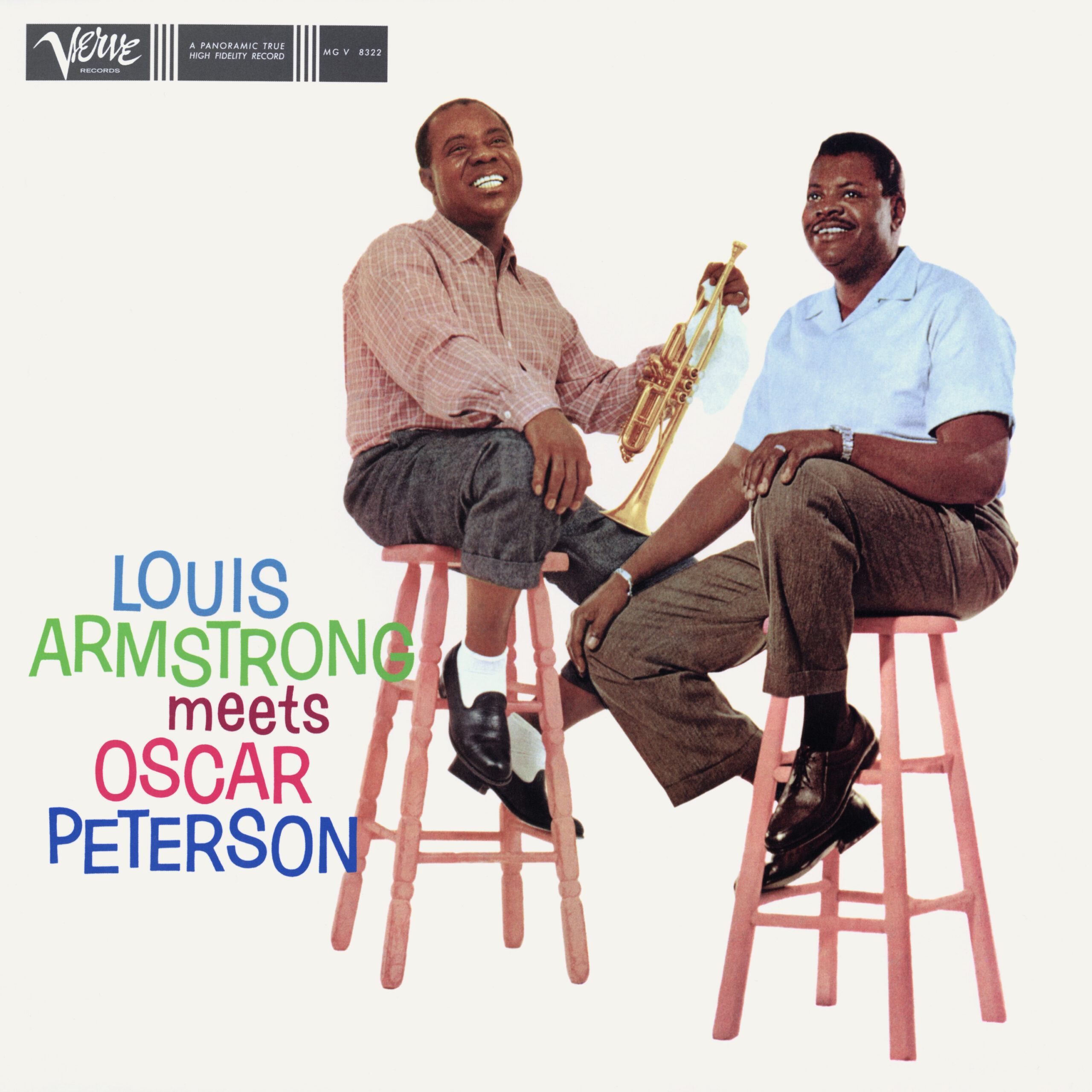
Louis Armstrong Meets Oscar Peterson: one voice, four attentive partners
Louis Armstrong does not require a large ensemble to make a song his own. On Louis Armstrong Meets Oscar Peterson, his singing and trumpet meet Oscar Peterson, Herb Ellis, Ray Brown and Louie Bellson. That gives us five musicians and several ways of telling a melody’s story. The voice contributes language and personal articulation; the trumpet offers a different kind of breath and line. Piano, guitar, bass and drums create the space in which those two sides of Armstrong can work. The title names the encounter, while the music reveals the relationships that give it substance.
The recording belongs to 1957. Norman Granz supervised the project, and Leonard Feather wrote the sleeve notes. The programme’s character rests on the combination of Armstrong with Peterson’s piano, Ellis’s guitar and Brown’s double bass, joined by Bellson on drums. This is more than a piano trio accompanying a singer: the additional guitar changes the possibilities between melody and accompaniment. Piano and guitar can occupy different places within the same harmonic setting, while bass and drums sustain the movement. Listening to that distribution offers a way into the album beyond the famous singer at its centre.
Twelve standards make up the programme. Their titles evoke memory, closeness, change and feelings that return. You do not need to know the history of every song to appreciate why this repertoire suits Armstrong: familiar words offer a voice the opportunity to give them personal emphasis. A short pause, an altered beginning or a word held a little longer can shift the meaning of a line. The record invites attention to those small decisions. It also remains an ensemble album, because the effect of a vocal phrase depends partly on how the other musicians make room for it.

Twelve songs heard as a complete album
That Old Feeling opens side A, followed by Let’s Fall in Love, I’ll Never Be the Same, Blues in the Night, How Long Has This Been Going On and I Was Doing All Right. These six titles suggest different perspectives before a note is played. A feeling returns, an invitation is offered, a change cannot be undone. Those are possible points of entry into the repertoire, rather than detailed descriptions of every interpretation. Armstrong’s task is to place familiar words so that they become present and personal again within this particular recording, supported by the responses around him.
Side B contains What’s New, Moon Song, Just One of Those Things, There’s No You, You Go to My Head and Sweet Lorraine. The sequence moves between questions, memories and direct address. It is worth hearing these pieces as more than separate favourites. A record can develop its own course through the order of its songs: one selection changes the way the next begins, and the ending gains weight from what has preceded it. This edition retains the twelve-track programme without inserting bonus performances into the shape of the original album as presented here.
One rewarding approach is to consider the relationship between words and melody. When does your attention follow the lyric most closely, and when does a musical phrase take over? Then ask a similar question of the trumpet: how does the storytelling change when words no longer determine the meaning? This is not a competition between Armstrong’s two forms of expression. It reveals different ways of communicating a musical thought. The rhythm section provides a continuing point of reference, connecting the movement between sung and instrumental lines and giving the individual songs a shared frame within the complete programme.

Listening more closely to Peterson, Ellis, Brown and Bellson
Oscar Peterson plays piano, Herb Ellis guitar, Ray Brown double bass and Louie Bellson drums. Those four names deserve attention alongside Armstrong. Piano and guitar can both make harmonic relationships clear, yet their attacks and decays are very different. Bass combines pitch with rhythmic direction, while drums can mark accents, organise movement and leave space. This combination already suggests several levels of listening. Begin with the voice, then gradually move further into the ensemble. Each shift of attention can reveal another relationship without requiring the song to be broken into isolated technical components.
For example, try hearing a familiar selection primarily through the guitar. On a later pass, follow the bass and notice how its line continues underneath a sung phrase. Then return your attention to Armstrong. The point is not to analyse every instrument separately, but to experience the connections between them more clearly. A singer with such an unmistakable articulation can easily command so much attention that the accompaniment’s contribution to relaxation, tension or movement goes unnoticed. The small group offers a particularly clear setting in which to rediscover that contribution and bring it back into the overall experience.
The documented album credits identify the five players, but do not provide an exhaustive instrument-by-instrument account of every passage. They should not be read as a claim that Armstrong sings and plays trumpet simultaneously, or uses both on every part of every selection. The panel records his roles within the album and the personnel carrying the programme. Norman Granz is likewise not counted as an additional performer. These distinctions keep the focus clear: a singer and trumpeter meets four individual partners whose collective playing shapes the songs. The record is more than a celebrated voice placed in front of anonymous accompaniment.
The stereo edition in the Verve Acoustic Sounds Series
This Verve Acoustic Sounds Series reissue presents the album on one 180-gram stereo LP at 33⅓ RPM. Ryan K. Smith at Sterling Sound handled the mastering, and the record was pressed at Quality Record Pressings. Its edition number is B0031689-01, with shop reference AVER 68901. A gatefold jacket is part of this release’s presentation. Identifying the version accurately matters because the packaging draws on features of the historical issue that do not, by themselves, provide a reliable guide to the audio format of this particular reissue.
The jacket uses the catalogue number associated with the earlier mono release and does not carry an unambiguous stereo indication. Nevertheless, the documented edition offered here is stereo. Its release note describes an early recording with left, centre and right channels. That does not mean the LP requires three separate playback channels: the record presents the programme in stereo. The information helps explain potentially misleading packaging. It is not used to promise a particular spatial effect or to claim superiority over other releases without comparison. The first requirements are to identify the edition correctly and explain its documented production details.
Musically, the album offers twelve opportunities to explore Armstrong’s singing and trumpet within a small ensemble. It belongs comfortably in a collection of vocal records while also rewarding an interest in Peterson and his partners. Michael 45 dispatches orders from Hilden in Germany, allowing customers in Germany and the EU to order without importing it themselves from the United States or waiting for customs clearance. If you want to buy Louis Armstrong Meets Oscar Peterson on vinyl, this stereo Acoustic Sounds Series edition is presented with the complete running order and a clear distinction between its performing musicians and production credits.
Current availability and delivery information appear beside the purchase controls; this edition description is not a statement of stock availability.
Series: Verve – all 34 records: voices, organ and bossa nova
Musicians
Participants and documented credit status. Track references correspond to the tracklist.
- Louis ArmstrongPortrait reference: 1953 · Porträtvorlagevocals, trumpetParticipation: all twelve tracks
- Oscar PetersonPortrait reference: 1977pianoParticipation: all twelve tracks
- Herb EllisPortrait reference: später, undatiertguitarParticipation: all twelve tracks
- Ray BrownPortrait reference: 1976double bassParticipation: all twelve tracks
- Louie BellsonExisting portrait; not a session depictiondrumsParticipation: all twelve tracks


Supervision: Norman Granz. Liner notes: Leonard Feather. Art direction: Sheldon Marks. Cover photography: Phil Stern. Series supervision: Chad Kassem. Mastering: Ryan K. Smith, Sterling Sound. Stereo edition despite the historical mono catalogue number on the jacket.

Reviews
There are no reviews yet.