

George Wallington and a band with a future
George Wallington is one of those pianists whose importance exceeds the frequency with which his name appears on present-day jazz recommendation lists. When Jazz for the Carriage Trade was recorded at Rudy Van Gelder’s Hackensack studio on January 20, 1956, he had already participated in bebop’s early history. Here, however, he appears as the leader of an active quintet rather than simply as a witness to an earlier era. Donald Byrd plays trumpet, Phil Woods alto saxophone, Teddy Kotick double bass and Art Taylor drums. The record shows an experienced pianist creating a shared setting for younger horn players.
Born Giacinto Figlia in Palermo and raised in New York, Wallington had worked with Dizzy Gillespie during bebop’s formative years. His own compositions include Godchild and Lemon Drop, neither of which appears on this album. That absence helps define the programme. Wallington does not construct a retrospective around his best-known writing. Instead, he selects music by Tadd Dameron, Frank Foster and Phil Woods, together with two songs from the American standard repertoire. His approach to leadership can therefore be found in the choice and combination of other writers’ voices as well as in his playing.
The quintet had a history at New York’s Cafe Bohemia. In 1955, Byrd, Jackie McLean, Wallington, Paul Chambers and Taylor performed there together. For Jazz for the Carriage Trade, Woods takes the alto position and Kotick the bass chair, while Byrd and Taylor remain. It would consequently be inaccurate to describe the studio LP as a document of the identical, unchanged club band. The movement within this circle is more interesting: musicians meet in new combinations, and a leader gives those encounters a recognisable form. This album captures one such formation at a precise moment in January 1956.

Phil Woods, Donald Byrd and a pianist who makes room
Woods and Byrd bring two distinct horn colours to the front of the group. Both are still near the beginning of long careers. Although Wallington remains the named leader, the personnel make clear that this is not a piano session with occasional contributions from horns. The quintet depends on several melodic voices. Following the themes reveals how alto and trumpet meet, and how their relationship to the piano changes as improvisation begins. The pianist’s role is expressed throughout that process, not only during his own solo passages.
Woods is particularly interesting as a composer here. He wrote Together We Wail and But George, contributing two selections to another musician’s album and appearing on the writers’ list alongside Dameron, Foster and the song composers. These pieces represent an early aspect of his work that can be overshadowed by his later reputation as an alto saxophonist. In November 1956, Woods, Byrd and Kotick would reunite at Van Gelder’s for The Young Bloods, where four of the six selections are Woods originals. The connection between the two records therefore involves both personnel and musical material, offering a rewarding way to follow the development of a working association.
Kotick and Taylor keep the quintet moving. All five musicians participate in all six performances, allowing their interaction to be followed across a complete album. The bass links harmonic direction to rhythmic motion; the drums can pick up accents, mark transitions and respond to the length of a phrase. Wallington works between those impulses and the horn line. This provides an engaging approach to his leadership: listen not only for the moments when he comes forward, but also for the ways he surrounds the other voices and gives them room. A bandleader’s musical identity can be expressed through these relationships as clearly as through an extended solo.

Dameron, Gershwin and music from the younger generation
Tadd Dameron’s Our Delight establishes the album’s opening point of reference. The choice places the programme within a jazz tradition in which melodic invention and harmonic movement are closely connected. George and Ira Gershwin’s Our Love Is Here to Stay follows. Moving from a jazz composition to a familiar song gives the same band different starting points. A well-known melody can offer the listener a clear orientation, while a less familiar theme initially draws attention to its shape and to the ensemble’s collective presentation.
Foster Dulles, the third track on side one, was written by Frank Foster. Accurate authorship matters here, since widely circulated secondary listings have attributed it to Wallington. It is no more a Wallington composition than the two Woods pieces on the second side. A precise tracklist therefore reveals something different from a casual assignment of every less familiar number to the leader. Wallington brings together material by several writers and trusts his band to establish a relationship between it. The resulting programme reflects selection and interpretation as well as composition.
Side two opens with Woods’ Together We Wail. Bob Haggart and Johnny Burke’s What’s New? follows, before But George provides the conclusion. Woods thus stands at both ends of this half of the album, with a song offering another approach to melodic expression in between. It is worth listening for distinctions beyond tempo alone. The length of a theme, the placement of a response and the balance between ensemble melody and space for improvisation all contribute to the way a performance develops. The consistent personnel make it easier to follow those differences without having to adjust to a new band on each track.
For collectors, Jazz for the Carriage Trade consequently offers more than an overlooked Prestige title with famous sidemen. It brings an early bebop pianist together with two emerging horn players and a consistent rhythm section. Woods and Byrd can be heard within a framework shaped by Wallington, while the leader himself comes back into focus. Listeners who enjoy moving through jazz history from musician to musician and session to session will find several fruitful connections here. Yet the album also has a clear identity without them: five musicians, six selections and one concentrated studio encounter.
The Analogue Productions Prestige mono LP
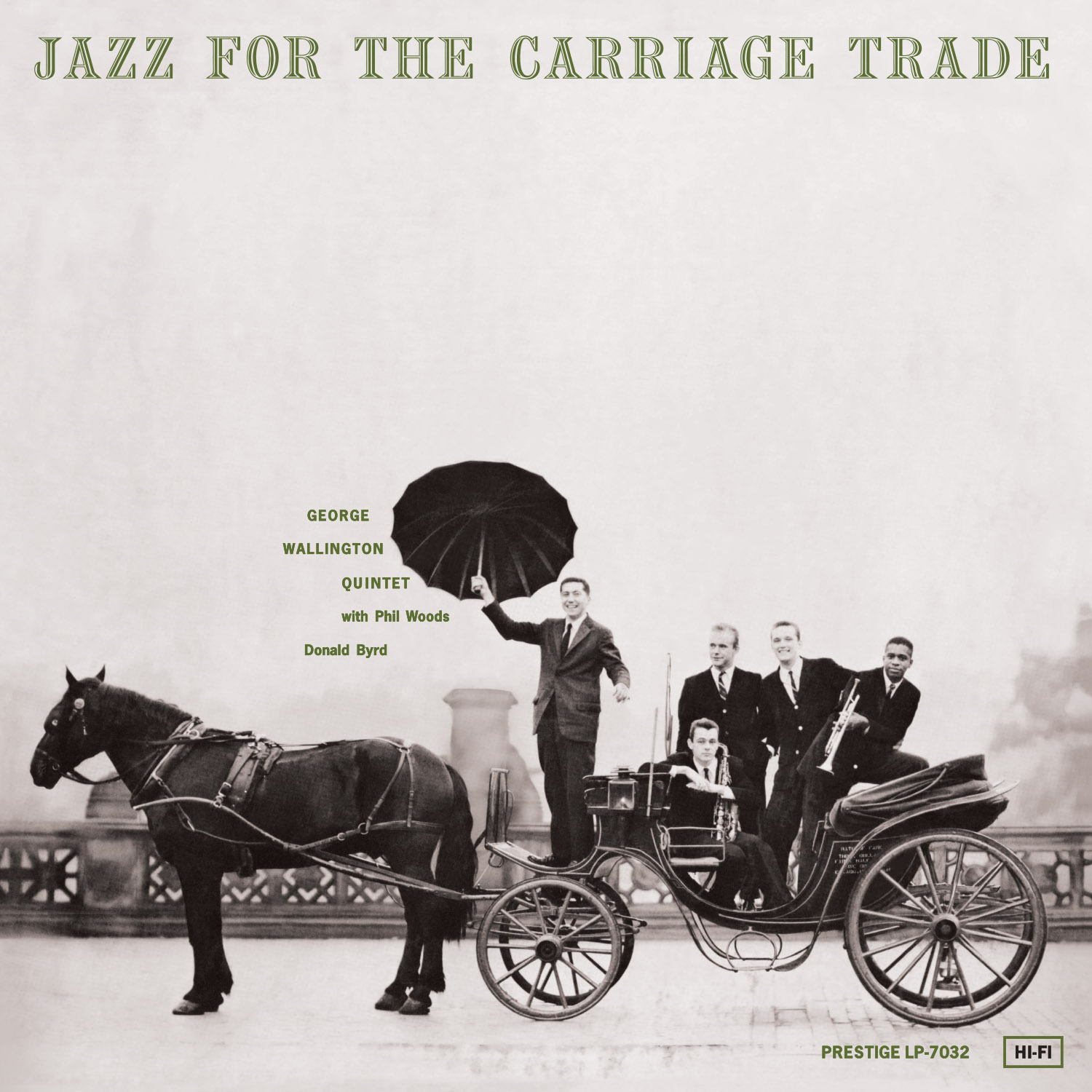
The edition offered is APRJ 7032, a single Analogue Productions mono LP running at 33⅓ RPM. Kevin Gray handled the mastering and lacquer cutting at Cohearent Audio. The label identifies analogue masters as the source, with manufacture by Quality Record Pressings. The current edition is listed at 180 grams and includes a high-gloss Stoughton tip-on jacket. The playful carriage photograph on the original cover remains part of the album’s familiar presentation; the music itself was, of course, recorded in the studio.
The early Analogue Productions edition from 2013 was manufactured on 200-gram vinyl. Later 180-gram pressings retain the same catalogue number, so an old weight specification should not automatically be applied to a current copy. Early numbering likewise does not describe the entire present edition. This account refers to the 180-gram release currently listed by the label and its documented manufacture, without promising characteristics that belong specifically to early collectible copies.
With three tracks on each side, the programme retains two continuous sequences. The first moves from Dameron through Gershwin to Foster; the second places Woods’ compositions around What’s New?. One side change serves the complete album. It is a suitable format for music whose appeal lies in getting to know a band and the relationships within it. You order from Michael 45 in Germany. We arrange the US import and dispatch from Hilden.
Customer question: Buying Analogue Productions records in Europe
Series: Analogue Productions Prestige – all 50 records, musicians and session paths
Musicians
Participants and documented credit status. Track references correspond to the tracklist.
- Phil Woodsalto saxophoneParticipation: A1, A2, A3, B1, B2, B3
- Teddy Kotickdouble bassParticipation: A1, A2, A3, B1, B2, B3
- Art TaylordrumsParticipation: A1, A2, A3, B1, B2, B3
- George WallingtonpianoParticipation: A1, A2, A3, B1, B2, B3
- Donald ByrdtrumpetParticipation: A1, A2, A3, B1, B2, B3


All five musicians on all six tracks; January 20, 1956, Hackensack.

Reviews
There are no reviews yet.