An orchestra takes the soloist's place
A concerto without an individual soloist: the title of Béla Bartók's Concerto for Orchestra overturns a familiar expectation. Rather than placing a piano or violin in front of the ensemble, the work makes the orchestra itself a counterpart to its individual voices. Instrumental groups emerge, answer one another and return to the collective texture. The resulting virtuosity cannot be located in one spectacular part. It lives in the exchanges between many participants, inviting the listener to move attention from one group to another as the piece develops.
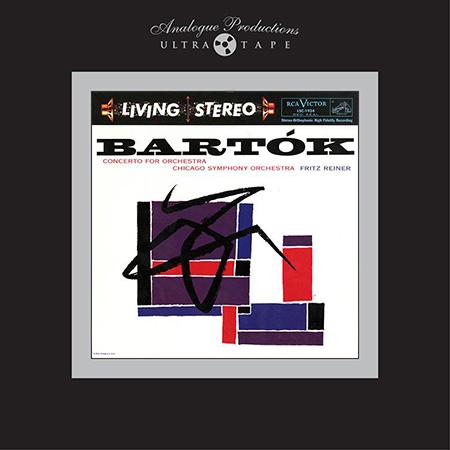
Fritz Reiner and the Chicago Symphony Orchestra recorded the work on October 22, 1955, at Orchestra Hall in Chicago. Reiner's connection with Bartók, however, reaches much further back than this session. They shared a Hungarian background and a personal acquaintance, and Reiner was among the supporters who helped bring about the commission. The recording is consequently also an encounter between a conductor and a work whose creation had personal significance for him. It belongs to the history of that relationship as well as to the development of RCA's stereo catalogue.

Creative energy renewed
Bartók composed the concerto in the United States in 1943. Serge Koussevitzky's commission arrived during a difficult period of the composer's American exile; Reiner and violinist Joseph Szigeti had advocated on his behalf. The score took shape during the summer and autumn in Saranac Lake. Koussevitzky conducted its premiere with the Boston Symphony Orchestra in December 1944. That Boston beginning should not be confused with the location of the Chicago recording offered here. Approximately eleven years and a different orchestra separate the two events.
The five movements connect grave, playful and energetic situations in a broad arch. The “Introduzione” leads to the play of instrumental pairs, with the “Elegia” at the centre. The “Intermezzo interrotto” and “Finale” carry the work onwards without simply erasing its earlier contrasts. Bartók himself described a progression from the stern opening and the mourning of the central movement towards affirmation in the conclusion. This plan provides a useful first approach to the piece: the movements differ sharply, but they are not interchangeable episodes placed beside one another at random.

Small distances, substantial differences
Bartók's conception of the orchestra becomes particularly tangible in the second movement. Bassoons, oboes, clarinets, flutes and muted trumpets appear in pairs. Each pair uses a different interval, changing not only the instrumental colour but also the relationship between the two lines. You do not need to name those intervals to notice the result. Begin by following the arrival of each new pair and the framing role of the side drum. What initially sounds like a straightforward succession becomes a carefully organised presentation of contrasting orchestral personalities.
These passages offer an especially revealing way into Reiner's work with the Chicago Symphony Orchestra. A large climax demonstrates only part of what the score demands; clarity, timing and the balance between moving lines matter just as much. In the fourth movement, interruption is already built into the title. The music establishes an order and introduces something that disturbs it. Repeated listening can therefore follow a different thread each time: the paired winds, the string writing, or the changing relationship between exposed individual voices and the full weight of the ensemble.
This recording on Ultra Tape
Analogue Productions identifies its Ultra Tape edition as RRAP 0020. It contains the five movements of the Concerto for Orchestra on quarter-inch tape at 15 ips, using two-track stereo, or half-track, and IEC equalisation. A playback machine needs to support that combination. This is neither the historical RCA consumer tape nor one of the parallel LP editions. Its technical specifications must be considered independently: a record's playing speed or lacquer-cutting credit does not describe this tape product.
The publisher specifies real-time duplication on an ATR-modified Ampex machine and describes a copy of the original analogue master tape as the source. This does not establish a precise sequence of tape generations or a separate mastering credit for this edition. The musical identification is nevertheless clear: Reiner, the Chicago Symphony Orchestra and the October 1955 recording. Its five movements offer an opportunity to hear a large ensemble through the smaller relationships within it, fulfilling the idea of a concerto in which the orchestra itself supplies a continually changing cast of soloists.
You order from Michael 45 in Germany. We arrange the US import and dispatch from Hilden. Editions not currently in stock are dispatched after the goods arrive.
Also in another edition: Bartok: Concerto For Orchestra
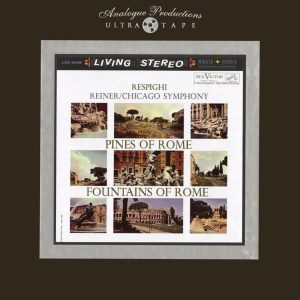
More by Fritz Reiner: Prokofiev: Lieutenant Kije / Stravinsky: Song of the Nightingale · Respighi: Pines Of Rome & Fountains Of Rome
Artist page: All titles by Fritz Reiner
Customer question: Buying Analogue Productions records in Europe
Musicians
Documented participants in this recording. Publisher-only credits are identified; track references correspond to the tracklist.
| Name | Instrument / role | Participation |
|---|---|---|
| Fritz Reiner | conductor | Album personnel |
| Chicago Symphony Orchestra | orchestra | Album personnel |
Other individual orchestra members are not identified for this session.

Reviews
There are no reviews yet.