

When the long-playing record gave the music more time
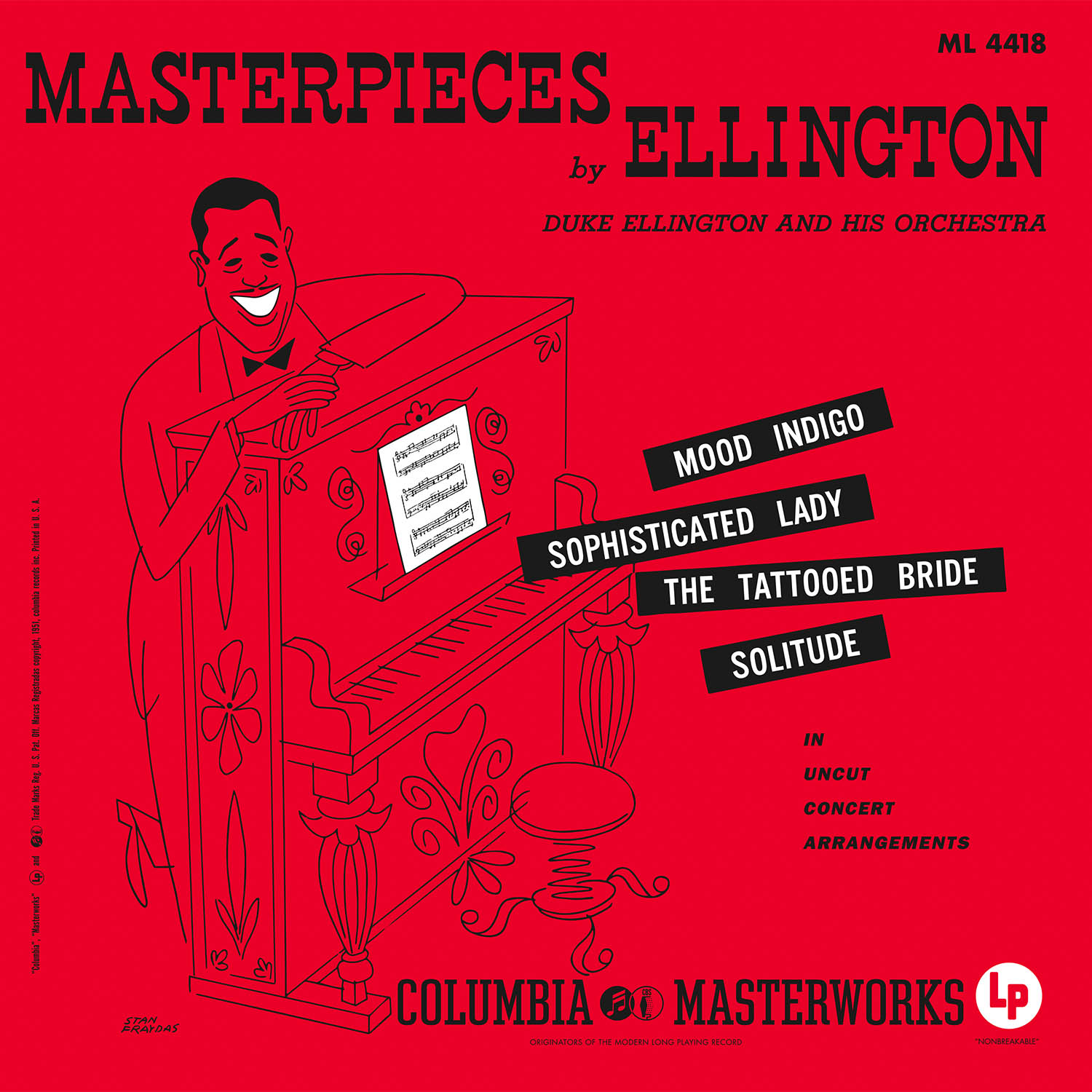
Masterpieces by Ellington tells a story about a great orchestra and about a new relationship with the record itself. In December 1950, Duke Ellington recorded four extended pieces at Columbia’s 30th Street Studio in New York. The album appeared in 1951 as Columbia Masterworks ML 4418. The playing time of a twelve-inch LP allowed familiar compositions to escape the compression of a short record side. Melodies could be transformed, soloists could develop longer statements, and arrangements could unfold through several related sections instead of reaching their conclusion almost immediately.
Three familiar titles, “Mood Indigo”, “Sophisticated Lady” and “Solitude”, stand alongside “The Tattooed Bride”, a larger composition dating from 1948. The result is more than four independent favourites placed together. Each piece becomes a musical space in which the orchestra can reveal its different voices. Listeners who know Ellington primarily through concise swing recordings encounter another sense of duration here. The additional length does not simply provide more of the same material. It creates an opportunity to reconsider how the interior of a piece is organised.
Ellington and Billy Strayhorn are credited for the arrangements, and both appear in the piano credits. The available documentation does not consistently establish which pianist plays each individual passage, so those assignments remain open. Their shared work can nevertheless be understood as central to the album. An orchestra possesses many colours, but the ordering of those colours turns a long performance into a convincing progression. A restrained passage can prepare a later ensemble entrance, while one individual voice can change the perspective from which a familiar melody is heard.
The timing lends the recording another significance. Johnny Hodges, Lawrence Brown and Sonny Greer were still in the orchestra shortly before their paths diverged from it, temporarily or permanently. The album therefore preserves a particular personnel relationship as well. In Ellington’s work, instrumental sections were never merely anonymous blocks of sound. Individual musicians’ characteristics belonged to his compositional thinking. A more expansive record format could give those personal voices greater room while showing how each remained connected to the larger whole.

Named soloists and voices with histories of their own
Alto saxophonist Johnny Hodges is one of the defining personalities of this line-up. Lawrence Brown plays trombone, Sonny Greer drums and Wendell Marshall double bass. The trumpet section includes Cat Anderson, Harold “Shorty” Baker, Andrew “Fats” Ford, Ray Nance and Nelson Williams. Tyree Glenn and Quentin Jackson join Brown among the trombones. These names already show why an account of the record cannot stop with the bandleader. The orchestra consists of musicians with distinct responsibilities and expressive possibilities, rather than interchangeable occupants of instrumental positions.
Jimmy Hamilton is credited with clarinet and tenor saxophone. “The Tattooed Bride” gives his clarinet particular room and can be heard in that sense as an almost concerto-like opportunity for the soloist. Russell Procope contributes alto saxophone and clarinet, and Paul Gonsalves tenor saxophone. Their instruments do more than provide a background for other featured players. They belong to a flexible palette through which the arrangements can move between a single line, a smaller instrumental group and the full orchestra.
An important additional voice enters “Mood Indigo” and “Sophisticated Lady”: Eve Duke, credited on the original release as Yvonne Lanauze. Her singing is part of the identity of these extended versions. It should neither disappear into a general orchestral credit nor be confused with another Ellington vocalist. When familiar instrumental themes are placed within larger forms, the arrival of a singer changes the listener’s perspective. A thought previously expressed by an instrument gains words, another kind of phrasing and a different position within the course of the piece.
Two credits require restraint. Harry Carney is listed by the supplementary album encyclopedia on baritone saxophone and bass clarinet, but is absent from the publisher and Discogs personnel lists compared for this release. Mercer Ellington’s instrument is described inconsistently as French horn or flugelhorn. Both cases remain qualified in the credits. The securely documented reed and brass credits already demonstrate the range of colours available to Ellington. On another listen, it can therefore be rewarding to follow the exchanges between instrumental sections rather than directing all attention towards the featured solos.

Four extended forms instead of a parade of short standards
“Mood Indigo” opens the album in a performance lasting approximately a quarter of an hour. The familiar melody provides a starting point to which the arrangement can establish several different relationships. Ellington biographer John Edward Hasse draws attention to changing metres, a waltz section and movement through several keys. That suggests a straightforward listening approach: rather than only awaiting the theme’s return, notice what changes between those encounters. The scale of the performance comes from its internal variety, not just the amount of time that passes.
“Sophisticated Lady” follows on the second side, with the vocal passage bringing another perspective to a familiar title. The extended form allows instrumental and sung sections to affect one another. Follow the way a soloist’s entrance is prepared and the way the orchestra resumes after the contribution. Such transitions help determine whether a long recording feels like a string of separate features or a continuous development. They are also places where the care of the arrangement becomes particularly evident, without requiring the listener to identify every individual instrument immediately.
The third side belongs to “The Tattooed Bride”. The composition emerged from a different setting from the older standards and brings a larger, almost concertante design. Hamilton’s clarinet offers an important guide, but the surroundings of the soloist deserve attention too. Which instruments answer, what movement continues underneath, and when does the density change? “Solitude” closes the programme. Lawrence Brown’s trombone solo provides one specific moment when the personal voice of an orchestral player moves unmistakably towards the centre of the performance.
A satisfying relationship consequently runs through the four pieces. Familiar melodies are reconsidered, a larger work receives space, and individual musicians remain recognisable within written arrangements. No musicological preparation is required. A first hearing can follow the tunes, a later one the shifting combinations within the orchestra. For collectors, the album is also a document of early LP history. The new format is being used not merely to fit more short selections onto one disc, but to give the compositions themselves more time in which to develop.
The mono double LP at 45 RPM
The edition described here is Analogue Productions AAPJ 4418-45, a mono double LP running at 45 RPM. Ryan K. Smith cut it at Sterling Sound, from the original analogue tapes according to the publisher, with manufacture by Quality Record Pressings. The historical recording credits include engineers Fred Plaut and Harold Chapman. The publisher identifies an Ampex 200 using 3M 111 tape at 15 inches per second. Sources disagree on the exact December day, so the securely established month and year are retained here.
The arrangement is particularly clear: “Mood Indigo” on side A, “Sophisticated Lady” on side B, “The Tattooed Bride” on side C and “Solitude” on side D. Each work receives a complete side, and none of the extended arrangements is divided into two parts. Compared with the single 33⅓ RPM record, however, there are additional side changes between the works. Listeners who prefer two pieces without interruption can take that difference into account; those who enjoy giving each arrangement its own listening section may appreciate the clarity of this version. Rotational speed alone does not replace consideration of the actual mastering and individual listening habits.
A small detail from the record’s reception belongs to this double LP. After recommending the 33⅓ RPM edition, critic Fred Kaplan expressed a wish for a 45 RPM version. His recommendation appeared in 2015, and the documented double LP followed in 2017. That establishes a sequence of events, rather than proving a causal relationship. For collectors, the useful distinction lies in the catalogue numbers and side allocations of the two AP versions. These are the same four historical recordings in a different vinyl edition, not additional performances or a stereo alternative.
The earlier 45 RPM pressing from 2017 is documented at 200 grams, and the 2021 repress at 180 grams; the publisher now lists the 180-gram double LP. This does not imply that the physical stock batch has been inspected. The Stoughton tip-on gatefold jacket reprises Stan Fraydas’s original cover design. Musical history, precise edition identity and physical presentation belong together here. Mono describes the original recording perspective, rather than limiting the variety of voices within the orchestra. Those individual musicians remain at the centre of the story, whether the four works are experienced across two sides or four.
You order from Michael 45 in Germany. We arrange the US import and ship from Hilden.
Also in another edition: Masterpieces By Ellington
More by Duke Ellington: Duke’s Big 4 · The Ellington Suites
Customer questions: 45 or 33⅓ RPM: which edition is worth it? · Buying Analogue Productions records in Europe
Musicians
Participants and documented credit status. Track references correspond to the tracklist.
- Duke EllingtonpianoParticipation: piano assignments with Strayhorn unconfirmed
- Billy StrayhornpianoParticipation: individual track assignments unconfirmed
- Cat AndersontrumpetParticipation: album personnel
- Harold “Shorty” BakertrumpetParticipation: album personnel
- Andrew “Fats” FordtrumpetParticipation: album personnel
- Ray NancetrumpetParticipation: album personnel
- Nelson WilliamstrumpetParticipation: album personnel
- Lawrence BrowntromboneParticipation: album personnel
- Tyree GlenntromboneParticipation: album personnel
- Quentin JacksontromboneParticipation: album personnel
- Mercer EllingtonFrench horn (Wikipedia) / flugelhorn (original-release Discogs credit); disputedParticipation: album personnel
- Jimmy Hamiltonclarinet, tenor saxophoneParticipation: album personnel; soloist C
- Johnny Hodgesalto saxophoneParticipation: album personnel
- Russell Procopealto saxophone, clarinetParticipation: album personnel
- Paul Gonsalvestenor saxophoneParticipation: album personnel
- Harry Carneybaritone saxophone, bass clarinet (B)Participation: Participation listed only in supplementary source
- Wendell Marshalldouble bassParticipation: album personnel
- Sonny GreerdrumsParticipation: album personnel
- Eve Duke (Yvonne Lanauze)vocalsParticipation: A, B


Recorded December 1950 at Columbia 30th Street Studio, New York; sources disagree on the exact day (18th/19th). Engineers: Fred Plaut and Harold Chapman. Arrangements: Duke Ellington and Billy Strayhorn; individual piano assignments unconfirmed. Vocals: Eve Duke, originally credited as Yvonne Lanauze. Harry Carney is listed only by the supplementary encyclopedia; Mercer Ellington’s instrument is disputed. Liner notes: George Dale; original cover: Stan Fraydas. AP mastering: Ryan K. Smith; pressed at Quality Record Pressings.
🎧 Review video: The 20 Best Audiophile Analogue Production Editions (Still in Print 2021)
This video is hosted by YouTube (Google). It only loads once you switch on “Functional” in the cookie settings.

Reviews
There are no reviews yet.