
A work that thinks in movement
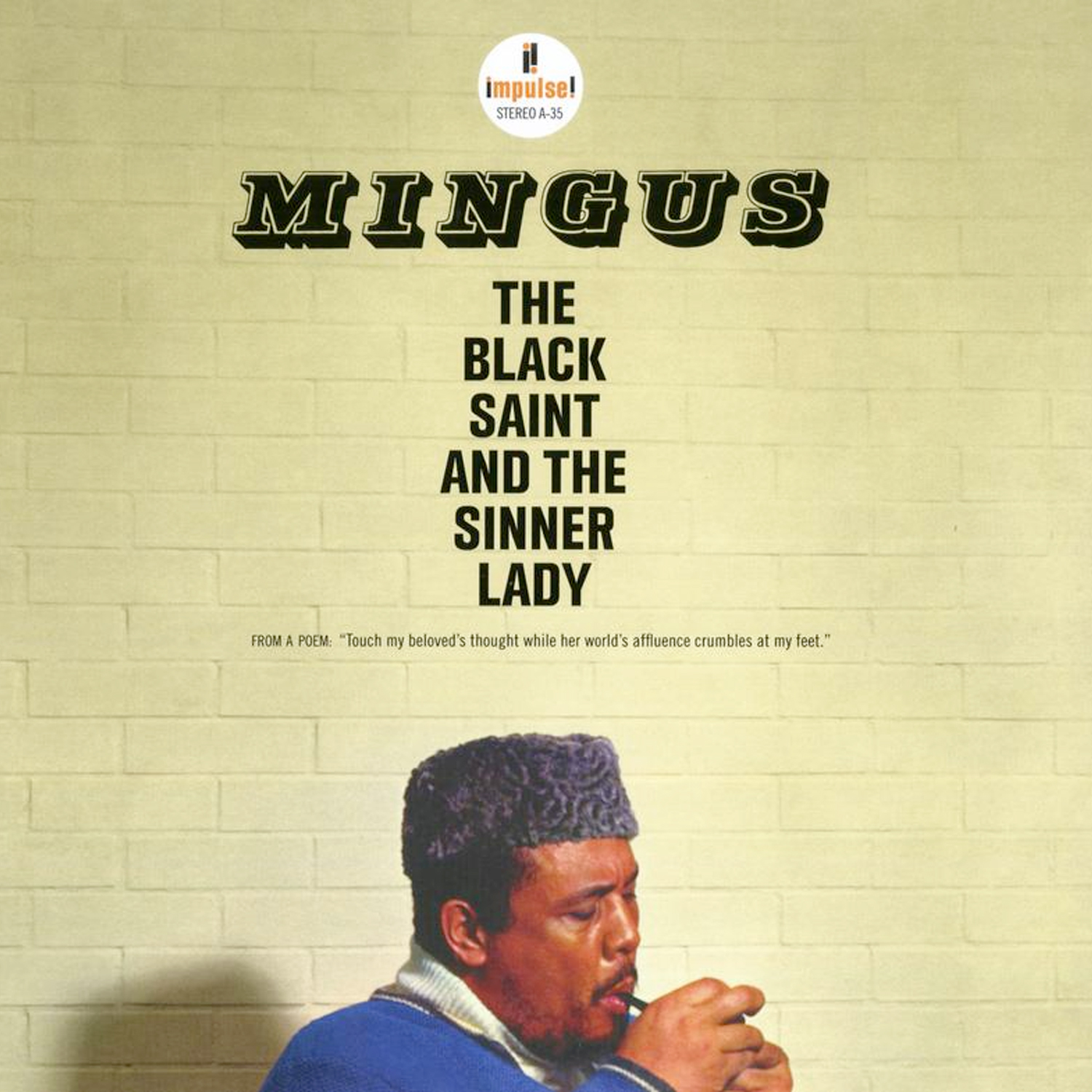
The Black Saint and the Sinner Lady is not adequately described as a collection of separate jazz pieces. Charles Mingus conceived a continuous composition whose parts relate to one another and whose titles repeatedly invoke dance: solo, duet, group, movement and countermovement. The work was partly conceived as a ballet. No particular choreography has to be known or imagined in order to approach it. Its design already invites us to understand music as an encounter between bodies and voices—as convergence, disagreement, collective pressure and the sudden release of space.
The recording was made on 20 January 1963 at RCA Studios in New York. Bob Thiele produced and Bob Simpson was the engineer. Those credits are worth noting on an Impulse! album: not every recording for the label came from Rudy Van Gelder’s studio. Mingus worked with an eleven-piece band, with Bob Hammer contributing arrangement and co-orchestration. Impulse! released the album in July 1963 as A-35 and AS-35. That concentrated recording history belongs to a work whose internal architecture reaches well beyond the idea of a conventional sequence of session performances.
The original liner notes are another distinctive part of its history. Alongside Mingus, Edmund Pollock, his psychotherapist at the time, contributed to the sleeve. This is an unusual perspective on a jazz album, but it should not encourage listeners to interpret every musical turn as a diagnosis. The work remains a composition, made from instruments, motifs, contrasts and a deeply individual conception of expression. The biographical proximity of the notes expands the context without replacing attention to the musical decisions themselves.

Eleven musicians, many colours and a shared idea
Mingus is credited on double bass and piano and composed all the sections. The ensemble includes Jaki Byard on piano, Dannie Richmond on drums and Jay Berliner on classical guitar. Its richly stocked wind and brass section comprises Jerome Richardson on soprano and baritone saxophones and flute, Charlie Mariano on alto saxophone, Dick Hafer on tenor saxophone and flute, trumpeters Rolf Ericson and Richard Williams, Quentin Jackson on trombone and Don Butterfield on tuba. Even the personnel list suggests possibilities beyond alternating a theme with one featured solo instrument.
The differences between these voices offer a useful entrance. Mariano’s alto occupies a different register from Richardson’s baritone; flutes alter the colour established by brass; tuba extends the lower register, while Berliner’s guitar brings its own accent to the ensemble. An album-level list should not, however, be taken to mean that every credited instrument is continuously present in every section. The documented personnel identify the contributors to the work. They do not automatically supply a fully verified soloist map for each movement.
Bob Hammer belongs among the contributors as arranger and co-orchestrator, rather than as a twelfth performing musician. That distinction helps give the work behind the ensemble its proper place. A count of instruments alone cannot explain the effect of a band; the question is how its voices are brought together and separated. For Mingus, the ensemble is part of the compositional thought. Listening once to the relationship between high and low voices, and then again with attention to the drums, can reveal different paths through the same continuous form.
This is also a record on which learning the musicians’ names has a purpose beyond collecting credits. Each name opens a possible point of attention. A large group need not be heard only as a single block of sound, just as individual players need not be isolated from the structure around them. The interest lies in moving between those perspectives: following a voice, then noticing the larger shape into which it returns.

Six movements within the architecture of an LP
The work contains six movements arranged into four principal tracks on the LP. Side A presents “Track A – Solo Dancer,” “Track B – Duet Solo Dancers” and “Track C – Group Dancers.” Side B brings Modes D, E and F together in one continuous passage. That distinction matters to a useful track listing. The three modes on the second side should remain visible as parts of the work’s progression, without being misrepresented as three unrelated, artificially separated pieces.
The extended subtitles refer to physical closeness, freedom, revolution, love and pain. They indicate the range of the conception without providing a simple set of instructions for every bar. Mingus connected the music with his own understanding of dance and cultural memory; the frequently discussed Spanish and flamenco-related gestures belong to that context. The result is not a picturesque travel scene. Different influences are drawn into a work whose identity depends on the relationships among its parts.
A good first approach is therefore to follow the progression before trying to name every event. Where does the ensemble become denser? When does an individual voice emerge? How does a new instrumental colour alter expectations for the next passage? The single-LP edition at 33⅓ RPM supports exactly that kind of encounter. After the first side’s three tracks, the connected Modes D–F can unfold across side two without another record change. For a suite with such close internal relationships, preserving this continuity is a practical attraction of the original format, independent of blanket claims about competing playback speeds.
Within a Mingus collection, the album is a substantial point of reference. It reveals the composer and designer of ensembles as clearly as the bassist. From here, a listener can return to smaller groups and recognise that personal expression and detailed organisation belong together in his work. A larger band opens additional possibilities, but the central question remains: how can distinct musical personalities form a shared idea without losing their differences?
Acoustic Sounds Series: AIMP 60201
This is The Black Saint and the Sinner Lady on a stereo LP in the Verve/UMe Acoustic Sounds Series. The shop and publisher catalogue number is AIMP 60201, while the documented label number is B0033602-01. Released in 2021, the edition offers 180-gram vinyl at 33⅓ RPM, pressed at Quality Record Pressings, in a Stoughton tip-on gatefold jacket. Ryan K. Smith at Sterling Sound handled the mastering, from analogue tapes according to the publisher, with Chad Kassem supervising the reissue project.
Accurate series identification avoids confusion with other Mingus editions. The Acoustic Sounds Series is a Verve/UMe programme; the involvement of Acoustic Sounds and QRP does not make this LP interchangeable with an unspecified Analogue Productions release. Nor can information from a Japanese SACD or another vinyl pressing simply be transferred to it. For a work issued in many forms, catalogue numbers and production details help establish exactly which object is being offered. The gatefold also belongs to the historical conception of an album whose notes and presentation provide a context of their own.
The strongest reason to spend time with the record remains the composition itself. The Black Saint and the Sinner Lady joins an exceptionally individual conception of expression to an ensemble containing many clearly distinguishable voices. It does not require everything to be decoded on the first encounter. Instead, it offers enough relationships, contrasts and forms to invite a return—and the chance to follow another musician or another movement through the same work on the next visit.
You order from Michael 45 in Germany. We arrange the US import and dispatch from Hilden.
More by Charles Mingus: Mingus Mingus Mingus Mingus Mingus · Blues & Roots
Series: Impulse! – all 19 records: the house that Trane built
Musicians
Participants and documented credit status. Track references correspond to the tracklist.
- Charles MingusPortrait: 1959double bass, pianoParticipation: Album personnel; movement assignments unconfirmed
- Jerome RichardsonPortrait: existing portraitsoprano saxophone, baritone saxophone, fluteParticipation: Album personnel; movement assignments unconfirmed
- Charlie MarianoPortrait: late 1970salto saxophoneParticipation: Album personnel; movement assignments unconfirmed
- Dick Hafertenor saxophone, fluteParticipation: Album personnel; movement assignments unconfirmed
- Rolf EricsonPortrait: 1955trumpetParticipation: Album personnel; movement assignments unconfirmed
- Richard WilliamstrumpetParticipation: Album personnel; movement assignments unconfirmed
- Quentin JacksontromboneParticipation: Album personnel; movement assignments unconfirmed
- Don ButterfieldtubaParticipation: Album personnel; movement assignments unconfirmed
- Jaki ByardPortrait: 1965pianoParticipation: Album personnel; movement assignments unconfirmed
- Jay Berlinerclassical guitarParticipation: Album personnel; movement assignments unconfirmed
- Dannie RichmondPortrait: 1961drumsParticipation: Album personnel; movement assignments unconfirmed
- Bob Hammerarrangement, co-orchestrationParticipation: Work; not a performing instrumentalist


20 January 1963, RCA Studios New York; producer Bob Thiele, engineer Bob Simpson, composer Charles Mingus, arrangement/co-orchestration Bob Hammer (not a performer). Notes by Mingus and Edmund Pollock. Eleven-piece band; individual instruments/solos per movement not fully documented. Six movements within four LP tracks: side B Modes D–F continuous. Times follow documented AS LP; other editions differ; Whitney/Whitey varies by source.
How Michael hears this edition
Listening impression · paraphrased from the video
Michael particularly highlights the Acoustic Sounds edition’s exceptionally deep soundstage and describes it as demonstration material for his system. It ranks second in his personal list of jazz reissues for 2021. This is a personal annual selection of different albums, not a direct comparison of every pressing of this title.
Watch Michael’s video moment · 10:36
In a separate direct comparison, Michael prefers this Acoustic Sounds 33⅓ RPM edition to his earlier AP 45. His copy plays more quietly, and he hears more punch and sharper definition. He praises the deep soundstage of both editions and finds the older 45 slightly softer. His observation about surface noise concerns his own copies.
🎧 Review video: Charles Mingus: Mingus x5, The Black Saint and the Sinner Lady + Shootout 45 RPM vs. 33,3 RPM
This video is hosted by YouTube (Google). It only loads once you switch on “Functional” in the cookie settings.

Reviews
There are no reviews yet.