

Bill Evans in the concert hall
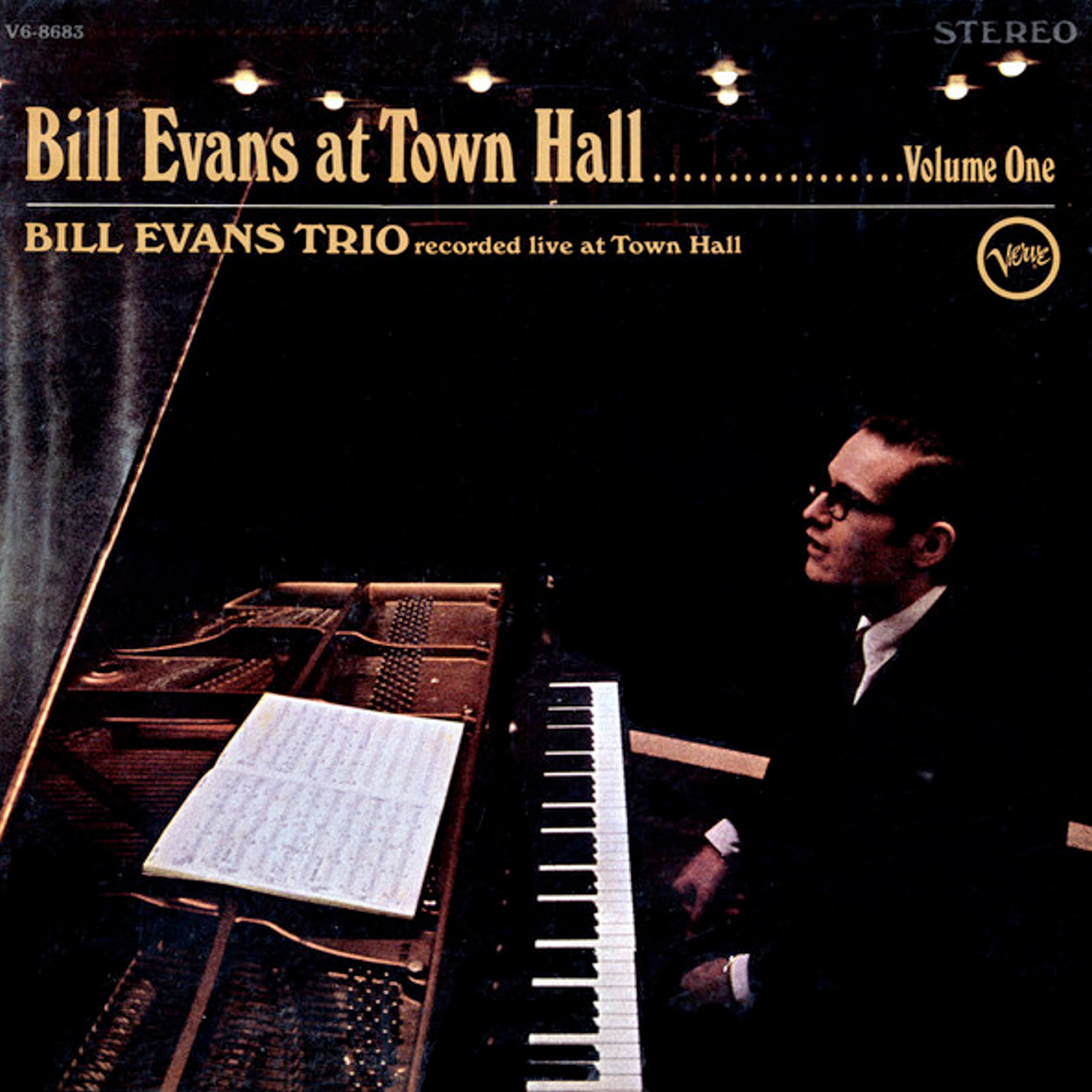
At Town Hall, Volume One documents Bill Evans on February 21, 1966, at New York’s Town Hall. The concert venue provides a different historical setting from the club recordings often associated with his name. The defining feature of this LP, however, is its internal design. Evans plays four selections in a trio with Chuck Israels on double bass and Arnold Wise on drums, followed by an extended solo-piano sequence. The album places collective playing and a particularly personal dedication within the same release.
Verve issued the record in 1966 under the original stereo catalogue number V6-8683. Creed Taylor and Helen Keane are credited with production for the documented release. The programme has five principal selections, the last joining several sections into one continuous solo work. That organisation matters. Treating the suite’s subsections as unrelated songs would obscure part of the larger direction in which the album moves and the significance of its sustained closing form.
The record offers two complementary ways of considering Evans’ playing. In the standards, a familiar melody meets the shared decisions of three musicians. In the closing solo, the pianist assumes complete responsibility for continuity, balance and transitions. The change of personnel therefore affects more than the number of instruments involved. It alters the circumstances of musical storytelling and gives the second side a particularly concentrated place within the album’s overall shape.
The designation Volume One points towards a broader concert context. Another part of the evening involved orchestral material arranged by Al Cohn. That music is not included on this LP, and the proposed second volume did not appear as the corresponding continuation. Collectors benefit from keeping the history of the concert distinct from the contents of the released album. This volume’s five works form a specific selection whose character depends on the relationship between trio performances and solo piano.

Chuck Israels and Arnold Wise as musical partners
Chuck Israels plays double bass on the four trio selections. His instrument participates independently in the melodic and harmonic understanding within the group. With Evans, it is particularly rewarding to notice the other players even when they are not explicitly featured. A movement in the bass can affect the direction of a piano phrase, suggest an alternative or provide continuity through a section. Relationships between the voices are therefore as useful an area of attention as the pianist considered in isolation.
Arnold Wise plays drums on those same four selections. His participation is a specific feature of this concert record and should not be confused with the personnel of other, more familiar Evans albums. Part of a trio’s work involves maintaining a shared pulse without giving every musical movement identical weight. Concentrating on the drums offers a way to follow the relationship between rhythmic orientation and the freedom of a piano line. The smallest change of emphasis may matter within such a compact ensemble.
The personnel boundary falls after “Make Someone Happy.” Israels and Wise appear on the three pieces of side one and the opening piece of side two; the following suite is performed by Bill Evans alone. Stating the distinction makes the album’s design easier to understand and prevents general personnel credits from being mistaken for the instrumentation of the solo. The musician section therefore identifies participation by track. The extended closing sequence is explicitly a solo-piano performance.
The juxtaposition of the two settings is one of the record’s attractions. After several standards played by a group, the same pianistic personality is encountered without the other two musicians. Continuities and differences can be equally interesting. Which responsibilities remain with the piano, and which additional ones does it assume? How is a transition shaped without another player supplying an impulse? The album provides a concrete opportunity to consider these questions within a single concert document rather than through unrelated recordings.

Four standards and a solo for Harry L. Evans
Side one opens with “I Should Care,” by Axel Stordahl, Paul Weston and Sammy Cahn. Richard Rodgers and Lorenz Hart’s “Spring Is Here” follows, then Anthony Newley and Leslie Bricusse’s “Who Can I Turn To.” Three different songs give the trio its points of departure. Familiar material can offer an initial orientation: the melody remains a reference while phrasing, harmonic emphasis and the dialogue between instruments open other perspectives on it.
“Make Someone Happy,” written by Jule Styne, Betty Comden and Adolph Green, begins the second side. It is followed by “Solo – In Memory of His Father Harry L. Evans, 1891–1966.” Evans’ father had died only a few days before the concert, and the album explicitly names him in the dedication. That information explains the dedication’s occasion without requiring every musical detail to carry a predetermined psychological meaning. The performance can be approached both as a personal tribute and as an intentionally organised musical form.
The approximately thirteen-minute solo sequence consists of “Prologue,” “Improvisation on Two Themes: Story Line – Turn Out the Stars,” and “Epilogue.” The middle section brings two thematic points of reference into an improvisation. “Turn Out the Stars” had already been written; describing its composition solely as an immediate response to the father’s death would therefore be inaccurate. Here, existing musical material is placed within the context of a dedication. The distinction gives a more precise account while allowing the music its own history.
Together, the four trio performances and the suite create a strongly defined album sequence. The solo is a substantial concluding work with an internal progression. Giving it an uninterrupted hearing allows its sections to be understood as parts of that larger movement. A prologue opens the form, two themes are treated improvisationally, and an epilogue brings it to a close. The titles offer useful orientation without restricting every passage to a single interpretation or asking the listener to convert musical details into a fixed biographical narrative.
The Acoustic Sounds Series edition
This stereo LP at 33⅓ RPM belongs to the Acoustic Sounds Series, with catalogue number AVER 78101. Ryan K. Smith at Sterling Sound mastered the release from the original analogue tapes. The 180-gram record is pressed at Quality Record Pressings, and the tip-on gatefold jacket is manufactured by Stoughton Printing. Named people and production facilities give a concrete account of the edition. They also help place it accurately within the extensive Evans catalogue and its many different reissues.
The single LP preserves the programme in two substantial sections. The first side’s three standards lead, after the side change, to “Make Someone Happy” and the complete solo sequence. The 33⅓ RPM format suits a way of listening that gives the longer musical development room and requires just one interruption. That fact does not establish a general sonic ranking against other releases. The identifiable mastering, manufacture and retained album sequence are the immediate points of reference here.
The record is also a useful reminder that an artist’s discography contains more than a handful of emblematic groups. Israels and Wise belong to this album’s particular identity, while the extended solo supplies another dimension altogether. Returning to it can mean following the trio conversation more closely, reconsidering a standard, or giving the final suite its own sustained attention. Each approach is grounded in the programme actually preserved on the LP.
At Town Hall, Volume One presents Evans with two specifically identified partners and then alone at the keyboard. Its distinctive position comes from bringing trio communication and the continuity of a personal solo dedication together. You order from Michael 45 in Germany. We handle the US import and ship from Hilden. For listeners interested in following Evans beyond his most celebrated trio recordings, this album provides a focused and musically substantial point of entry.
More by Bill Evans: Trio ’64 · Trio ’65
Artist page: All titles by Bill Evans
Series: Verve – all 34 records: voices, organ and bossa nova
Musicians
Participants and documented credit status. Track references correspond to the tracklist.
- Bill Evansportrait reference 1964pianoParticipation: All tracks
- Chuck Israelsdouble bassParticipation: A1–A3, B1; absent from solo B2
- Arnold WisedrumsParticipation: A1–A3, B1; absent from solo B2

Four trio performances and multi-part solo suite B2. Recorded February 21, 1966, Town Hall, New York. Concert-production credits in this pressing record: Creed Taylor and Helen Keane. Orchestra from the concert’s second half is not on this original LP; no CD bonus tracks.

Reviews
There are no reviews yet.