



Journey in Satchidananda: a musical world of its own
The instrumentation of Journey in Satchidananda is already an invitation to listen differently. Harp, piano and soprano saxophone meet bass and drums, while tambura, bells and tambourine extend the possibilities. Alice Coltrane brings these instruments into music in which repetition and movement sustain each other. A recurring foundation can provide orientation while another voice searches for new routes above it. The album can therefore be approached as a journey without turning its titles into a fixed narrative programme. What matters is attention to the changes taking place within an apparently settled relationship.
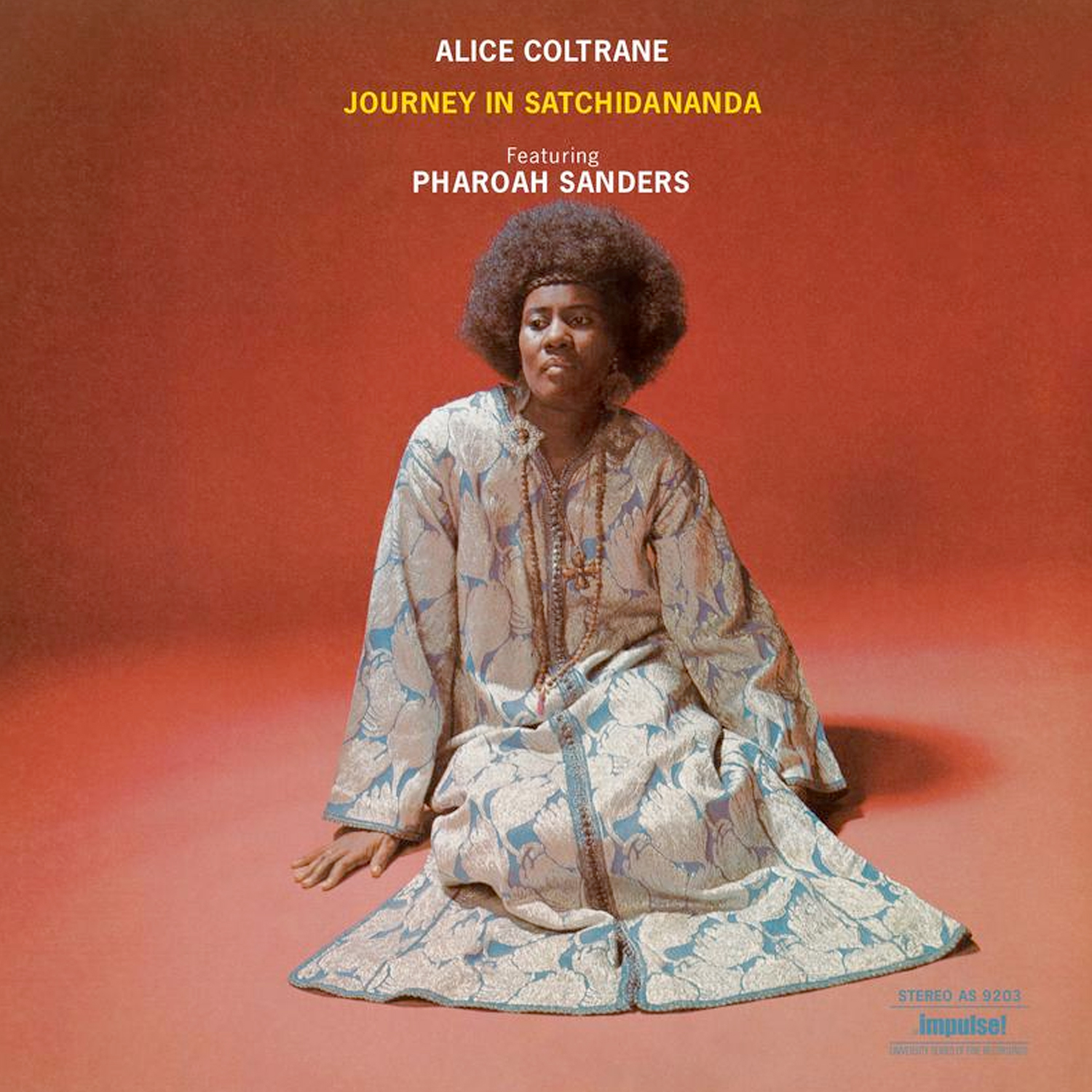
Released in 1971, this Impulse! recording presents Coltrane as a composer, pianist, harpist and musical leader in her own right. All five pieces are her compositions. The title refers to Swami Satchidananda and belongs to the spiritual context of her life. No particular religious commitment is necessary, however, to approach the music. The instruments and their relationships make the idea of a shared search tangible. Listeners discovering the record through its connection with John Coltrane encounter an independent artistic language here. His memory belongs within that world, but it does not explain everything Alice Coltrane develops inside it.
The recording history also contains two distinctly different locations. The first four pieces were recorded on November 8, 1970, at the home studio in Dix Hills, New York. The closing selection, Isis and Osiris, had been recorded live on July 4, 1970, at the Village Gate in New York. The album sequence is therefore not a chronological account of one session. It brings together two personnel configurations and two recording situations. That distinction makes the record more interesting: its coherence grows out of Coltrane’s musical decisions, even though the material originates in different circumstances.

Five compositions and a passage between two settings
The title piece opens the first side and establishes the album’s direction. One useful way to listen is to begin with the foundation: the relationship between bass movement, rhythmic impulses and sounds that remain present over a longer span. Harp and soprano saxophone can develop as contrasting lines above it. The harp offers a plucked attack with its own decay; the saxophone produces a tone shaped by breath. Much of the recording’s distinctive colour resides in that encounter. It can be discovered through the interplay of actual instruments without prematurely assigning the whole album to a single mood.
Shiva-Loka and the shorter Stopover Bombay complete side one. Their titles open different imaginative spaces, but it is also useful to notice their relative scale. Two more extended pieces sit alongside a compact form. The side consequently has an internal rhythm that differs from a continuously maintained atmosphere. Familiar instrumental colours can be placed within a different temporal frame. On another hearing, pay attention to the transitions between selections: what remains in the memory, and how does the next composition alter the expectations established by the preceding one? The fixed sequence gives those questions a practical setting.
Side two begins with Something About John Coltrane. The wording itself leaves room: it suggests a personal approach rather than a complete musical biography. Isis and Osiris, the Village Gate performance, follows. Here the participating instruments and musicians change. That shift belongs to the album’s design and deserves more attention than a passing technical footnote. The LP gathers five compositions without maintaining an identical group sound across every selection. Its closing performance can therefore encourage a return to the first side, bringing the connections between the two ensembles into sharper focus. The different recording dates help explain the change without reducing it to a question of chronology.

Eight musicians, two ensembles and clearly assigned roles
At Dix Hills, Alice Coltrane is joined by Pharoah Sanders on soprano saxophone and percussion, Cecil McBee on bass and Rashied Ali on drums. Tulsi plays tambura, while Majid Shabazz contributes bells and tambourine. Coltrane’s credits for those four studio tracks list harp and piano. This describes the available palette without asserting that each instrument is heard continuously on every piece. The saxophone identification is especially useful: Sanders plays soprano here. Listeners who know him primarily as a tenor saxophonist encounter another instrumental aspect of his work on this record.
For Isis and Osiris, the core of Alice Coltrane, Sanders and Ali remains. Charlie Haden takes the bass role and Vishnu Wood plays oud; Coltrane is credited with harp on this live performance. Cecil McBee, Tulsi and Majid Shabazz belong to the studio selections instead. Across the album, eight different people participate. The two bassists are not interchangeable entries in an extended list: their assignments explain how the ensemble changes between locations. Tambura and oud likewise belong to different sessions. An illustration combining those instrumental colours is an album vignette, not a reconstruction of a group that recorded together in that configuration.
Coltrane’s responsibilities extend beyond performing. She wrote the compositions and is named in production with Ed Michel. Orville O’Brien and Roy Musgnug appear in the engineering credits, with O’Brien additionally credited for the location recording. This provides a useful context for listeners: the unusual instrumentation is part of an album shaped by Coltrane herself. To follow individual contributions, begin with the bass, add the rhythmic layers, then attend to the leading lines. That approach requires no classification of the record as relaxation or meditation music. It takes seriously the interaction of musicians and the possibility that stillness can be shaped as deliberately as increasing density.
Alice Coltrane on vinyl: the specific Acoustic Sounds edition
This reissue of Journey in Satchidananda carries catalogue number AIMP 67501. It belongs to the Acoustic Sounds Series and presents the Impulse! album as a stereo LP playing at 33⅓ RPM on 180-gram vinyl. The publisher credits Ryan K. Smith at Sterling Sound with mastering from the original analogue tapes. The record is pressed at Quality Record Pressings and housed in a Stoughton tip-on gatefold jacket. These identify the principal production features of this particular release and are best considered together when comparing different versions of the same album.
The five pieces occupy a single record, with three on side A and two on side B. This preserves extended musical stretches and requires only one side change. Relating the format to the music is especially useful here. A programme working with recurring figures and sustained development allows its relationships to emerge without frequent interruptions. That does not establish a general sonic verdict on other speeds or pressings. It describes the practical listening form of this edition and helps clarify how the album might fit into a collection. The live closing piece remains part of the same record rather than becoming a detached extra.
If you want to buy Journey in Satchidananda on vinyl, this release offers a clearly defined programme, a specified production route and carefully distinguished session credits. The central discovery remains Coltrane’s handling of musical time: contrasting instruments, a shared point of reference and room for individual movement. The record is approachable without exhausting its possibilities on a first hearing. Its five compositions invite changes of perspective, allowing a familiar colour to become an independent voice again. That combination gives the album a place of its own within a listening collection. You order from Michael 45 in Germany. We arrange the US import and dispatch from Hilden.
Series: Impulse! – all 19 records: the house that Trane built
Musicians
Participants and documented credit status. Track references correspond to the tracklist.
- Cecil McBeeExisting portrait; not a session depictionBassParticipation: A1 to B1
- Charlie HadenPortrait reference: 2007BassParticipation: B2
- Majid ShabazzBells, TambourineParticipation: A1 to B1
- Rashied AliDrumsParticipation: A1–B2
- Alice ColtranePortrait reference: circa 1970Harp, PianoParticipation: Harp, piano A1–B1; harp B2
- Vishnu WoodOudParticipation: B2
- Pharoah SandersPortrait reference: 2006Soprano Saxophone, PercussionParticipation: A1–B2
- TulsiTamburaParticipation: A1 to B1


A1–B1: Dix Hills, November 8, 1970. B2: Village Gate, July 4, 1970, live. Alice Coltrane: harp and piano A1–B1, harp B2; all compositions. Production: Alice Coltrane with Ed Michel; engineers: Orville O’Brien, Roy Musgnug; location recording: O’Brien. Reissue: Ryan K. Smith / Sterling Sound, original analogue tapes; QRP, 180 g; Stoughton gatefold (publisher specifications).
How Michael hears this edition
Listening impression · paraphrased from the video
Michael describes open mastering with a large sense of space, wide dynamics and clearly distinguishable instruments. He explicitly applies this assessment both to Journey in Satchidananda and the Acoustic Sounds edition of Karma discussed alongside it.
🎧 Review video: Acoustic Sounds Series: Alice Coltrane Journey In Satchidananda
This video is hosted by YouTube (Google). It only loads once you switch on “Functional” in the cookie settings.

Reviews
There are no reviews yet.