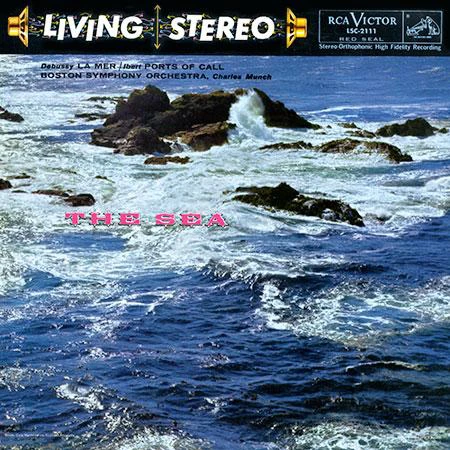


Debussy: La Mer / Ibert: Escales as a hybrid multichannel SACD from Analogue Productions’ RCA Living Stereo series: Charles Munch and the Boston Symphony Orchestra, remastered by Ryan Smith at Sterling Sound from the original analogue master tape. Both works play in one sequence – Debussy’s three symphonic sketches, then Ibert’s three ports of call.
Two French views of the sea
Debussy’s La Mer and Ibert’s Escales belong together without telling the same story about the sea. For Debussy it becomes three symphonic sketches – morning light, playing waves and a dialogue between wind and water – while Ibert turns to named places, ports and Mediterranean landscapes. Far more than an attractive supplement, the Ibert has colours and a character all its own.
Munch was a particularly fascinating conductor for this repertoire. Born in Strasbourg in 1891, he began as a violinist and served as concertmaster of the Leipzig Gewandhaus Orchestra, and from 1949 to 1962 he was music director of the Boston Symphony Orchestra. According to discographic records, the recording was made at Boston’s Symphony Hall in December 1956; the original stereo release appeared in 1958 as RCA Victor LSC-2111.

Ralph Gomberg’s oboe
One player is named as a soloist: Ralph Gomberg, oboe, in Ibert’s Escales – principal oboist of the Boston Symphony Orchestra from 1950 to 1987. In Tunis–Nefta, the second of Ibert’s ports, his singing line is central to the atmosphere; within a richly coloured orchestral journey, a single wind instrument draws you close and gives a passage an unusually personal character.
Munch and his orchestra perform both scores, which makes the comparison so rewarding: Debussy’s broad design develops motives across long spans, while Ibert’s shorter character pieces set three destinations side by side. The full orchestra stays the same – only its tasks change.

From Debussy’s sketches to Ibert’s ports
Debussy worked on La Mer between 1903 and 1905 – partly in Burgundy, far from the coast – and Hokusai’s famous wave adorned the score’s cover. The first performance, in Paris in 1905 by the Orchestre Lamoureux under Camille Chevillard, met a reserved response; this now-beloved score had to earn its place. De l’aube à midi sur la mer, Jeux de vagues and Dialogue du vent et de la mer give orientation without dictating every event.
Ibert, a generation younger, completed Escales in 1922 after a journey made in 1921; Paul Paray conducted the premiere in 1924, again with the Lamoureux orchestra. Its route runs from Rome–Palerme through Tunis–Nefta to Valencia – after La Mer, a delightful change of viewpoint in which the sea stays present while the perspective shifts.
The hybrid multichannel SACD from Analogue Productions
CAPC 2111 SA is a hybrid multichannel SACD from Analogue Productions’ RCA Living Stereo series. According to the publisher, Ryan Smith at Sterling Sound remastered it from the original analogue master tape. For the three-channel programme you need a multichannel-capable SACD player and a matching setup; the CD layer plays on any conventional CD player. The disc contains Debussy’s La Mer and Ibert’s Escales.
You order from Michael 45 in Germany. We arrange the US import and ship from Hilden.
More from the series: RCA Living Stereo Series
Also in another edition: Debussy: La Mer / Ibert: Escales
More SACDs with Charles Munch: Saint-Saëns: Symphony No. 3
Customer question: Buying Analogue Productions records in Europe
Musicians
Participants and documented credit status. Track references correspond to the tracklist.
- Charles MunchconductorParticipation: Debussy and Ibert
- Boston Symphony OrchestraorchestraParticipation: Debussy and Ibert
- Ralph Gombergoboe soloParticipation: Ibert: Escales


Recorded at Symphony Hall, Boston, December 1956; discographic records give 9/10 December. Original RCA LSC-2111 release: 1958. Original liner notes: John N. Burk. AP remastering: Ryan K. Smith, Sterling Sound. Original producer and recording engineer remain unconfirmed.

Reviews
There are no reviews yet.