When Rock Broke Its Boundaries
Seven records, seven routes from psychedelia through Krautrock and jazz rock to Magma’s Zeuhl — and the story of a continent that found musical languages of its own.

Seven years were enough for the familiar rock song to change almost beyond recognition in Europe. The journey runs from a Saarland school band through London’s underground and The Hague to Berlin’s Quartier Latin and the Taverne de l’Olympia in Paris. It ends not in a genre box, but in seven very different answers to one question: how far can rock travel without losing its inner force?
In the video, I present the exact copies that were in my listening room. In this article, I place my personal impressions inside their wider historical context. The sound judgements are my own observations; dates, line-ups and production details have been researched separately.
A definitive first pressing cannot be identified from the cover alone. Where complete label and runout photographs are missing, the exact variant deliberately remains open.
The Blackbirds
No Destination


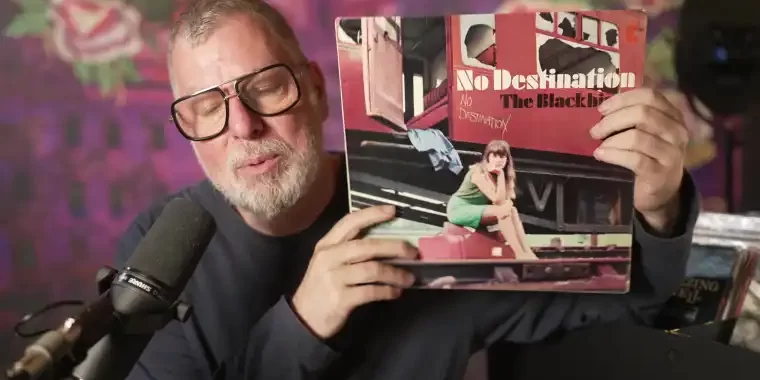
The journey begins in Püttlingen. The Blackbirds grew out of a school band and recorded No Destination in 1968 at Horst Jankowski’s studio in Stuttgart. That constellation says much about the period: a young regional group was moving beyond beat and rhythm & blues, yet initially found no suitable home for its debut in Germany. The LP appeared on the British Saga label — an unusual bridge between the Saarland scene and the British record market.

Musically, No Destination still has one foot in compact songcraft. Yet Hammond organ, hovering harmonies and abrupt shifts of atmosphere repeatedly pull the music beyond beat. This is not yet the expansive Krautrock of the early 1970s. It is the moment immediately before it: a pop song can suddenly tilt, shimmer, unsettle and open into a different state of mind.
The high voices can initially sound oddly sweet. That contrast is precisely what makes the record interesting. Darker, more searching music works beneath the surface; the Hammond is not merely colour but gives many passages their real identity.
For me, this record was “a genuine revelation”. My starting points are the title track and Something Different. What matters is not the retrospective Krautrock label, but the audible movement towards that language — and my astonishment that the album is not far better known.
Pressing note: The British Saga copy, catalogue number FID 2113, is consistent in date and design with the debut. Definitive identification requires both labels and the complete runouts.
Edgar Broughton Band
Wasa Wasa


One year later, freedom no longer sounds weightless but physical. Wasa Wasa is electric blues placed under excessive voltage: heavy riffs, a tugging bass, drums with no polite distance and Edgar Broughton’s rough voice working through the music.
The band had moved from Warwick to Notting Hill, directly into London’s underground milieu. Through Blackhill Enterprises, the organisation around the early Pink Floyd, they reached EMI’s new Harvest label. Evil / Death of an Electric Citizen became the label’s first single in 1969. Producer Peter Jenner gave the band unusual freedom by their own account. You can hear it: this debut does not introduce itself cautiously; it immediately tests the limits of the amplifiers and the conventional song form.
On side two, Dawn Crept Away stretches to almost fourteen minutes. Its length is not progressive-rock ornament but a consequence. A riff needs time to bite; tension grows from repetition and the feeling that the music might disintegrate at any moment.
What I hear is “psychedelic blues rock at its very best”. I love how a strong central idea develops across a long span. Broughton’s untamed voice and the trio’s physical force make this an absolute hammer of a record for me.
Victor Unitt leads directly from here to the Pretty Things. Europe’s underground did not consist of seven isolated islands, but of a mobile network of musicians, producers and labels.
Pressing note: The video shows the early German Harvest edition 1C 062-04 083. Whether it is precisely the first German variant must be established from label details and runouts.
Clark-Hutchinson
A=MH²


With Clark-Hutchinson, the conventional rock band almost disappears. Andy Clark and Mick Hutchinson played most of the instruments themselves. According to the documented band history, they had only two twelve-hour studio sessions for A=MH². From that concentration came a highly individual meeting of blues, jazz and non-European scales.

The titles already point the way: Improvisation on a Modal Scale and Improvisation on an Indian Scale. Guitar, organ, flute, sitar and percussion are not exotic decoration added to a rock framework. They determine how the music moves. Motifs are circled; a tonal centre may matter more than a chorus.
Despite its open forms, the album is not formless. The improvisation has direction and tension. Clark and Hutchinson allow passages to grow, compress them, withdraw energy and open new spaces. The personnel story also continues: both had previously played in Vamp, the short-lived group formed by former Pretty Things drummer Viv Prince.
I experience A=MH² as an “instrumental psychedelic journey” that is almost impossible to compare with any other record. Indian influences, freely evolving structures and two multi-instrumentalists effectively replacing an entire band: for me, it is unique.
Pressing note: The album was recorded in 1969 and appeared around the turn of 1969/70. My copy is the 1975 German Nova reissue, probably 6.22426 AO or 6.22426 AJ — not a British first pressing. The suffix remains open.
The Pretty Things
Parachute


Parachute is an album about carrying on. After S.F. Sorrow — later celebrated as a landmark but not the success the band had hoped for at the time — and Dick Taylor’s departure, the Pretty Things could have collapsed. Instead, Phil May and Wally Waller continued writing. Norman Smith returned as producer, and Victor Unitt arrived from the Edgar Broughton Band circle.
The record does not tell a linear story, but it has a clear internal drama. Waller described side one as a view of the city; side two circles around someone unable to decide between city and country. “Escape to the country” is therefore too simple. Parachute is about tension, not a completed decision.

On side one, hard guitars, urban anxiety and darker images become compressed. On side two, the horizon widens. Harmonies and pastoral moments open the music without resolving its uncertainty. The close voices may recall the Beatles, yet the Pretty Things sound less flawless and therefore more vulnerable.
I experience side one as darker, more aggressive and immediate, while side two feels more beautiful, open and free. That contrast makes Parachute a major discovery for me. My points of entry are Cries from the Midnight Circus, Grass and the title track.
Pressing note: The German Harvest copy shown, 1C 062-04 406, dates from the year of release. Identifying the exact early variant requires complete label and runout information.
Earth and Fire
Earth and Fire


In the same year, a different route opened in the Netherlands. Earth and Fire did not begin with extended improvisation but with the song. Their debut combines memorable singles with psychedelic colour and the first signs of progressive form. Here, progressive music does not emerge because every piece becomes longer and more difficult. It grows out of exceptionally good pop.

Producer Freddy Haayen recorded the album at G.T.B. Studios in The Hague; it was released in September 1970. Seasons, written by Golden Earring’s George Kooymans, had already been a success. Ruby Is the One and Wild and Exciting show how confidently the band connects melody, organ, guitars and dynamic changes.
Jerney Kaagman stands at the centre. Her voice is clear, powerful and melodic, but never bland. It can shine above the arrangement and then lead directly into more dramatic passages. The object tells part of the story too: Ron Seubert designed the early Dutch edition as a matchbook, with photography by Leo van der Noort. Other countries received different sleeves, including a Roger Dean cover in Britain.
For me, this debut is “fantastic”: extremely melodic, dynamic, exciting and beautiful at the same time. I recommend not just one track but the entire album, precisely because short and accessible moments open so naturally into larger dramatic arcs.
Jerney Kaagman died on 31 July 2026 at the age of 79. Her debut with Earth and Fire remains powerful evidence of how decisively one voice can shape the identity of an entire band.
Pressing note: The matchbook sleeve and Polydor catalogue number 2441 011 are consistent with an early Dutch edition from 1970. The runouts remain decisive for final identification.
Kraan
Live


Five years later, the cautious opening of the song has become a complete collective. On Live, Kraan need no fixed hierarchy between soloist and accompaniment. Hellmut Hattler’s bass can lead a piece; Peter Wolbrandt’s guitar can move into texture; Johannes Pappert’s saxophone can tear open a new direction, while Jan Fride keeps the rhythm mobile.
The performances were recorded in October 1974 at Berlin’s Quartier Latin and released as a double album in 1975. Conny Plank captured the concerts. His work preserves the band’s mobility: the instruments occupy the room clearly enough for their individual lines to be followed, yet the recording never domesticates the risk of the moment.

Kraan combine jazz, rock, funk and Asian influences without turning them into an academic demonstration. Nam Nam drives, Holiday am Marterhorn shimmers and branches out, while Kraan Arabia creates a pull in which groove and melodic imagination do not work against one another. The long sides are the form this band requires.
I hear jazz rock, fusion and Krautrock in a state of complete joy in playing. My high point is Kraan Arabia: the bass tells its own story, while guitar, saxophone and drums respond like a single organism. For me, this double album is simply magnificent.
Pressing note: The video shows the 1975 British Gull edition GUD 2001/2. The album first appeared in Germany on Spiegelei; Gull issued the British edition. Calling it a “British first pressing” would go too far without comparing labels and runouts.
Magma
Magma Live / Hhaï


At the end stands music that resists the usual language of progressive rock. Christian Vander conceived Magma not simply as a band but as a world of its own. That world includes the invented Kobaïan language and Zeuhl — Vander’s name for music understood as a vibrating spiritual force.
Zeuhl is neither a branch of Krautrock nor free improvisation with a choir. Its forms are composed and often tightly organised. Repeating bass and drum figures build pressure; voices appear as a collective; themes return in altered form. Improvised eruptions exist, but within an architecture of repetition, escalation and physical impact.

After the major line-up upheaval of 1974, Vander assembled a new formation. Magma’s first live album was recorded at the Taverne de l’Olympia in Paris from 1 to 5 June 1975. Older pieces received new arrangements; Hhaï and Lïhns were introduced. Didier Lockwood’s violin cuts through the dense rhythms, answers the voices and gives the line-up a nervous, luminous energy.
I hear a rhythm-driven, dense and — in the best sense — chaotic total experience. What fascinates me is that the recording never collapses, even at its most intense. Anyone looking for an entry point can begin with Hhaï; anyone wanting to understand Magma should follow the complete arc.
Pressing note: The French Utopia double LP CYL2-1245 is consistent with an early 1975 edition. The exact variant remains open without complete runout documentation.
Two Live Albums. Two Answers.
Kraan and Magma released double live albums because, for both bands, the stage was more than a place to reproduce finished studio pieces. It was where the music found its actual form.
Kraan sound elastic: a bass line opens a door, the guitar walks through it, the saxophone turns away, the drums shift the ground. Magma sound inevitable: rhythmic cells return, voices become architecture, escalation becomes ritual.
In 1968, a Hammond organ could tip a beat song in a new direction. By 1975, conventional ideas of the song were barely sufficient to describe Kraan’s collective groove or Magma’s Zeuhl.
Not Seven Islands, but a European Network of Sound
Conventional rock history likes to sort by country: British underground here, Dutch progressive rock there, German Krautrock and French Zeuhl in separate drawers. These seven records tell a more vivid story.
Labels such as Harvest created space for music that had little room in normal pop programming. Producers including Peter Jenner, Norman Smith, Freddy Haayen and Conny Plank captured very different ideas of freedom on tape. Musicians moved between groups: Victor Unitt connects the Edgar Broughton Band with the Pretty Things; Viv Prince leads from their earlier history to Vamp and Clark-Hutchinson. George Kooymans and Freddy Haayen connect Earth and Fire to the Dutch network around Golden Earring.
The connection is therefore not a genre term but an attitude: rock may change as long as the music retains its inner necessity. With the Blackbirds, a psychedelic crack opens inside beat. With Edgar Broughton, blues is pushed into overload. With Clark-Hutchinson, the studio becomes a laboratory. With the Pretty Things, it is the tension between city and country. With Earth and Fire, pop opens outward. With Kraan, the collective becomes equal. With Magma, an entirely new musical world appears.
These albums are not seven curiosities at the edge of history. They are seven pieces of evidence that European rock between 1968 and 1975 discovered its own rules, its own colours — and finally even its own languages.
More stories about music, pressings and listening can be found in the English shop magazine, From the Listening Room.
Continue listening with me in the video
Sources and Further Reading
- Earth and Fire official archive: album information, production and cover design
- Earth and Fire official archive: Jerney Kaagman
- Magma official discography: Magma Live
- WDR Rockpalast: Kraan and Kraan Live
- Interview with Edgar Broughton on the early Harvest years and Wasa Wasa
- University of Gloucestershire: Clark-Hutchinson and A=MH²
- Band interviews about the making of the Pretty Things’ Parachute
- the Blackbirds, No Destination, Saga FID 2113
