
Four musicians and one day in March
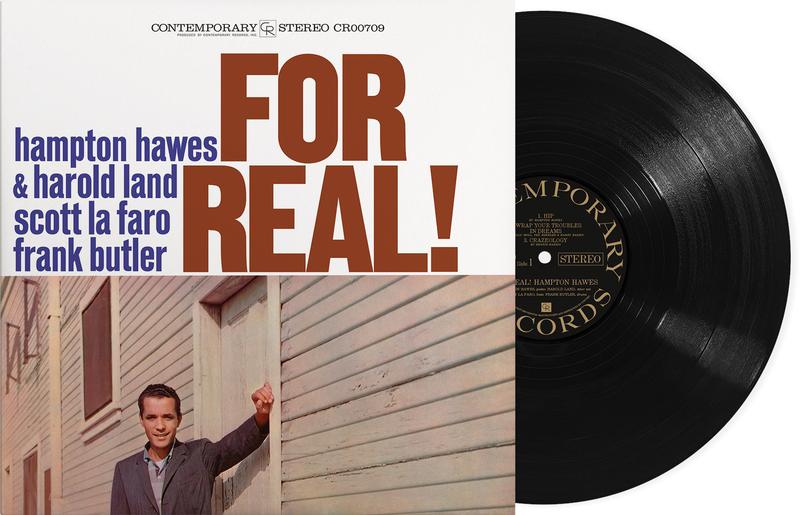
On 17 March 1958, Hampton Hawes, Harold Land, Scott LaFaro and Frank Butler met at Contemporary's Los Angeles studio. That single session produced For Real!. The instrumentation deserves attention. Hawes had led trios and guitar-equipped quartets, but here a tenor saxophone stood alongside his piano. Land brought experience from the Clifford Brown–Max Roach Quintet and contributed as a composer to two of the album's pieces. The horn was part of the project’s musical identity, rather than an incidental guest addition.
Hawes, Land and Butler were of similar ages; LaFaro was only twenty-one. Land and Butler already knew each other through Curtis Counce's group, while LaFaro was working with musicians including Victor Feldman. Four distinct careers converged without requiring a large ensemble. Lester Koenig produced and Roy DuNann engineered the six performances. They did not appear on record until 1961, three years later. The recording and release dates consequently describe quite different moments in the lives of the musicians involved.

Scott LaFaro before Bill Evans
LaFaro is now especially associated with Bill Evans and the Village Vanguard recordings. For Real! takes us to the period before that partnership. He had not yet joined Evans' trio when he recorded with Hawes, Land and Butler. If you know the later performances, this album provides a specific earlier point of comparison. Follow the bass within the quartet and consider how its role changes alongside piano, tenor saxophone and Butler's drums, rather than listening only for signs of what would come next.
During the same month, the Hawes–LaFaro–Butler trio recorded additional material that would surface decades later on Bird Song. Release dates can therefore distort our sense of the order in which this music developed. For Real! also carries a tragic proximity: Leonard Feather's sleeve notes are dated 8 July 1961, two days after LaFaro's fatal car accident. A separate text by Koenig concerns the young bassist. The finished release preserves an earlier encounter whose participants had already reached very different circumstances by the time listeners could buy it.

Original pieces and a connection to Parker
Three of the six compositions come from the band. Hawes wrote “Hip”, while he and Land share the credits for “Numbers Game” and “For Real”. Alongside them are “Wrap Your Troubles in Dreams”, Benny Harris' “Crazeology” and Cole Porter's “I Love You”. The programme balances original themes with established repertoire. The title track extends beyond eleven minutes, giving the quartet room to develop its ideas, whereas Porter's song closes the album in a much shorter form.
“Crazeology” also leads back to Charlie Parker. Hawes had played with Parker as a young musician and identified his approach to musical time as a major influence. The connection therefore reaches beyond choosing a familiar bebop tune. It belongs to the education of a pianist who learned much of his craft by ear. As you listen, follow the exchange between tenor and piano lines and the work of the rhythm section underneath them. The quartet setting makes those different responsibilities particularly easy to trace.
This Contemporary reissue
ACONC 709 is a single 180-gram LP in Craft's Contemporary Records Acoustic Sounds Series. Bernie Grundman cut the lacquers and Quality Record Pressings manufactured the vinyl. Craft specifies original master tapes and an AAA cutting chain, with the record presented in a tip-on jacket. These are details of this particular reissue, rather than general claims applicable to every pressing carrying the album title. Earlier OJC releases belong to their own edition histories.
The programme retains all six original tracks. “Hip”, “Wrap Your Troubles in Dreams” and “Crazeology” occupy the first side; “Numbers Game”, “For Real” and “I Love You” form the second. The session remains a coherent album sequence. Listeners arriving through LaFaro also encounter an important Hawes quartet and Land as a substantial musical partner. All four names on the sleeve identify active contributors whose interaction can be followed across the entire record, not simply through one celebrated solo or one later association.
You order from Michael 45 in Germany. We arrange the US import and dispatch from Hilden.
More by Hampton Hawes: Four! With Barney Kessel, Shelly Manne & Red Mitchell
Series: Contemporary – all 24 records: sunny jazz from Los Angeles
Musicians
Personnel for this album version are documented. Track-specific participation is shown in the final column.
| Name | Instrument / role | Participation |
|---|---|---|
| Hampton Hawes | piano, bandleader | Album personnel |
| Harold Land | tenor saxophone | Album personnel |
| Scott LaFaro | double bass | Album personnel |
| Frank Butler | drums | Album personnel |



Reviews
There are no reviews yet.