One voice, six strings
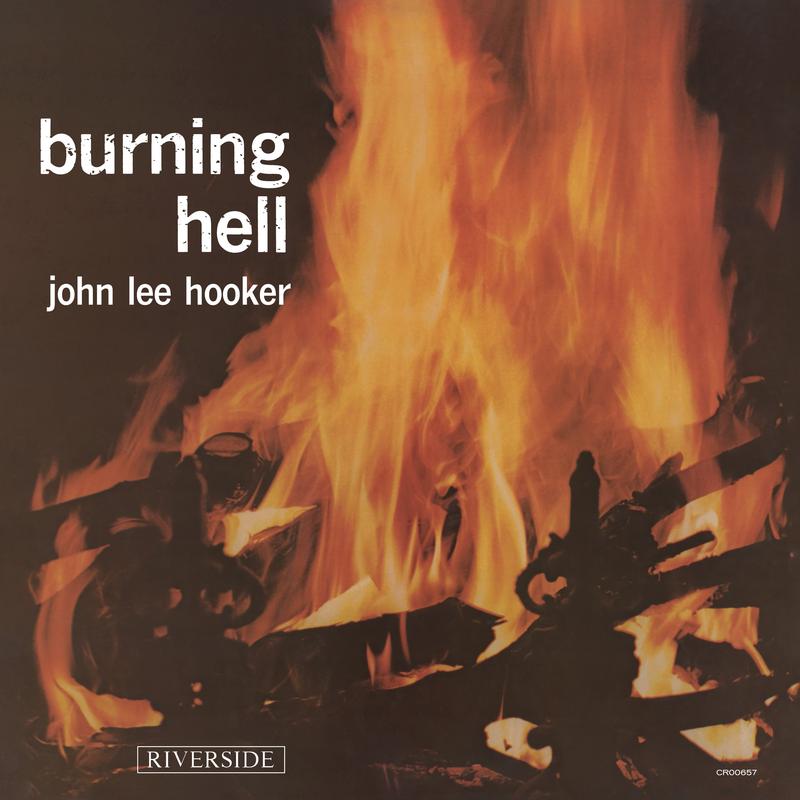
Detroit, April 1959. John Lee Hooker records for Riverside with only his acoustic guitar. On Burning Hell, there is no ensemble to carry the pulse forward and nobody else to fill the pauses. Voice and strings shape the entire performance. That small scale is precisely what makes the album inviting: it offers a chance to follow a musician whose expression grows from storytelling, repetition and a deeply personal sense of time.
Hooker had already enjoyed a major breakthrough with “Boogie Chillen’” in 1948. For Riverside, the roots of his playing came into focus. These recordings belong to the period of the sessions for The Country Blues of John Lee Hooker, but Burning Hell did not appear in Europe until 1964. Five years separated the session from the album’s release. The music returns us to an earlier chapter, well before his late collaborations with celebrated rock musicians.

A shared repertoire, a personal language
The twelve selections bring original material together with songs that have passed through many hands. “Baby Please Don’t Go”, “Smokestack Lightnin’” and “Key To The Highway” are part of that shared blues repertoire. Here, the relationship between familiar form and individual delivery is especially rewarding to consider. What happens to a recognisable phrase when one voice and one guitar determine where it goes?
In a solo recording, the smallest choices become part of the story: the space between lines, the next guitar entrance, the way a figure continues. Burning Hell gives those decisions a concentrated setting. The guitar provides accompaniment and a rhythmic counterpart at once. Listeners who mainly know Hooker’s electrically accompanied recordings can approach the same musician from a different angle.

Twelve selections, one complete album
The title track opens the record and “Natchez Fire” closes it. Between them come “Graveyard Blues”, “Jackson, Tennessee” and “Blues For My Baby”, among others. Throughout the sequence, attention remains on Hooker’s solo performance. It is an opportunity to listen to a person telling stories and to discover how little instrumentation is needed to open a musical space.
This edition contains the complete twelve-track sequence, including “How Can You Do It?”, as listed by Craft Recordings. For an album with a long reissue history, that detail matters. The Bluesville LP preserves the programme of Burning Hell as a coherent album, ready to be followed from the first side to the second.
The Bluesville edition
Released in 2024, this edition belongs to Craft Recordings’ Bluesville Acoustic Sounds Series. It is a single 180-gram LP, catalogue CR00657, distributed under ACONC 657. Craft specifies an all-analogue lacquer cut from the original master tapes by Matthew Lutthans at The Mastering Lab. The record is pressed at Quality Record Pressings.
A tip-on jacket and an obi with notes by Scott Billington add historical context to the music. That care suits an album made with so few ingredients: one record, a clearly defined programme and a musician whose voice and guitar have our undivided attention.
You order from Michael 45 in Germany. We arrange the US import and dispatch from Hilden.
More by John Lee Hooker: The Healer · It Serve You Right To Suffer
Musicians
Participants and documented credit status. Track references correspond to the tracklist.
- John Lee Hookervocals, acoustic guitarParticipation: Album personnel

Personnel: John Lee Hooker – vocals, acoustic guitar; solo recording, all twelve tracks. Recorded in April 1959 in Detroit (April 20, 1959, per session discography). Producer: Bill Grauer. Liner notes: Alan Bates. This edition (2024): mastering and lacquer cutting by Matthew Lutthans (The Mastering Lab); obi notes by Scott Billington; pressed at QRP.
🎧 Review video: Craft Recordings presents: Welcome to Bluesville! (Official Trailer)
This video is hosted by YouTube (Google). It only loads once you switch on “Functional” in the cookie settings.

Reviews
There are no reviews yet.