Jackie McLean finds his own voice
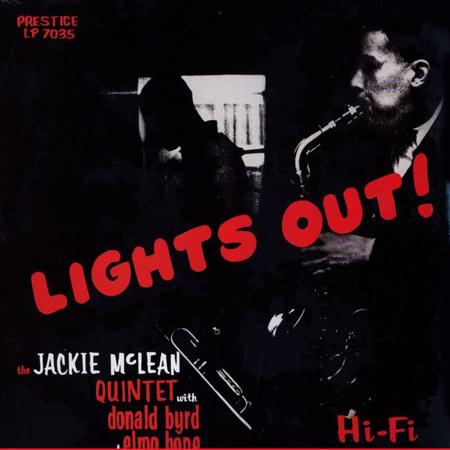
Lights Out! brings us to a young Jackie McLean whose musical ancestry is readily apparent, yet whose individuality is already making itself felt. The alto saxophone belongs to the world shaped by Charlie Parker: agile lines, rhythmic alertness and an ability to illuminate familiar harmonies from fresh angles. But McLean’s tone contains a tension that cannot simply be assigned to a school. The slightly tart edge of his playing would become one of his unmistakable signatures. Here it appears within a concentrated quintet recording that takes the blues as seriously as the mobility of bebop.
The session took place on January 27, 1956, at Rudy Van Gelder’s studio in Hackensack. McLean was twenty-four, and Parker had been dead for less than a year. That proximity helps us understand the setting without reducing the record to a document of succession. Young musicians did not have to choose between abandoning a language entirely and repeating it faithfully. Individual character could emerge from familiar vocabulary: from the colour of a note, the placement of a phrase or the manner of answering another player. Lights Out! allows that process to be followed within a small, clearly defined ensemble.
Donald Byrd’s trumpet contributes much more than a second sequence of solos. The two horn players knew one another through the George Wallington Quintet, and their shared experience makes the dialogue especially interesting. Two instruments carrying the same melody need not produce a uniform statement. Alto and trumpet can rub against each other, reinforce an idea or briefly suggest different directions. The relationship between cohesion and independence offers a useful way into this music. Even before the first piece begins, the personnel promises an exchange between recognisable musical personalities rather than a collection of interchangeable voices.

Elmo Hope and a responsive rhythm section
Elmo Hope at the piano, Doug Watkins on double bass and Art Taylor on drums provide the foundation. Hope is one of those pianists whose place in modern jazz can be overshadowed by more familiar names, even though his appearance in a personnel list immediately deserves attention. Here he works between two horns with strongly individual articulation. His chords and lines can establish a direction or offer another perspective on it. On a return visit to the album, following the piano reveals a different organisation of the same music from the one heard when attention remains entirely on McLean.
Watkins and Taylor are no more interchangeable than the frontline musicians. A double bass supplies harmonic orientation and forward motion, but the precise placement of its notes helps determine the feel of a phrase. Drums can reinforce that movement, loosen it or reorganise it through a small accent. The three rhythm players must respond both to one another and to the changing horn voices. Their task cannot be fully fixed in an arrangement. Part of the appeal of these Prestige recordings lies in this shared shaping of the musical moment, within structures that leave room for immediate decisions.
The label describes McLean and Byrd exchanging short improvised interjections. One can approach this as a particularly compact form of conversation: a statement need not be lengthy to invite a reply. Sometimes a brief figure is enough to suggest a fresh direction. Such an exchange benefits from a rhythm section that supports the activity without immediately filling every opening. Lights Out! consequently offers more than an orderly succession of themes and solos. The transitions matter too: the passing of an impulse from one player to another, and the moments in which several voices acquire significance at once.

Original compositions and a Gershwin song
Five of the six pieces come from the two horn players. McLean contributes Lights Out, Up and Inding, while Byrd supplies Lorraine and Kerplunk. The programme is therefore strongly shaped by the musicians performing it. Original compositions can provide a common starting point more closely suited to a group than an arbitrarily selected standard. They also remind us that leadership begins before the solo. It includes choosing the material and deciding what kinds of musical situations the ensemble will explore together. On this record, the two frontline voices are also responsible for most of the written starting points.
The first side moves through Lights Out, Up and Lorraine. That sequence offers a chance to encounter both composers within the same instrumental setting. Not every difference needs to be attributed to authorship; tempo, interpretation and the reactions of the other musicians are equally important. For precisely that reason, it is rewarding to pay renewed attention to the theme when it returns after the solos. It is no longer merely an introduction, but a framework whose possibilities the players have just explored. The journey back to the melody is part of the story of the piece.
Side two opens with A Foggy Day by George and Ira Gershwin, providing a familiar point of reference in a programme otherwise devoted to originals. Byrd’s Kerplunk and McLean’s Inding follow. This balance makes an inviting entry into early hard bop. The standard supplies melodic orientation, while the originals show the musicians defining their own working space. Collectors who already own several McLean albums can also follow the persistence of his identity across different pianists and instrumental combinations. Elmo Hope is an essential part of the particular environment heard here, rather than a name that could be substituted without changing the picture.
Prestige in mono, with room for a complete side
This Analogue Productions reissue carries catalogue number APRJ 7035 and belongs to the Prestige Mono Series. The publisher credits Kevin Gray with cutting from analogue master tapes and Quality Record Pressings with pressing the record. The current description specifies a 180-gram LP and a high-gloss tip-on jacket. The edition presents McLean’s early Prestige programme as a self-contained six-track LP in its original mono form. Alongside the later Blue Note albums, it can make a rewarding connection within a collection: the personal voice is already present, while the musicians from the New York circle around Wallington provide a different musical setting.
The six selections occupy a single record played at 33⅓ rpm, with three pieces on each side. That sequence has a value of its own. McLean’s and Byrd’s compositions remain in a readily grasped relationship, while the side change provides a natural break before the Gershwin song. The LP encourages the listener to spend several pieces with the band, rather than treating each performance as an isolated demonstration. For music whose appeal depends so much on familiar partners and small changes in their interaction, this is a particularly appropriate frame. Continuity can be as important to the experience as the individual track.
Mono directs attention towards the shared centre of the quintet. The interesting question is less about placing an instrument at the far left or right than about recognising voices through attack, register and rhythmic movement. McLean’s alto, Byrd’s trumpet and Hope’s piano offer three distinct perspectives on the same material. Lights Out! is a rewarding record for collectors who like to understand an artist’s development through specific musical encounters. It presents an early McLean whose connection to Parker remains clear, while his own handwriting already has enough character and resistance to leave a lasting impression.
You order from Michael 45 in Germany. We arrange the US import and dispatch from Hilden.
More by Jackie McLean: 4, 5, and 6 · Jackie’s Pal
Customer question: Buying Analogue Productions records in Europe
Series: Analogue Productions Prestige – all 50 records, musicians and session paths
Musicians
Participants and documented credit status. Track references correspond to the tracklist.
- Jackie McLeanalto saxophoneParticipation: Album personnel
- Doug Watkinsdouble bassParticipation: Album personnel
- Art TaylordrumsParticipation: Album personnel
- Elmo HopepianoParticipation: Album personnel
- Donald ByrdtrumpetParticipation: Album personnel


Track and side references refer to this LP edition.

Reviews
There are no reviews yet.