

Two tenor voices, one shared language
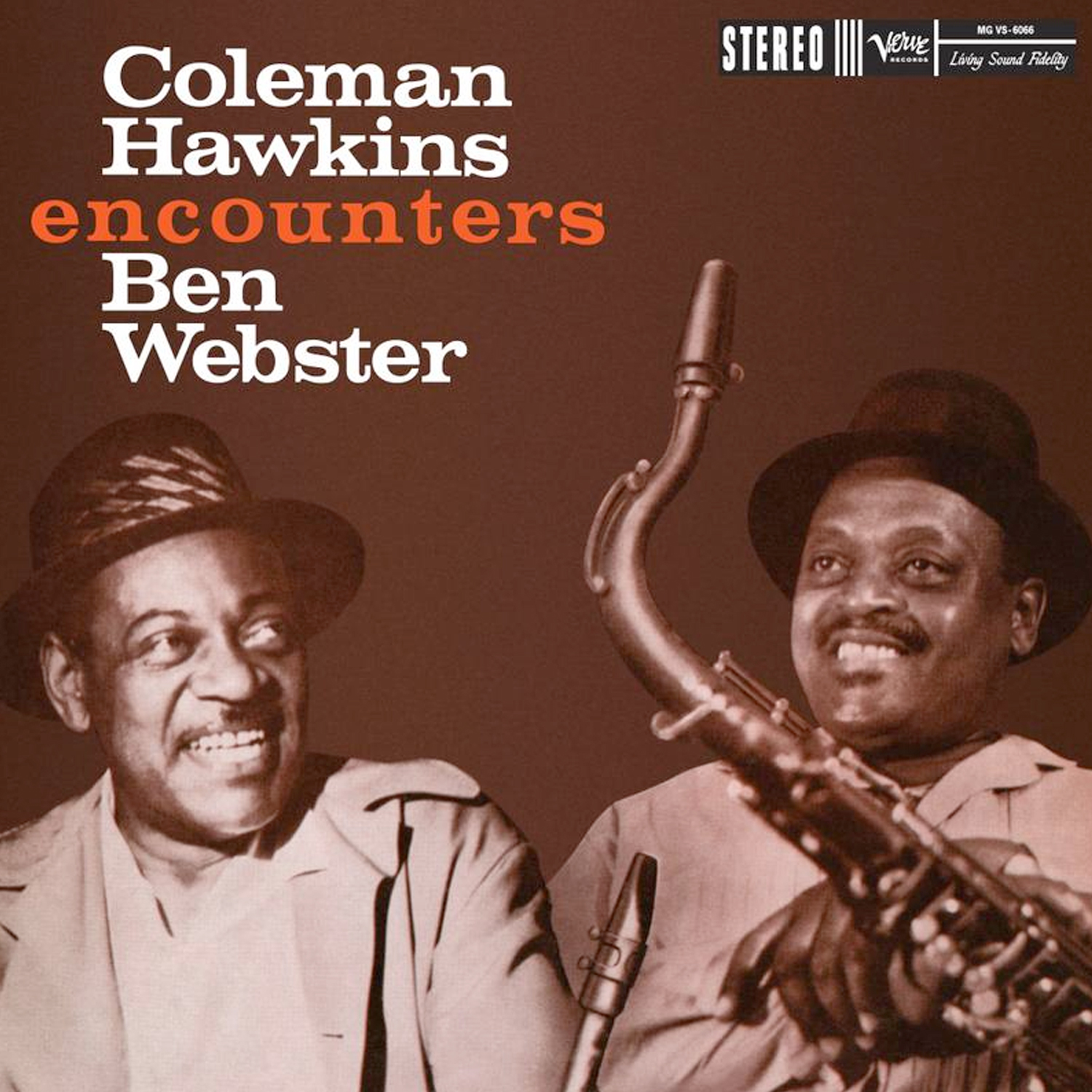
Coleman Hawkins and Ben Webster need no elaborate presentation on this album. Two tenor saxophonists, a rhythm section and seven pieces are enough to sustain an encounter of considerable significance. Coleman Hawkins Encounters Ben Webster was recorded in Hollywood on 16 October 1957; its original Verve release followed in 1959. Both dates belong to the story, but they describe different events. The music comes from a single session in 1957, while the album reached record shops later. Norman Granz supervised a meeting whose appeal begins with the particular musicians he brought together.
Hawkins and Webster play the same instrument, yet each gave it an unmistakable voice. Hawkins was one of the decisive figures in establishing the tenor saxophone as an independent solo instrument in jazz. Webster developed an equally personal language, one in which strength and tenderness need not be opposites. Their encounter invites closer attention: how differently can a melody be weighted? How much character lies in the beginning of a note, its duration, or the movement towards the next phrase? There is no need to turn the two musicians into competitors to appreciate the particular value of hearing them in company.
They are joined by Oscar Peterson on piano, Herb Ellis on guitar, Ray Brown on double bass and Alvin Stoller on drums. This is therefore a sextet album, rather than a collection involving changing large ensembles. Its manageable scale makes the relationships between the players especially interesting. Two horns share a common space; piano and guitar can assume different harmonic responsibilities within it, while bass and drums maintain the movement of time. Anyone familiar with the famous names on the cover has a good reason to read the smaller names as carefully. They are part of this session’s musical identity, rather than incidental details attached to an encounter between stars.

A blues and six routes through the songbook
Hawkins’ “Blues for Yolande” opens the programme and is his sole composition among these seven selections. It is followed by “It Never Entered My Mind” and “Rosita”. The first side already offers more than three interchangeable opportunities for saxophone solos. A blues and songs with their own melodic histories invite different decisions. The blues provides a shared formal point of reference; a standard carries a melody whose outlines may remain present even as an improvisation moves away from it. An encounter between experienced soloists can find its expression precisely in the balance between those commitments and freedoms.
Side two contains “You’d Be So Nice to Come Home To”, “Prisoner of Love”, “Tangerine” and “Shine on Harvest Moon”. Cole Porter’s song sits alongside repertoire with roots extending well beyond the immediate jazz scene. “It Never Entered My Mind” comes from Richard Rodgers and Lorenz Hart, while “Tangerine” bears the names of Johnny Mercer and Victor Schertzinger. These credits recall the relationship between popular song and improvised music. The songs are not neutral frameworks. Their melodic shapes and harmonic paths give the musicians something to acknowledge, reinterpret and sometimes leave behind as a performance develops.
Attentive listening can therefore begin with the sequence itself. How does the character of the two tenor voices change when a different song sets the terms? Where does a phrase place its emphasis, and how much room remains after it ends? Such questions lead further into the record than an attempt to declare a winner among the soloists. The seven selections can be approached as a connected conversation with changing starting points. The title “Rosita”, as used on this edition, is retained here; alternative spellings in other discographies are no reason to casually rewrite the actual tracklist. For collectors, that care is part of respecting a particular release.

Peterson, Ellis, Brown and Stoller in the conversation
Oscar Peterson, Herb Ellis and Ray Brown form an especially significant relationship within this group. Piano, guitar and double bass bring together three different ways of supporting harmonic movement. A piano can thicken a chord or bring a single line into focus; a guitar has a different relationship between attack and decay; the double bass connects harmonic orientation with the passage of time. These are the possibilities of the instruments. The musical interest lies in how the players turn those possibilities into a shared setting in which two tenor saxophones can each find a place. Accompaniment becomes a relationship rather than a merely background function.
Alvin Stoller is just as fully part of the recording. His name should not be replaced by a more familiar drummer simply because Peterson or either saxophonist made other records with different rhythm sections. Such substitutions substantially change the picture of a session. The appeal of this album rests in its specific combination: Hawkins, Webster, Peterson, Ellis, Brown and Stoller. Six musicians, one recording date and a defined programme. That clear framework allows considerable musical variety without requiring extra participants or undocumented stories about what happened in the studio. Knowing who was actually there is a useful beginning to listening closely.
The two tenor saxophones also deserve to be understood as instruments. The distinction between Hawkins and Webster does not arise because one takes a different register of the saxophone family. Both are tenor players here. Tone colour, articulation, phrasing and the relationship to melody consequently become particularly revealing points of comparison. One can follow the horns through a piece and then return with attention directed towards piano, guitar and bass. The personnel have not changed, but the perspective has. That is an attractive quality for a collection: a compact record can remain absorbing when its individual voices retain enough character to reward more than one way of listening.
The Acoustic Sounds Series stereo LP
This edition, catalogue number AVER 37701, belongs to the Acoustic Sounds Series and presents the album on a 180-gram stereo LP at 33⅓ RPM. The publisher names Bernie Grundman for mastering from the original analogue tapes. The record is pressed at Quality Record Pressings and comes in a Stoughton tip-on gatefold jacket. These specific details describe the reissue more reliably than transferring credits from other records in the same series. With reissues, the individual title deserves attention: membership of a series is not a substitute for the actual mastering credit attached to the record being offered.
The original Verve catalogue numbers and this current edition identify different releases of the same historical recording. Both levels can matter to a collector. The original places the music within its release history; the reissue explains how the programme is presented on vinyl today. Neither the vinyl weight nor the elaborate jacket changes the session of October 1957. They belong to the material presentation of the album. Information about the original tapes, mastering, pressing plant and packaging makes an informed choice possible without pretending that this particular copy has already been personally compared with every alternative pressing.
Three selections on the first side and four on the second preserve an easily grasped sequence. 33⅓ RPM here means a single LP and one side change: a practical, continuous presentation of these seven pieces. You order from Michael 45 in Germany. We arrange the US import and dispatch from Hilden. Coleman Hawkins Encounters Ben Webster offers an encounter with two strongly defined musical personalities and an accompanying group with its own share in the story. For listeners interested in the relationships between jazz musicians as well as the soloists themselves, it provides a clear point of entry. The celebrated names awaken the interest; the particular personnel and carefully chosen repertoire give that interest somewhere to stay.
More by Coleman Hawkins: Coleman Hawkins and Confreres
Series: Verve – all 34 records: voices, organ and bossa nova
Musicians
Participants and documented credit status. Track references correspond to the tracklist.
- Coleman Hawkins1964 · later portrait referencetenor saxophoneParticipation: All tracks
- Ben Webstertenor saxophoneParticipation: All tracks
- Oscar Peterson1978 · later portrait referencepianoParticipation: All tracks
- Herb EllisguitarParticipation: All tracks
- Ray Brown1976 · later portrait referencedouble bassParticipation: All tracks
- Alvin StollerdrumsParticipation: All tracks


Sextet from the session of 16 October 1957. No additional personnel imported from other Hawkins/Webster albums.

Rune Persson –
Love this album and the pressing is superb